Ader Éole
Éole is the steam-powered aeroplane in which Clément Ader reported a brief lift-off in 1890, without demonstrating sustained, controlled flight.
History
Clément Ader approached the problem of flight in a France where balloons and airships already provided means of aerial experimentation. An engineer and inventor, he had worked in several fields, notably telecommunications, before committing substantial resources to a heavier-than-air machine. He studied flying animals, particularly bats, whose anatomy influenced his designs. Éole consequently emerged from personal research combining observation of nature, lightweight construction and the search for propulsion powerful enough to lift its own weight. This background explains its unusual appearance, but also the distance still separating the machine from an aeroplane that a pilot could operate regularly and reliably.
Éole had wings whose outline and articulation recalled those of bats. Its structure combined lightweight materials with a fabric covering. Ader chose steam power at a time when internal-combustion engines did not yet offer the aviation solutions that would subsequently prevail. Boiler, engine and associated equipment therefore had to form an assembly light enough to be carried aboard. A propeller provided thrust, while wheels allowed the machine to run along the ground. The central question remained control: generating a lifting force was not sufficient to establish stable, directed and repeatable flight under different conditions. The distinction is essential when assessing what the experimental machine actually achieved.
On 9 October 1890, Ader tested Éole on a property at Armainvilliers. The machine reportedly left the ground for several dozen metres, a distance often given as approximately fifty metres. The trial took place before a small group of witnesses and did not provide a documented public demonstration of sustained flight. The reported lift-off must therefore be distinguished from subsequent interpretations presenting it as an absolute first. Height, exact distance and, above all, the degree of control cannot be stated with the same confidence as for later, better recorded trials. The historical significance of the hop remains disputed, without negating the technical interest of the attempt itself.
Éole never entered commercial or military service. It was a test machine around which Ader continued his research. Support from the French Ministry of War subsequently opened a new phase, involving resources and expectations different from those of private experimentation. The question also acquired military significance: a flying machine might provide observation capabilities and, in Ader's thinking, become part of an organised air arm. It would nevertheless be inaccurate to turn that prospect into an operational career for Éole. No regular service, operating unit or series of missions resulted directly from the October 1890 experiment with this particular machine, whose purpose remained experimental rather than practical transportation.
The subsequent projects were not simply production versions of Éole. Ader worked on Avion II and then Avion III, a separate machine equipped with two steam engines and two propellers. The latter was tested at Satory in 1897 before military representatives without delivering the expected demonstration of controlled flight. Funding was withdrawn and Ader's practical flying-machine research came to an end. Accounts of the 1897 trials have also generated controversy. Distinguishing between the machines is therefore essential: the results, dimensions and power installation of Avion III must not be retrospectively attributed to the Éole of 1890, even though both belonged to the same inventor's research programme.
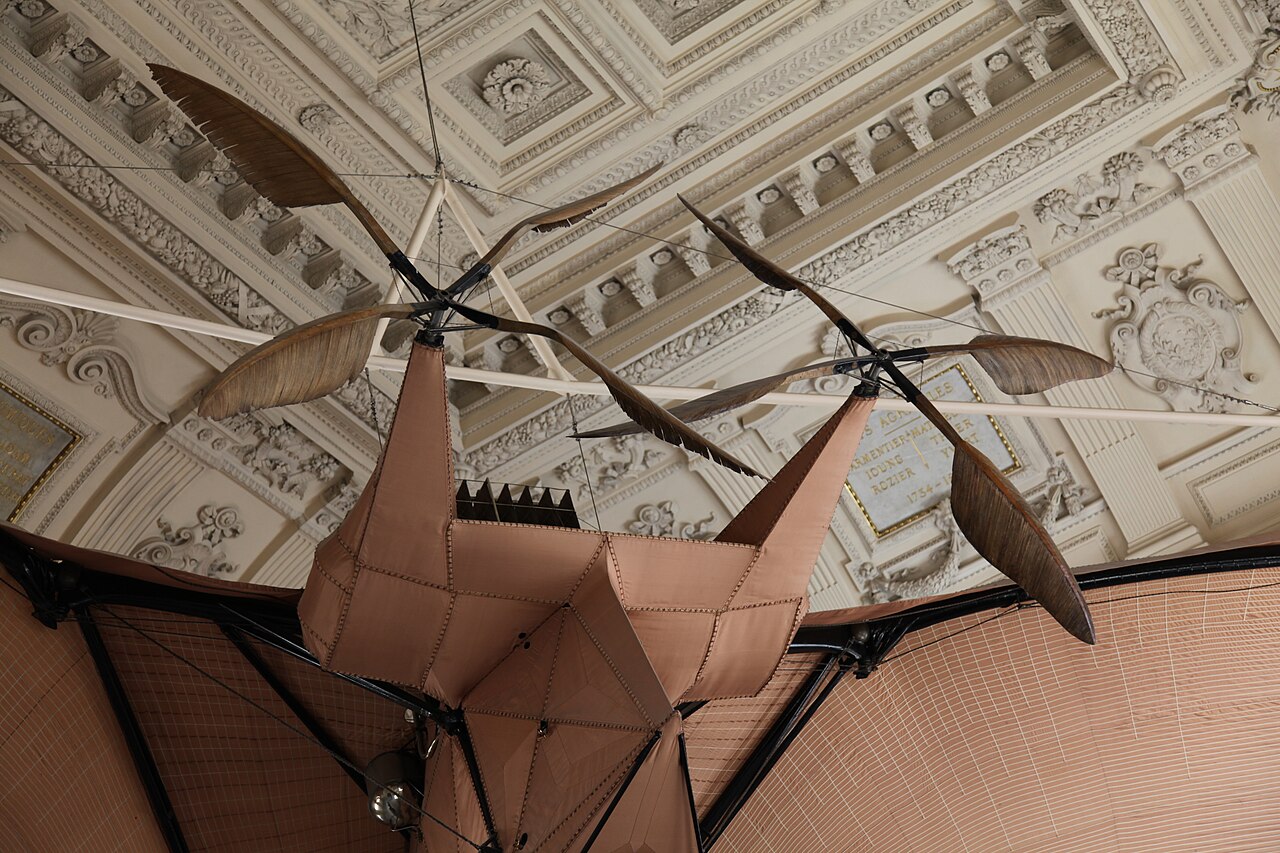
The image associated with this entry shows Avion III, preserved by the Musée des Arts et Métiers, rather than Éole. Ader donated that machine to the Conservatoire in 1903; it became material evidence of his research and of the importance he attached to saving weight. Its preservation allows a technical approach to be studied, but cannot by itself resolve controversies about the claimed flights. Ader's legacy lies in this exploration of airborne propulsion and heavier-than-air machinery, together with his thinking about military aviation. A rigorous account retains that importance without confusing a possible hop with demonstrated mastery of powered, sustained and controlled flight.
Why it mattered
- The reported lift-off of 1890 was an early experiment in airborne propulsion on a heavier-than-air machine.
- The significance of the hop must be distinguished from a demonstration of sustained, controlled flight.
- The preserved Avion III allows a later stage of Ader's research to be studied without confusing it with Éole.
Where to see it
No example is known with certainty to be on display
Sources
- Musée des Arts et Métiers — Collections
- Gallica — BnF — Presse et revues aéronautiques numérisées
- Musée des Arts et Métiers — Aéroplane, dit Avion n° 3