1783–1914
The pioneers (1783–1914)
From the balloons of 1783 to controlled aeroplanes: experiments, trades and institutions make flight practicable before the Great War.
6 min read
Historical context
On 21 November 1783, in Paris, Pilâtre de Rozier and the Marquis d'Arlandes made a free flight in a hot-air balloon built by the Montgolfier brothers. This ascent carried people without any connection to the ground, but did not provide control over a route. The balloon drifted with the winds; operating it mainly involved managing altitude and finding somewhere to land. Hydrogen balloons soon offered another way of ascending. Over the following century, scientific experiments, public spectacles and military uses sustained a culture of flight long before the aeroplane arrived.
The problem of directed movement gradually separated two approaches. Airships added propulsion and control surfaces to an aerostat; aeroplanes had to generate lift through motion. Steam engines, metallurgy, precision engineering and internal combustion engines supplied new resources without dictating a single solution. Experiments circulated through books, correspondence and journals. By the late nineteenth century, clubs and newspapers were organising prizes and comparing results. The transition from private experiment to public demonstration also changed the standards of evidence: witnesses, measurements and repetition became essential to establishing what a machine could actually do.
Technical advances
George Cayley distinguished lift, propulsion and control, opening the way to analysing an aeroplane as a collection of functions. Otto Lilienthal's gliding flights then demonstrated what experiments in the open air could contribute, but also their dangers. Lift depends on wing shape, speed and angle of attack; by itself it cannot guarantee balance. Movements must be controlled and disturbances corrected. The Wright brothers combined glider trials with wind-tunnel measurements rather than relying only on a more powerful engine. Their method connected practical flying experience with a systematic investigation of aerodynamic behaviour.
On 17 December 1903, their Flyer made four powered flights in North Carolina. Combining wing warping, a rudder and pitch control provided a coherent answer to the problem of piloting. The engine and propellers were designed for a light aircraft rather than simply adapted from a machine operating on land. Other builders subsequently adopted ailerons, different tail arrangements and monoplane or biplane layouts. The rotary engine offered a useful relationship between weight and power, alongside constraints of its own. No isolated device therefore explains aviation's emergence: integration mattered as much as invention.
People
Individual careers cannot be reduced to a table of records. In 1890, Clément Ader experimented with the steam-powered Éole; its brief lift-off did not demonstrate sustained, controlled flight. Alberto Santos-Dumont, already known for his airships, presented the 14-bis before observers in 1906. The Wrights' European demonstrations in 1908 made their command of flight visible to a wider public. These episodes require distinctions between take-off, measured distance, control and repeatability: assigning a single first without explaining the criteria obscures the different character of the experiments and the evidence available for each one.
The year 1908 marked a turning point for the European public. On 13 January, at Issy-les-Moulineaux, Henri Farman flew a one-kilometre closed circuit in a Voisin biplane and won the Deutsch-Archdeacon prize. In August, Wilbur Wright began his demonstrations at the Hunaudières racecourse near Le Mans, then at the Auvours military camp. His coordinated turns and the duration of his flights showed French observers how far mastery of control had advanced. European builders drew rapid lessons: ailerons became widespread, engines grew more dependable and flights of several tens of minutes became common. The following year, Hubert Latham's attempt to cross the Channel, cut short by engine failure and a forced landing in the sea, nevertheless showed that reliability remained the main limitation of these machines. The names of Farman, Wright and Latham thus remain associated with a phase in which the aircraft moved from isolated experiment to repeated public demonstration.
On 25 July 1909, Louis Blériot crossed the Channel in his Blériot XI. In 1910, Raymonde de Laroche became the first woman to hold an aeroplane pilot's licence. That same year, Henri Fabre flew his seaplane. In 1913, Roland Garros crossed the Mediterranean. Such careers depended on mechanics, financial backers and ground teams who were often less visible than the pilot. The feature on women in aviation also reminds us that participation did not mean equal access to training, resources or public recognition.
Industry and airlines
Manufacturers moved from individual machines towards still modest production runs. Voisin, Farman and Blériot sold aircraft and developed schools; engine manufacturers supplied equipment whose quality affected the entire machine. Wood, fabric, cables and metal fittings required skilled work, together with frequent inspection and repair. Buying an aeroplane was not enough: someone had to learn to fly it, find a field, shelter the machine and obtain replacement parts. A professional community formed around these requirements, linking workshop, school and trade, without yet amounting to an air transport system operating on a large scale.
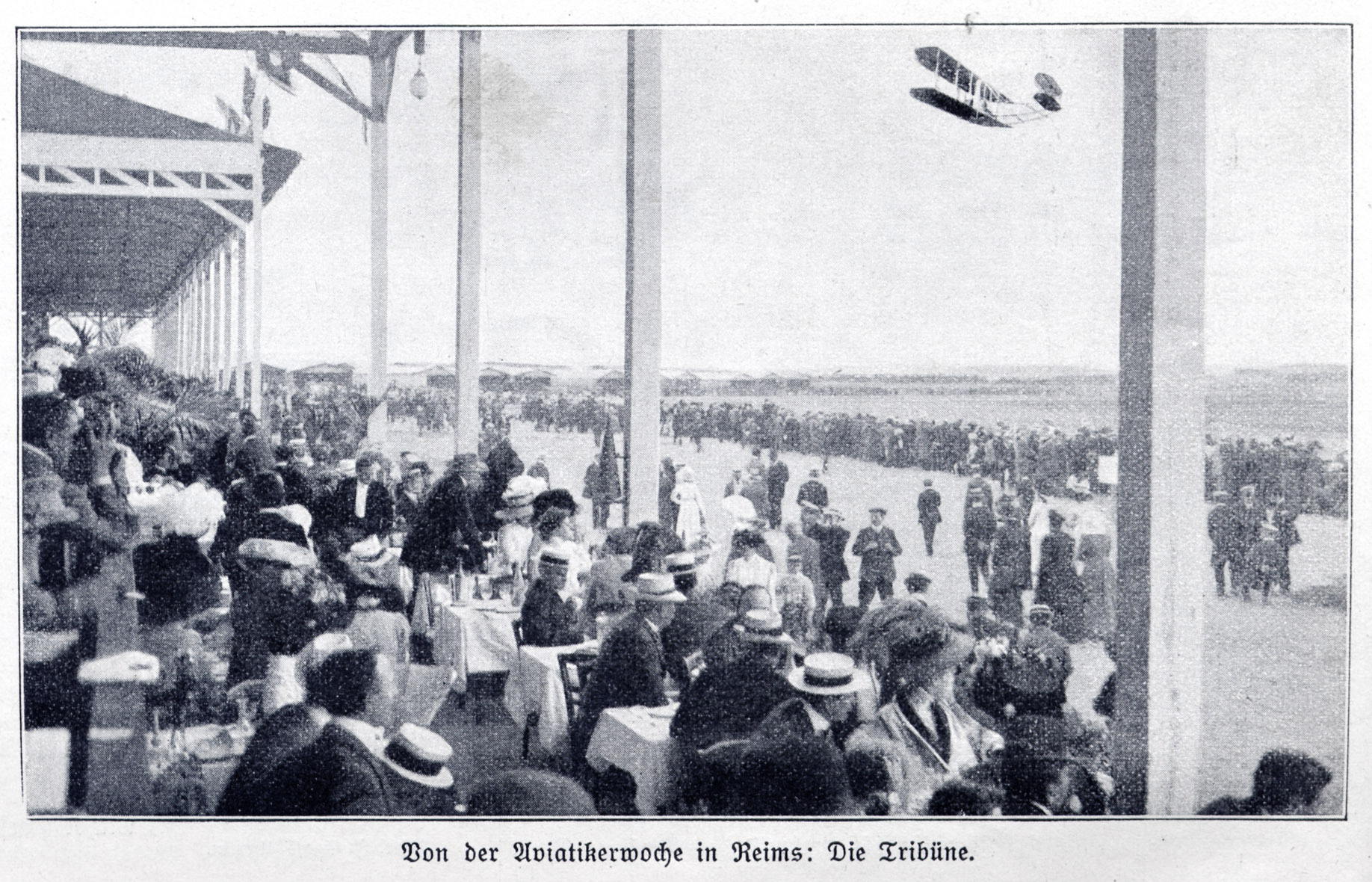
In August 1909, Reims Aviation Week brought together pilots, manufacturers and spectators. Competitions allowed endurance and speed to be compared while publicising manufacturers' names. The press turned results into events, while accidents recalled the fragility of the machines. Prizes attracted capital, but sales and training became more lasting activities than exhibition alone. On the eve of the war, scheduled services remained exceptional: limitations of payload, weather and engine reliability made it impossible to confuse a successful crossing with a dependable daily service. Building an aircraft market was not the same as establishing an airline network.
Military aviation
Military use of the sky preceded the aeroplane. Balloons served for observation; during the siege of Paris, balloons also carried mail and people out of the city. Airships subsequently promised more independent navigation. In the early twentieth century, armies tried aeroplanes for identifying positions and conveying intelligence. The quality sought was not simply speed: seeing beyond the horizon available to an observer on the ground could change a decision. Yet correctly identifying movements below and reporting the information in time remained difficult tasks, dependent on visibility and training as much as on the performance of the aircraft.
Before 1914, military purchases and exercises helped structure schools and manufacturing orders. They eliminated neither uncertainty about doctrine nor technical limitations. Observers had to interpret terrain from an unstable platform, communicate and sometimes take photographs; pilots had to preserve machines vulnerable to wind and mechanical failure. Reconnaissance and early bombing experiments suggested different applications, still far removed from their organisation during the Great War. Aviation was therefore not a mature weapon, but an experimental tool whose usefulness several states were trying to assess through practical exercises, institutional investment and experience in the field.
Legacy
The legacy of this era lies as much in a method as in objects. Measuring forces, testing progressively, recording results and training pilots became conditions of development. The distinction between invention and operation was already apparent: an aircraft capable of an outstanding flight could remain difficult to maintain or reproduce. Collections preserved in museums make these material choices legible, provided that repairs, failures and the variants accompanying each programme are not forgotten. A photograph of a successful flight summarises neither its human cost nor the work that made it possible behind the scenes.
The period 1914–1939, including the Great War, took up this inheritance within a transformed industrial and political setting. Principles of control and lightweight propulsion were available, but navigation, safety and the organisation of services still needed consolidation. Balloons and airships did not simply disappear with the aeroplane: several technologies continued to coexist. The pioneers' history is therefore better told as an accumulation of experiments, institutions and skills than as an inevitable sequence of records. It explains how flying became practicable, not why one particular form of aviation was supposedly destined to prevail over every alternative.
Milestones in this era
21 November 1783
First free manned balloon flight
1890
Clément Ader's Éole
17 December 1903
The Wright Flyer flies at Kitty Hawk
23 October and 12 November 1906
Santos-Dumont flies the 14-bis at Bagatelle
25 July 1909
Blériot crosses the Channel
August 1909
Reims Aviation Week
8 March 1910
Raymonde de Laroche, first woman to hold a pilot's licence
28 March 1910
Henri Fabre flies the first seaplane
23 September 1913
Roland Garros crosses the Mediterranean
Sources
- Smithsonian National Air and Space Museum — Collections
- Musée de l'Air et de l'Espace — Collections
- Gallica — BnF — Presse et revues aéronautiques numérisées
- Science Museum — Collections
- NASA — NASA History
- Encyclopædia Britannica — Wright brothers
Related reading
Aircraft
Wright FlyerAircraft
Blériot XIPioneer
The Montgolfier brothersPioneer
Alberto Santos-DumontFeature
Women in aviationEra
The Great War and the interwar years (1914–1939)