Feature
Women in aviation
From Raymonde de Laroche to Jacqueline Auriol: licences, endurance, crossings and testing, with Valentina Tereshkova as a spaceflight counterpoint and careful distinctions between different firsts.
5 min read
A licence, not an absolute beginning
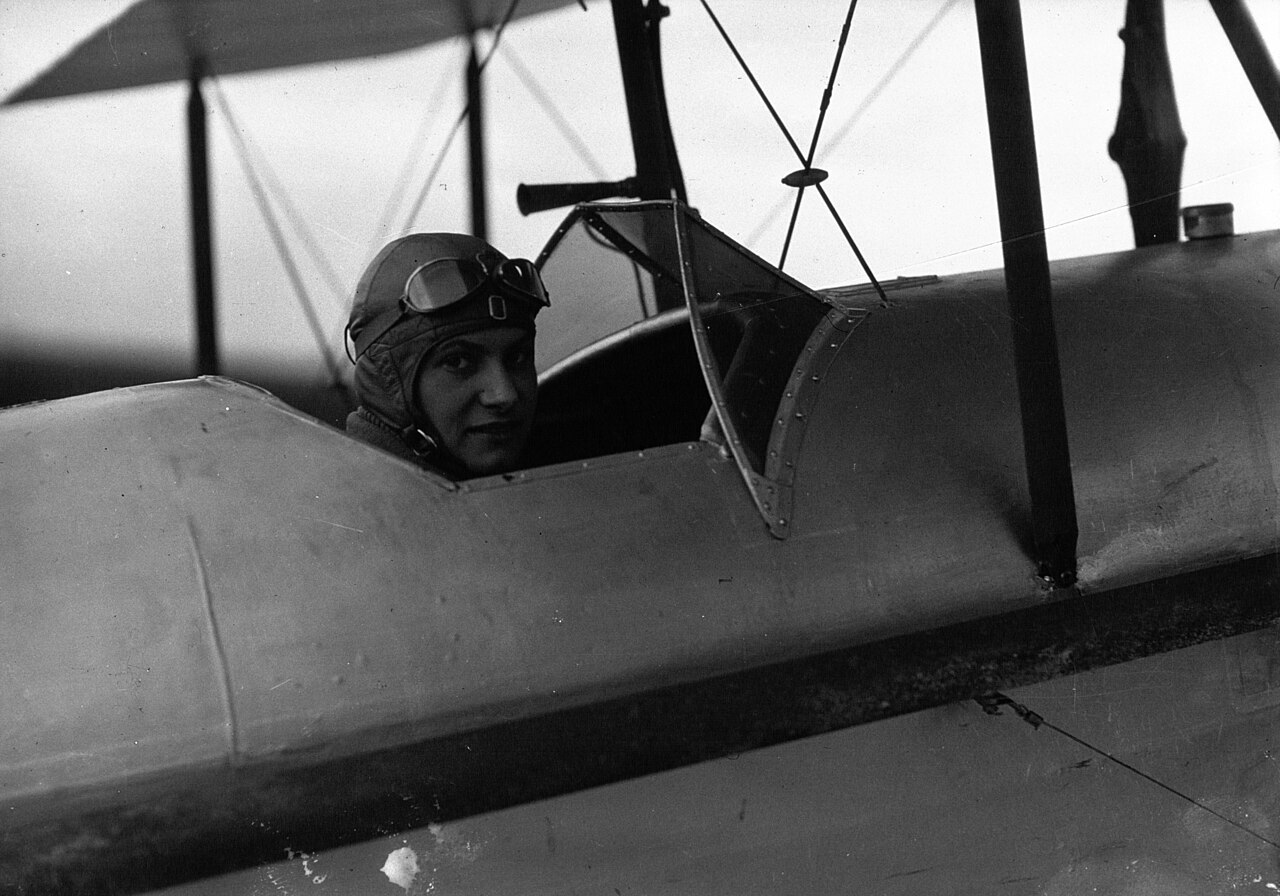
On 8 March 1910, the Aéro-Club de France awarded Raymonde de Laroche pilot's certificate number 36. She is generally recognised as the first woman to hold an aeroplane pilot's licence. That qualification matters: women had already taken part in ballooning, and early aeroplane flights are not the same thing as their administrative recognition. In the pioneer era, a certificate made competence visible and comparable. It meant neither that women had previously been absent from the skies nor that every branch of aviation was now open to them on equal terms with men.
Previously an actress, de Laroche learned to fly a Voisin aircraft. Her career belonged to the world of private schools, manufacturers and flying meetings, where training, demonstration and the search for funding overlapped. The success of Louis Blériot and the Blériot XI illustrates this economy of celebrity without describing her own experience in full. Other women soon obtained certificates, including Marie Marvingt and Hélène Dutrieu. Identifying them prevents a pioneer from becoming an isolated symbol: the opening was real, but remained fragile and depended on material resources as well as personal determination.
Hélène Boucher: learning, then measuring
Hélène Boucher gained her pilot's licence in 1931. She subsequently trained in aerobatics and entered competitions before joining the industrial setting of Caudron-Renault. In 1934 she established several speed records, notably women's records, in Caudron aircraft. These performances required precise work: preparing the aircraft, examining the courses, adjusting equipment and repeating flights. They combined the pilot's skill with that of engineers and mechanics. A record dossier is therefore not simply the account of an individual feat; it documents a collective achievement, dependent on the technical and organisational resources available to the pilot.
Boucher died on 30 November 1934 during a training flight at Guyancourt. Her very short career has often been told through its tragic ending. Placing it within the interwar years also reveals the role of records in industrial publicity and the press. Category, distance and conditions must be specified before describing a speed as the highest. An officially recognised women's record is not automatically an outright record. This distinction does not diminish the difficulty of the flight; it restores the rules under which the performance was established and allows meaningful comparisons between different achievements.
Maryse Bastié: endurance and crossings
Maryse Bastié gained her licence in 1925 and built her reputation through endurance and distance records. Endurance imposed demands different from speed: remaining alert for long hours, managing fuel and monitoring an engine that had to keep running steadily. The piston engine and the available range gave these flights their practical limits. Behind the published figures lay fatigue, the arrangement of the cockpit and the need to retain enough awareness to complete the flight and land safely. Such work belongs to the technical history of flight as much as the better-known pursuit of higher speeds.
On 30 December 1936 she flew solo from Dakar to Natal in a Caudron Simoun. This South Atlantic crossing took place within a region already traversed by mail crews, discussed in the Aéropostale feature. It should therefore not be described as the first crossing of that ocean. Its importance lies in the pilot flying alone, the women's performance and her command of a long overwater leg. Bastié thus shows that the history of women aviators cannot be reduced either to speed contests or to the familiar routes and celebrated crossings of the North Atlantic.
Amelia Earhart: distinguishing 1928 from 1932
In 1928, Amelia Earhart became the first woman to cross the Atlantic by aeroplane, but did not pilot the aircraft during that crossing. In May 1932 she flew solo from Newfoundland to Northern Ireland, becoming the first woman to make the crossing alone. Confusing these journeys removes precisely what changed in her role aboard the aircraft. The precedent set by Charles Lindbergh in 1927 gave a solo crossing strong public resonance without making the routes or conditions of the two flights identical. The distinction is essential to understanding both her experience and the claims made for it.
Earhart used this visibility to promote women's place in aviation and helped establish the Ninety-Nines, an organisation of women pilots. In 1937 she attempted a round-the-world flight with navigator Fred Noonan. Their aircraft disappeared in the Pacific on 2 July during the leg towards Howland Island. Their exact fate and the aircraft's location remain unestablished. A rigorous account separates documented evidence from later hypotheses. Nor should the disappearance absorb her entire biography: her experience as a pilot and her organisational work existed before the final flight and deserve to be considered on their own terms.
Jacqueline Auriol and the test-flying profession
During the Second World War, women notably ferried military aircraft in Britain and the United States. These responsibilities did not mean general equality of status or access to every combat mission. After the war, Jacqueline Auriol learned to fly and subsequently turned to testing. Seriously injured in an accident in 1949, she resumed her progress after numerous operations. Her career combined professional qualifications and records, two dimensions that should not be confused: test work cannot be measured solely by published speeds. It also requires disciplined observation and the ability to report an aircraft's behaviour accurately.
In 1953 Jacqueline Cochran broke the sound barrier before Auriol, who exceeded it later in the same year. Describing Auriol as the first supersonic woman would therefore be incorrect. In the jet age, she contributed to testing French aircraft and contested several women's speed records. The Mach number expresses a ratio to the local speed of sound, not a fixed speed applicable everywhere. This technical context, developed in the supersonic flight feature, helps distinguish crossing a threshold, securing official recognition of a record and systematically evaluating an aircraft through its various operating conditions.
Tereshkova: a spaceflight counterpoint
On 16 June 1963, Valentina Tereshkova launched aboard Vostok 6 and became the first woman in space. With a background in parachuting, she belonged to a cosmonaut selection rather than a test-piloting career comparable to Auriol's. A rocket placed her capsule in orbit; the flight belonged to a different technical and institutional system. This spaceflight counterpoint illuminates women's visibility in aerial exploration without equating orbital flight with piloting an aeroplane. Above all, it shows that a first can be spectacular without immediately opening a lasting professional route for others seeking to follow the same path.
Not until 1982 did another woman, Svetlana Savitskaya, fly in space. That long interval invites a distinction between public symbolism and continuity in recruitment. In aviation too, licensing, competition, commercial transport and testing represent different doors. The six careers gathered here do not describe a steady progression towards equality. They show opportunities won within particular settings, with their support networks and limitations. Sources must therefore be examined for what they actually measure: a flight, a licence, a record category or lasting access to a profession. Such distinctions give these achievements their historical meaning rather than diminishing them.
Sources
- Musée de l'Air et de l'Espace — Collections
- Smithsonian National Air and Space Museum — Collections
- NASA — NASA History
- Gallica — BnF — Presse et revues aéronautiques numérisées
Related reading
Pioneer
Hélène BoucherPioneer
Amelia EarhartPioneer
Jacqueline AuriolFeature
The Aéropostale (1918–1933)Era
The Great War and the interwar years (1914–1939)