Blériot XI
The Blériot XI linked France and England in 1909 before serving in training and reconnaissance.
History
Louis Blériot entered aviation after developing a business manufacturing motor-car headlamps. His industrial resources allowed him to finance a succession of aircraft, but testing was expensive and frequently interrupted by accidents. In the early twentieth century designers were still exploring very different arrangements: biplanes, monoplanes and machines with either forward or rear tail surfaces. Blériot worked with the engineer Raymond Saulnier on the development of the Type XI. The project therefore emerged not from an already settled formula but from a succession of corrections to earlier designs. The aim was an aircraft sufficiently light and manageable to undertake extended flights at a time when engine reliability remained a major constraint. His experience as a manufacturer supported, but did not remove, this experimental process.
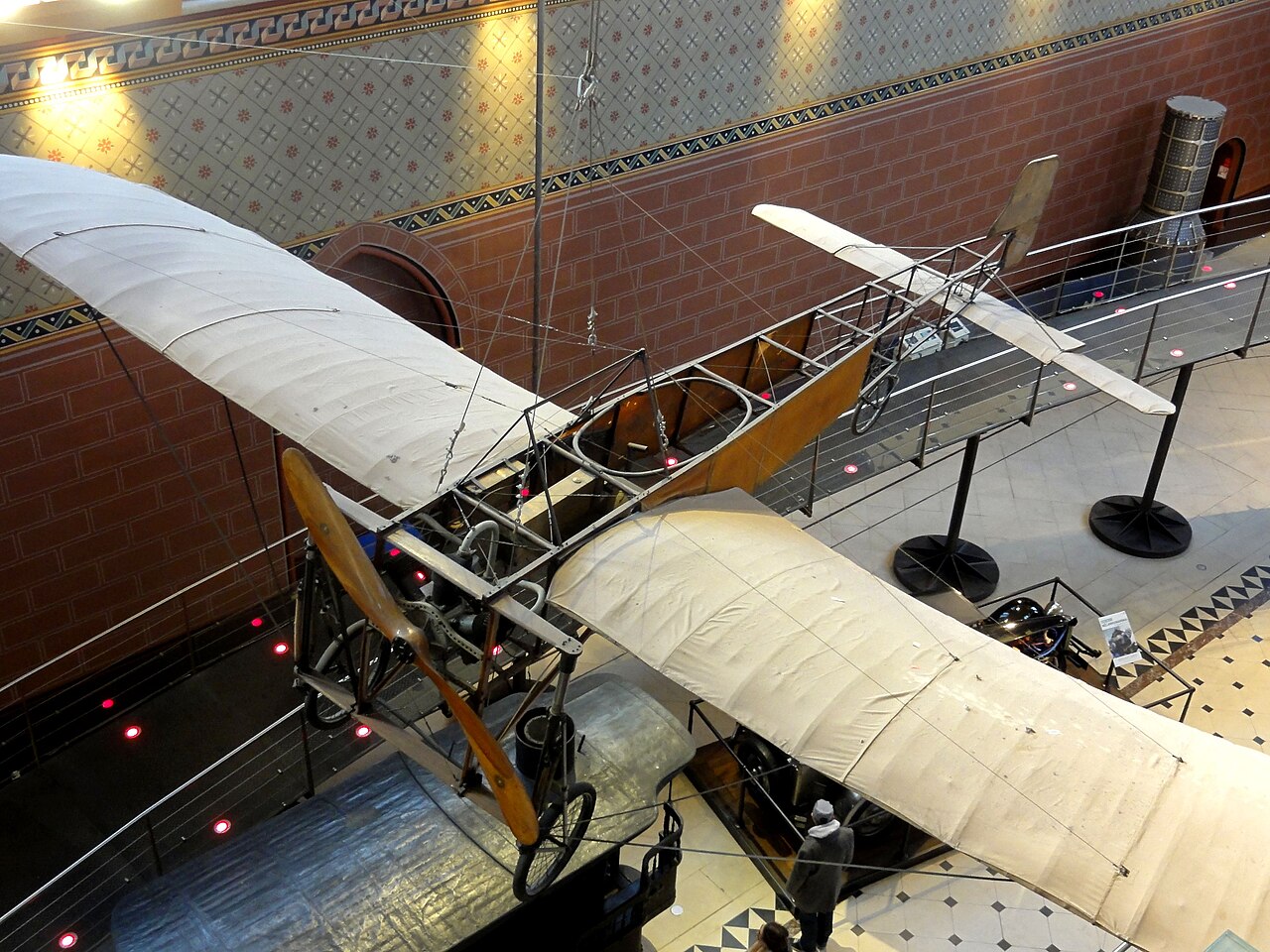
The Blériot XI was a monoplane whose wing stood above the lower part of the fuselage, rather than a high-wing aircraft in the later transport-aircraft sense. A lightweight wooden structure reinforced with wires carried fabric-covered surfaces. The pilot sat in the open behind the engine and operated elevator, rudder and wing-warping controls. The wheeled undercarriage incorporated a mechanism to absorb some landing movements. Apparent simplicity did not mean an absence of adjustment: wire tension, balance and the condition of the covering directly affected flight behaviour. On the Channel aircraft, a three-cylinder Anzani engine drove a tractor propeller. These features combined a relatively compact airframe with the control arrangements and bracing characteristic of the early period of powered aviation.
The Type XI first flew in January 1909, with testing and modifications continuing over the following months. On 25 July Blériot took off near Calais and crossed the English Channel to Dover in a little over half an hour. The journey was made without the navigation and communications equipment that commercial aircraft would later carry. Landing on British soil damaged the machine, but the crossing had been completed and qualified for the prize offered by the Daily Mail. The importance of the event lay as much in its public visibility as in the distance covered. An aeroplane carrying its pilot had crossed a stretch of sea separating two countries without an intermediate stop, giving a widely reported demonstration of its capabilities.
Publicity surrounding the crossing stimulated orders and transformed the Type XI into an industrial product. Schools used the monoplane to teach flying, while private owners and display pilots operated it at aviation meetings. Aircraft were sold abroad and licensed manufacture widened its distribution. Armed forces were interested in its observation capabilities rather than the carriage of heavy weapons. During the Italo-Turkish War of 1911 a Blériot XI took part in the beginnings of military aerial reconnaissance. Aircraft of the family were still in use at the opening of the First World War. Their low speed and vulnerability nevertheless limited their ability to remain in front-line service as newer aircraft appeared, changing the requirements placed on machines originally developed for civilian flying.
The name Blériot XI covers a family rather than a single configuration. Engines changed, including the use of rotary powerplants on some production series, and two-seat versions met training and observation requirements. Changes to the wings, fuselage and undercarriage accompanied these uses. The dimensions, power and performance of the July 1909 aircraft should therefore not be assigned to every example. The variety of versions and foreign production also makes a manufacturing total difficult without a precisely defined scope. This account consequently gives no overall figure. The model's development shows how a machine initially associated with an individual achievement became equipment that workshops, flying schools and military services had to maintain in everyday use, with requirements extending beyond a single celebrated flight.
Gradually superseded in operational units, the Blériot XI retained a place in instruction and in the remembrance of early flying. The Channel aircraft entered the collections of the Musée des Arts et Métiers in Paris in 1909 and is preserved there. It is a material witness distinct from replicas subsequently built for commemorations or demonstrations. Its legacy is twofold: it made the possibility of crossing a maritime frontier by aeroplane publicly visible and helped spread flying skills among many students. It also recalls the constraints of this aviation: an exposed pilot, maintenance of wire-braced structures and dependence on an engine that remained vulnerable to failure. The crossing did not abolish these difficulties; it demonstrated that they could be overcome under particular conditions.
Why it mattered
- The 1909 crossing gave international visibility to flight between two countries.
- The Type XI contributed to the spread of flying schools.
- Its versions illustrate the transition from sporting aviation to military reconnaissance.
Where to see it
- Musée des Arts et Métiers — Paris, FranceOriginal aircraft used for the 1909 crossing.
Sources
- Musée des Arts et Métiers — Collections
- Gallica — BnF — Presse et revues aéronautiques numérisées
- Science Museum — Collections