Feature
Supersonic flight, from the Bell X-1 to the Boom XB-1
From Yeager’s 1947 flight to the supersonic XB-1 on 28 January 2025: research, Concorde, acoustic constraints and the limits of the civil market.
5 min read
A barrier made of shock waves
The “sound barrier” is not a material wall. As speed approaches that of sound, some regions of the airflow become supersonic before the whole aircraft reaches Mach 1. Shock waves appear, drag increases and controls can lose effectiveness. Accidents and difficulties during the 1940s gave this transition a reputation as an impassable limit. What engineers needed was an understanding of a physical regime, the transonic range, rather than a way to overcome a single obstacle through engine power alone. Conditions varied with the aircraft and its altitude.
On 14 October 1947, Chuck Yeager crossed that limit in controlled level flight in the Bell X-1 above California. The experimental rocket-powered aircraft was released from a bomber to conserve its fuel. Its shape and thin wing served a research mission, not a transport requirement. Measurements of pressure, stability and handling mattered as much as the speed achieved. This result established the possibility of piloted supersonic flight; it did not settle the questions of endurance, operating cost or suitability for carrying passengers on a regular commercial service.
From laboratory to military aircraft
Over the following decades, supersonic speed became a routine part of military aviation. Swept wings and delta wings offered different answers to the demands of compressibility, strength and internal volume. The Mirage III illustrates the combination of a delta wing and supersonic performance; the SR-71 demonstrates the thermal constraints of still faster flight. These aircraft did not share the same missions. A brief burst of speed, an interception and a sustained cruise imposed different compromises in weight, propulsion and fuel consumption, even when described by similar speed figures.
The turbojet enabled flight far beyond the endurance of a rocket aircraft. Air intakes nevertheless had to slow and organise the flow before the compressor, while the airframe experienced increasing aerodynamic heating. Afterburning provided additional thrust at a high fuel cost. During the jet age, military experience and wind-tunnel experiments informed civil studies without making their solutions directly interchangeable. An airliner also required a pressurised cabin, repeated operation, fuel reserves and maintenance compatible with commercial schedules. Speed alone could not define the design or the conditions of its operation.
Concorde: organising cruise at Mach 2
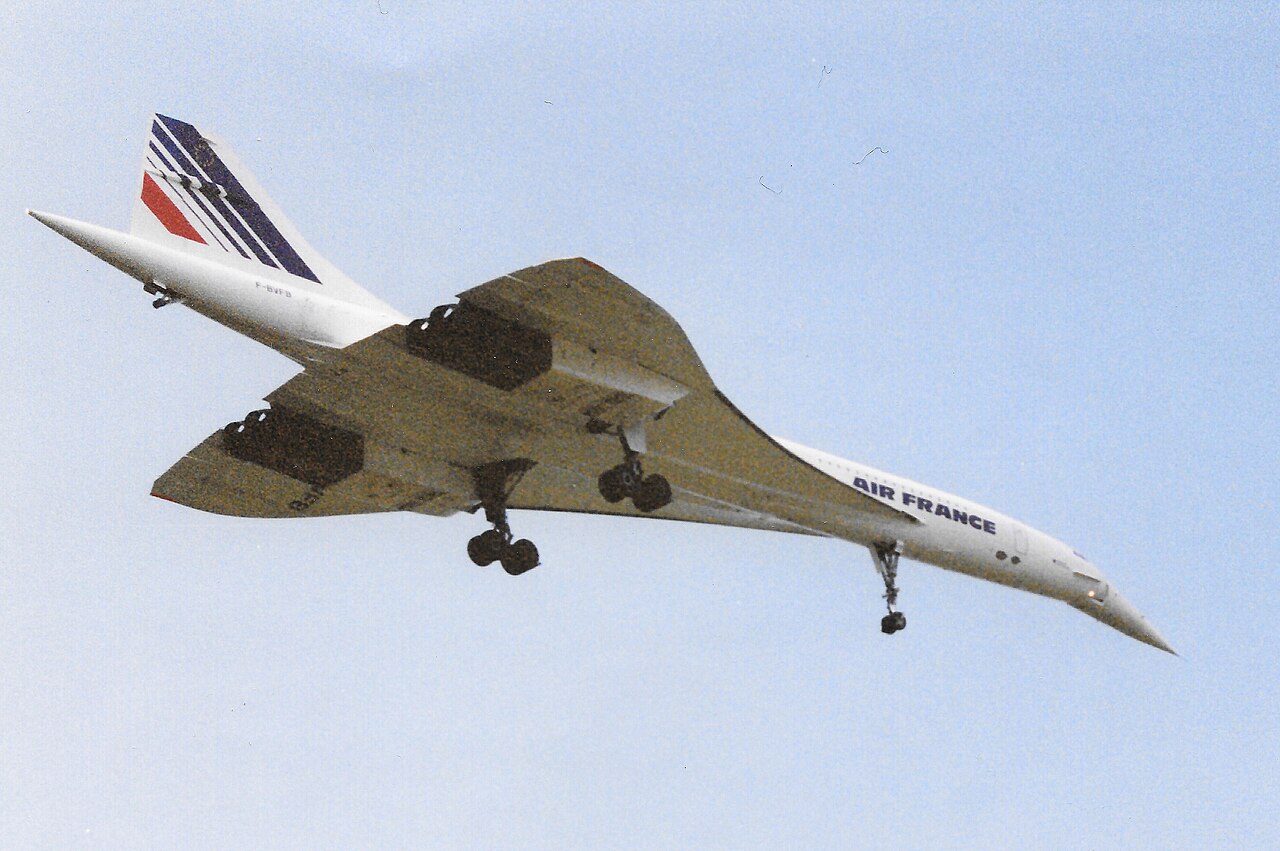
The Franco-British agreement of 1962 provided an industrial and political framework for Concorde. The French prototype first flew on 2 March 1969; the British prototype followed in April. The slender delta wing, drooping nose and variable air intakes resulted from interconnected constraints. The aircraft had to fly efficiently at high speed, but also take off, approach and allow its pilots to see the runway. Its Olympus engines used afterburning for take-off and acceleration, but not during normal cruise at Mach 2. That distinction matters when explaining the aircraft’s fuel consumption.
Fuel transfer between tanks adjusted the centre of gravity during flight. Structural expansion caused by heating was also incorporated into the design. On 21 January 1976, Air France and British Airways inaugurated commercial services, respectively to Rio via Dakar and to Bahrain. Unlike the Boeing 747, which spread its costs over a large capacity, Concorde carried around a hundred passengers and prioritised time saved. Fourteen aircraft were employed commercially by the two airlines; total production also included prototypes and development aircraft. The commercial fleet was therefore smaller than the total number of airframes built.
The boom, routes and market
The sonic boom is not simply a noise produced at the instant of crossing Mach 1. Shock waves accompany supersonic movement and can reach the ground along the flight path. Restrictions on supersonic flight over land therefore reduced Concorde’s commercial opportunities, with transatlantic routes becoming its best-known services. Noise around airports was another issue, separate from the boom during cruise. Nuisance, fuel consumption and operating permissions have to be considered together to understand the geography of its network. A technically feasible flight was not automatically an acceptable scheduled service.
The Soviet Tupolev Tu-144, which had flown before Concorde in December 1968, experienced only a very brief scheduled passenger service in 1977 and 1978. The American supersonic transport project was cancelled in 1971. These different paths show that a technical demonstration does not guarantee a market. Subsonic transport, illustrated earlier by the Boeing 707, continued to expand alongside these experiments. For airlines, capacity, frequency, fuel cost and network flexibility influenced decisions just as surely as the duration of a flight. The comparison involves complete transport systems, not speed records alone.
The end of service does not sum up its history
On 25 July 2000, an Air France Concorde crashed at Gonesse after taking off from Paris. The BEA investigation examined, among other factors, the destruction of a tyre after it struck a metal strip, damage to a fuel tank and the ensuing fire. Modifications preceded the resumption of commercial flights in November 2001. This episode belongs to the history of aviation safety: it needs to be described through the technical investigation, without reducing a complex sequence to a dramatic slogan or confusing the search for causes with judicial responsibility.
Air France and then British Airways ended their Concorde services in 2003. The accident alone does not explain that ending: commercial conditions, operating costs and support for a small ageing fleet also mattered. Concorde’s final flight, outside commercial service, took place on 26 November 2003 to Filton. Aircraft preserved in museums display an industrial experience as well as a distinctive shape. The maintenance feature helps explain this dimension: keeping a few specialised aircraft airworthy requires skills, parts and an organisation that cannot be inferred from flight performance alone.
XB-1: what a flight demonstrates
Boom’s XB-1 demonstrator first flew on 22 March 2024. On 28 January 2025, flown by Tristan Brandenburg above the Mojave Desert, it broke the sound barrier. The manufacturer reported Mach 1.122 for this first supersonic flight. These details describe a measured achievement by an experimental aircraft, not the entry into service of a civil transport. The composites, controls and design tools used belong to a different technical context from that of 1947, but flight testing still depends on careful expansion of the aircraft’s operating envelope through successive trials.
NASA’s X-59 programme addresses a different question: changing the acoustic signature through aircraft shape. Studying a reduced boom is not the same as eliminating every nuisance or obtaining general permission for overland flight. Likewise, XB-1 does not certify an airliner or establish its operating economics. At this October 2026 reading point, these programmes are presented through their documented achievements, without an assumed commercial timetable. The connection with decarbonisation remains essential: speed, energy consumption and atmospheric effects have to be assessed together rather than treated as unrelated measures of progress.
Sources
- Smithsonian National Air and Space Museum — Collections
- NASA — NASA History
- Aeroscopia — Collections
- BEA — Bureau d'Enquêtes et d'Analyses
- Air France — Notre histoire
- Boom Supersonic (source constructeur / manufacturer source) — Boom Achieves Supersonic Flight — 28 January 2025
Related reading
Aircraft
Bell X-1Aircraft
ConcordeAircraft
Dassault Mirage IIIFeature
From piston engine to turbofanFeature
Towards low-carbon aviation