Concorde
The Franco-British airliner that flew commercial services at about Mach 2 for twenty-seven years.
History
Concorde resulted from the convergence of French and British research into commercial supersonic transport. The intergovernmental agreement signed on 29 November 1962 established a lasting partnership between the two countries. Sud Aviation and the British Aircraft Corporation took responsibility for the airframe, while British and French engine manufacturers worked on propulsion. The ambition extended beyond simply replacing existing aircraft: the aim was to reduce long-distance journey times substantially. This choice nevertheless required new technical and economic problems to be solved. Work allocation, public funding and coordination between partners were essential features of the programme from the outset, alongside the performance expected from the aircraft itself.
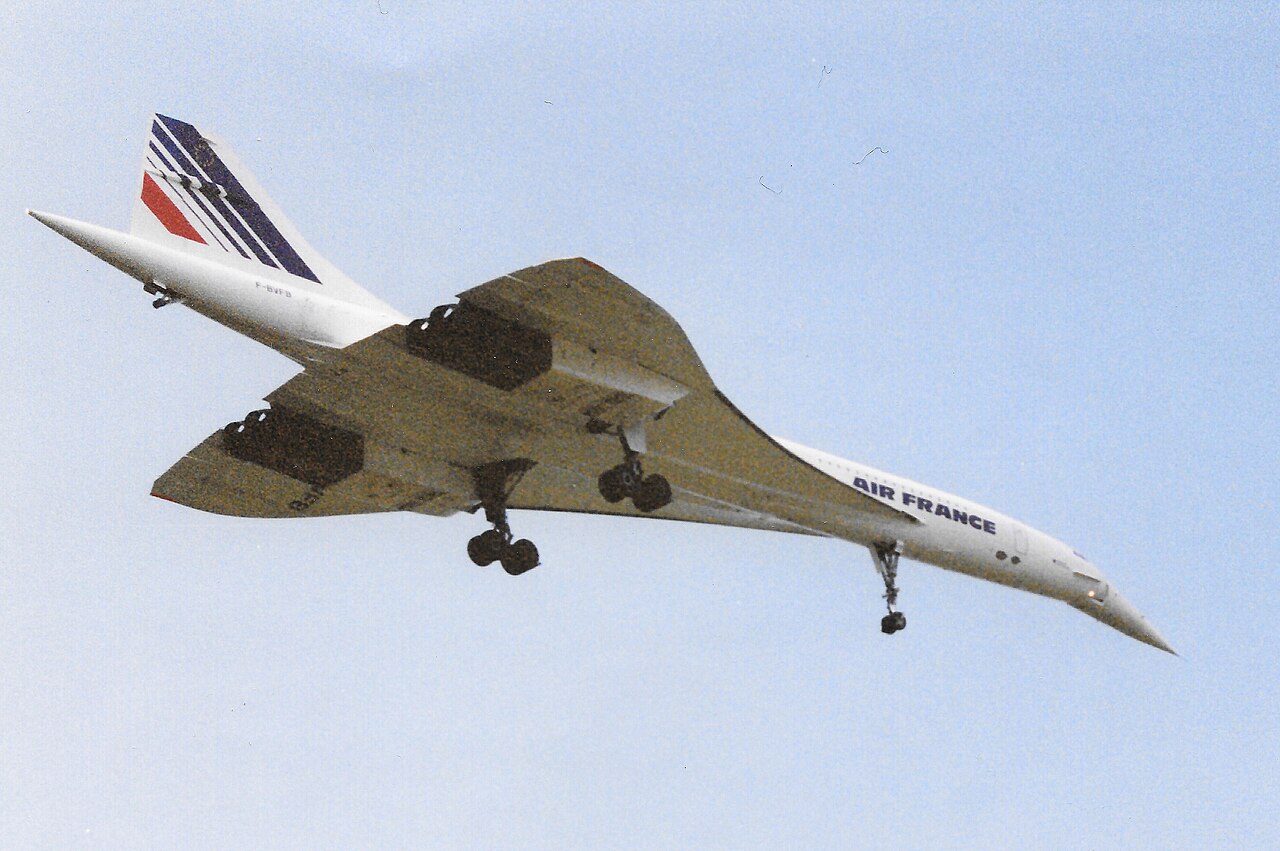
The aircraft combined an ogival delta wing, a narrow fuselage and four Olympus 593 engines. Its nose could be lowered to improve visibility during low-speed phases. At high speed, the intakes had to slow and control the airflow before it reached the compressors; their regulation therefore played a major part in propulsion. Reheat was used particularly for take-off and transonic acceleration, but was not required throughout Mach 2 cruise. Fuel transfer contributed to controlling the centre of gravity. Aerodynamic heating, expansion stresses and fuel consumption were also among the problems addressed by the engineers, reaching far beyond the aircraft's external shape and requiring coordination between several technical disciplines.
French prototype 001 flew at Toulouse on 2 March 1969; the British prototype took to the air the following month. Testing continued over several years to explore the flight envelope progressively and prepare for certification. Commercial service began on 21 January 1976, with Air France serving Rio de Janeiro through Dakar and British Airways flying to Bahrain. Transatlantic services subsequently assumed a central role, particularly those to New York. Supersonic operations nevertheless remained subject to geographical restrictions: the sonic boom limited opportunities for cruising above inhabited land. The advertised speed consequently did not provide the same advantage on every route that might otherwise have been considered for commercial operations.
Air France and British Airways were the two airlines to operate Concorde over a sustained period in their own fleets. Scheduled transport concentrated on customers willing to pay to reduce journey times, particularly across the North Atlantic. Cabins carried around a hundred passengers in a fuselage much narrower than contemporary widebodies. Charter flights and special journeys supplemented scheduled routes. The programme nevertheless failed to secure the international market originally envisaged: purchase intentions from numerous airlines did not lead to deliveries. Costs, operating constraints and environmental restrictions helped limit its spread, despite the technical results achieved during testing and service. Its airline history therefore differed considerably from the scale anticipated during the early development period.
Twenty aircraft were built in total, including prototypes, pre-production machines and production aircraft. This was not a family developed into numerous successive commercial variants: the principal differences concerned development stages and the transition to the passenger transport standard. Prototypes and development aircraft should therefore not be confused with the machines delivered for scheduled operations. The two airlines adapted their cabin arrangements and procedures to their requirements while using the same basic airframe and propulsion concept. The limited number of aircraft made industrial support particularly dependent on the continuity of the technical organisation, available spare parts and the specialised skills needed for maintenance throughout the type's service life.
On 25 July 2000, an Air France Concorde crashed at Gonesse after taking off from Paris. The fleet was grounded, and modifications subsequently allowed service to resume in November 2001. This return did not lead to a lasting extension: Air France and British Airways ended commercial flying in 2003, against a background of deteriorating economic conditions and high support costs. The accident should therefore not be presented as the sole explanation for retirement. Concorde left extensive experience of civil transport at Mach 2 and of binational industrial cooperation. Aircraft preserved in several museums also document the commercial and operational limits of a programme whose technical achievements did not lead to substantial production.
Why it mattered
- Concorde provided scheduled supersonic flights for twenty-seven years.
- Its development required sustained Franco-British industrial cooperation.
- Its career demonstrates the economic and environmental constraints of supersonic transport.
Where to see it
- Aeroscopia — Blagnac, FranceF-WTSB (pre-production) and F-BVFC (formerly Air France).
- Musée de l'Air et de l'Espace — Le Bourget, France
- Intrepid Museum — New York, USA
- The Museum of Flight — Seattle, USA
Sources
- Musée de l'Air et de l'Espace — Collections
- Science Museum — Collections
- Aeroscopia — Collections