Manufacturer
British Aerospace / BAE Systems
British Aerospace brought together several British manufacturers in 1977; renamed BAE Systems in 1999, the group focuses on defence.
4 min read
Origins and nationalisation
British Aerospace was established in 1977 through the nationalisation and combination of four companies: British Aircraft Corporation, Hawker Siddeley Aviation, Hawker Siddeley Dynamics and Scottish Aviation. The new organisation brought together civil and military aircraft, missiles, production facilities and design offices. This followed an industrial history already shaped by consolidation. BAC and Hawker Siddeley had themselves emerged from earlier combinations. British Aerospace was therefore not founded around a single aircraft or factory: it inherited programmes at different stages of development, existing orders and responsibilities for supporting aircraft already in service. Its initial organisation reflected those inherited commitments as much as plans for future products.
These origins explain the diversity of the initial portfolio. BAC’s activities included the British contribution to Concorde, while Hawker Siddeley brought in the Harrier and Hawk among other products. Scottish Aviation had experience in light aircraft and trainers. The legal integration of these companies did not immediately remove differences in products, skills and industrial locations. The creation of British Aerospace was initially a change in ownership and organisation. It placed a substantial part of British aircraft manufacturing under public control without turning all inherited projects into new programmes or ending the international partnerships in which the predecessor companies were already involved.
Concorde and commercial aircraft
Concorde was developed before British Aerospace was founded. The Anglo-French agreement of 1962 had brought together BAC and Sud Aviation, which was succeeded by Aérospatiale in 1970. Commercial service began in 1976. British Aerospace subsequently took over British manufacturing and support responsibilities. This sequence matters: the company created in 1977 inherited an aircraft already in operation rather than initiating its design. The programme remained binational, with expertise and facilities distributed on both sides of the Channel. Industrial support continued well beyond the first flights and the delivery of the initial aircraft to the airlines, as it did for other long-lived commercial products.
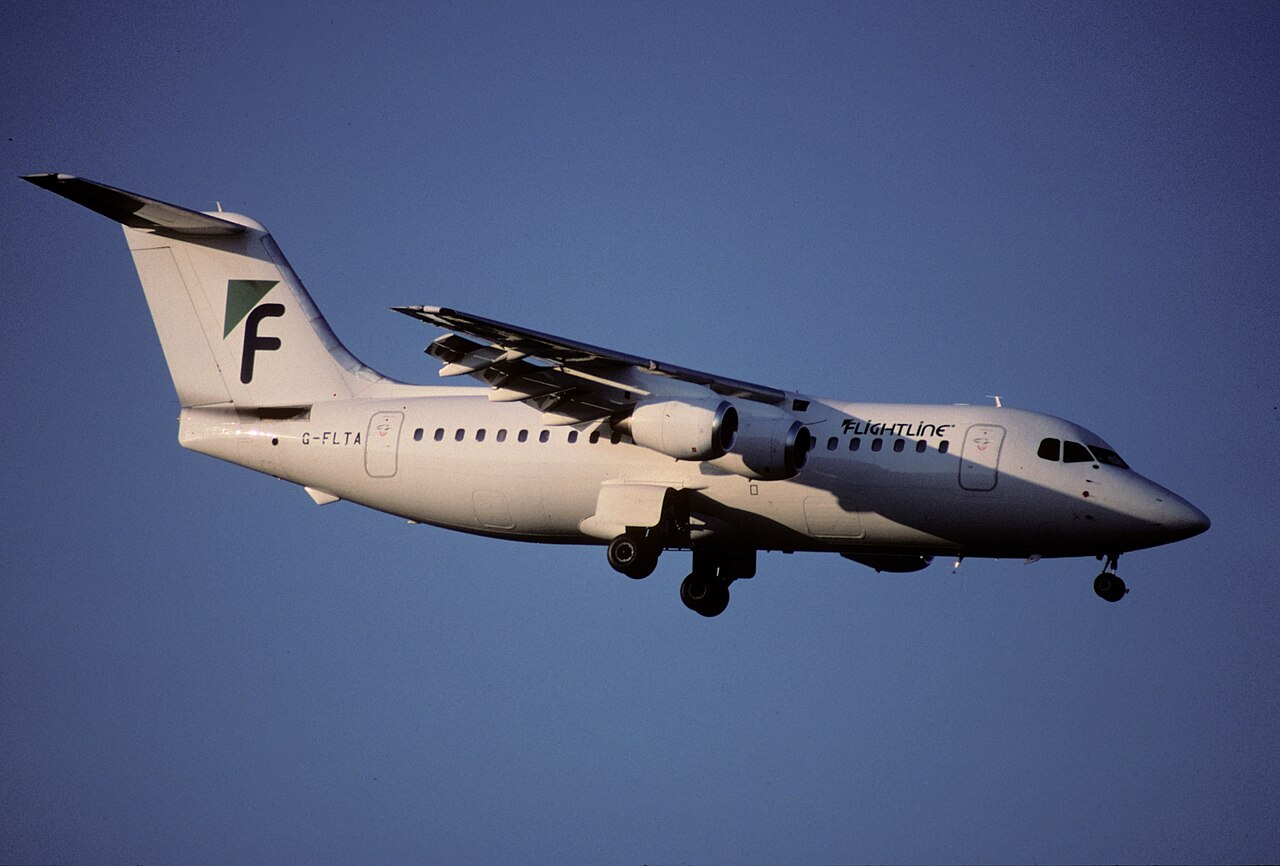
The BAe 146 represented another strand of civil activity. This high-wing, four-engined regional jet first flew in 1981 and entered service in 1983. Its configuration and capacity distinguished it both from larger airliners and from small turboprop transports. It was operated on regional routes and in configurations addressing different markets. The family subsequently evolved into the Avro RJ range. British Aerospace also produced the ATP regional turboprop. These aircraft show that, before its later concentration on defence, the group retained responsibility for complete commercial aircraft alongside its Airbus work. Its civil portfolio therefore included both independently marketed products and participation in a multinational industrial organisation.
Harrier, Hawk and defence
The Harrier used a short or vertical take-off and vertical landing configuration made possible by directing engine thrust. Originating with Hawker Siddeley, it underwent several developments for land-based and naval forces. British Aerospace also participated in the second-generation Harrier with American industry. The Hawk, another Hawker Siddeley inheritance, was a jet trainer used for advanced pilot instruction. It led to several versions and export sales. The two programmes addressed different missions: training cannot be treated as equivalent to the operational use of a short take-off combat aircraft. Their shared corporate ownership did not mean that they shared an aerodynamic arrangement, engine installation or principal role.
Defence activity was not confined to these two aircraft families. British Aerospace participated in multinational programmes including Tornado and subsequently Eurofighter. These relied on agreements between governments and manufacturers and on the division of development and production work. Missile activities inherited from Hawker Siddeley Dynamics also formed part of the initial organisation. The transition towards BAE Systems belongs within this wider context: military aircraft, equipment and systems became increasingly central to the group’s identity. This evolution should be distinguished from the gradual withdrawal from commercial aircraft, which took place through several transactions rather than as a single event applying to every business at once.
Airbus and privatisation
British Aerospace formally joined Airbus Industrie in 1979 with a 20 per cent shareholding. British industry had already been working on A300 wings through Hawker Siddeley. Entry into the consortium therefore formalised a partnership role and should not be mistaken for the beginning of all British work on Airbus. Wing design and manufacture remained important responsibilities in the United Kingdom, including for the A320 family. During the 1980s British Aerospace was privatised in stages, with an initial share sale in 1981 followed by the disposal of the remaining government holding in 1985. The change of ownership did not terminate the company’s participation in European aircraft programmes.
From British Aerospace to BAE Systems
In 1999, the combination of British Aerospace and Marconi Electronic Systems, the defence businesses of GEC, created BAE Systems. This was not a merger with the whole of Marconi’s telecommunications business. The new group combined military platforms with defence electronics. In 2006, BAE Systems sold its 20 per cent interest in Airbus to EADS, which became Airbus’s sole shareholder. The disposal concerned an ownership interest; it did not mean the end of wing production in the United Kingdom. BAE Systems continued in defence, while British Airbus facilities remained integrated within the European aircraft manufacturer. From that point, the two corporate histories followed separate institutional paths despite their shared industrial background.
Notable aircraft
Other models
- BAe 146
- Harrier
- Hawk
- ATP
Sources
- Airbus — Our history
- BAE Systems Heritage — British Aerospace
- Encyclopædia Britannica — BAE Systems
Related reading
Manufacturer
AirbusManufacturer
AérospatialeManufacturer
EADSAircraft
Concorde