Airbus A300
Airbus's first aircraft and the first twin-engine widebody.
History
The A300 took shape in the late 1960s in a market largely dominated by American manufacturers. Several European partners sought to combine their resources to offer a high-capacity transport aircraft suited to medium-haul routes. The Franco-German agreement of 1969 was a decisive step, followed by the creation of Airbus Industrie in 1970 to coordinate the programme. Cooperation involved dividing design and manufacturing between companies in different countries. It also required a shared commercial organisation. The initial project evolved into an aircraft smaller than some early studies, to respond more closely to airline requirements and the capabilities of available engines. This adjustment helped define the production aircraft rather than merely preserving the earliest proposal.
The choice of two engines distinguished the A300 from other contemporary widebodies, generally fitted with three or four engines. Its fuselage contained two aisles and a hold accommodating standardised containers. This combination aimed to reduce operating costs while retaining substantial useful volume. The programme used powerful turbofan engines, notably the General Electric CF6 on relevant versions. Airframe sections were produced at several locations before final assembly in Toulouse. Industrial logistics thus became a permanent element of the Airbus system. The technical concept concerned more than the passenger cabin: it brought together passenger transport, freight handling and maintenance organisation in an aircraft intended for intensive commercial use.
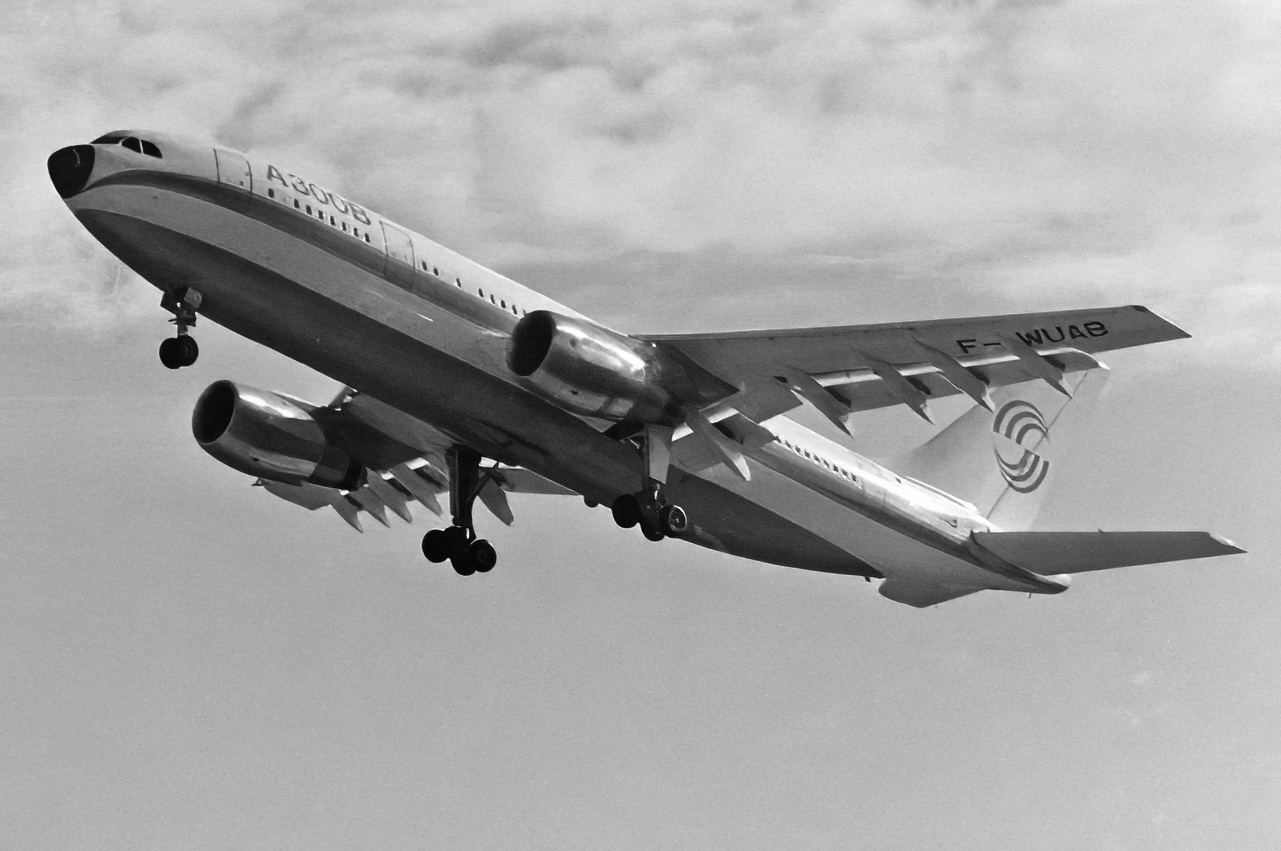
The first A300 made its maiden flight at Toulouse on 28 October 1972. Testing led to certification, and Air France inaugurated commercial service in May 1974. Operational introduction allowed the promised performance to be checked under an airline's everyday conditions. Sales nevertheless remained difficult at first: Airbus had to persuade carriers to adopt a new manufacturer and rely on its technical support. Establishing a network for spare parts, training and assistance was therefore as important as demonstrating the aircraft's qualities. The first deliveries did not immediately guarantee commercial success for a programme whose credibility also depended on providing lasting support to its operators and their engineering departments.
Eastern Air Lines' experience in the United States played an important part in this recognition. Following an evaluation period beginning in 1977, the airline ordered the aircraft in 1978. Distinguishing operational trials from the firm order helps clarify an episode often compressed into a single event. Other users in Europe, Asia and the Middle East subsequently expanded the type's presence. Missions included busy regional services, medium-distance international routes and, depending on the version, longer journeys. Cabin arrangements differed between airlines. The A300 should therefore not be associated with one passenger capacity or a single network model: its career reflected varied uses over several decades and across quite different airline markets.
The A300B2 and B4 were the principal early production versions. The A300-600 subsequently introduced changes to structure, systems and the flight deck, with the flight crew reduced to two pilots. Early versions, by contrast, carried a flight engineer: A300-600 characteristics should not be applied retrospectively to the entire family. The A310, developed as a separate aircraft, shared part of this technical and commercial history. Freight became increasingly important, with purpose-built versions and conversions of former passenger aircraft. The family also provided the basis for the A300-600ST Beluga, intended to carry large aircraft components, a mission clearly different from conventional commercial transport. These branches demonstrate both common origins and substantial differences in equipment and operation.
A300 production ended in 2007 after 561 aircraft. The end of deliveries did not mean the end of operations, particularly in freight, where specialist carriers maintained substantial fleets. Ageing airframes require appropriate inspections and maintenance programmes, as with any transport aircraft operated over a long period. The programme's legacy is twofold: it established Airbus as a commercial manufacturer and demonstrated the value of the widebody twinjet. Its original capabilities should nevertheless not be equated with those of later long-haul twinjets. The A300 belongs to a particular stage in that development, shaped by the engines, operating rules and network requirements of its own period rather than those of subsequent generations.
Why it mattered
- The A300 established Airbus in the commercial transport aircraft market.
- It introduced the widebody twinjet configuration into commercial service.
- Its freighter versions extended the use of the family beyond the end of production.
Where to see it
- Aeroscopia — Blagnac, FranceAn A300B4 (MSN 238) painted in the prototype’s colours.
Further reading
Sources
- Airbus — Our history
- Aeroscopia — Collections