Manufacturer
GE Aerospace
GE Aerospace develops civil and military aircraft engines rooted in the history of General Electric.
3 min read
Origins
General Electric, an American industrial group founded in the nineteenth century, entered aircraft propulsion during the First World War. In 1917, its engineers worked on a turbo-supercharger for piston engines, using exhaust gases to improve high-altitude performance. This work helped build expertise in turbines and heat-resistant materials. The history of GE Aerospace is therefore one of gradual development within a diversified group, rather than that of a company created under its present name.
After the Second World War, gas turbines became central to military and then commercial aviation. GE developed jet engines for US forces and contributed to the growth of the turbojet. The industry required extensive testing, precision manufacturing and close relationships with aircraft makers. Engines, accessories and in-service support formed a technical system in which reliability mattered as much as thrust.
Growth
The J47 was one of the post-war American jet engines manufactured in very large numbers. It powered military aircraft including the North American F-86, although that aircraft is not among this site’s entries. The later J79 powered several prominent military aircraft. These engines illustrate GE’s role in Cold War military programmes, where thrust, endurance and high-speed operation were major requirements.
Military experience was followed by the development of civil engines. The CF6 became an important widebody turbofan family and, depending on version and customer selection, powered aircraft such as the Airbus A300 and Boeing 747. It grew in an international market in which several engine makers competed for contracts while airlines and airframers assessed fuel use, availability, costs and worldwide support.
Major programmes
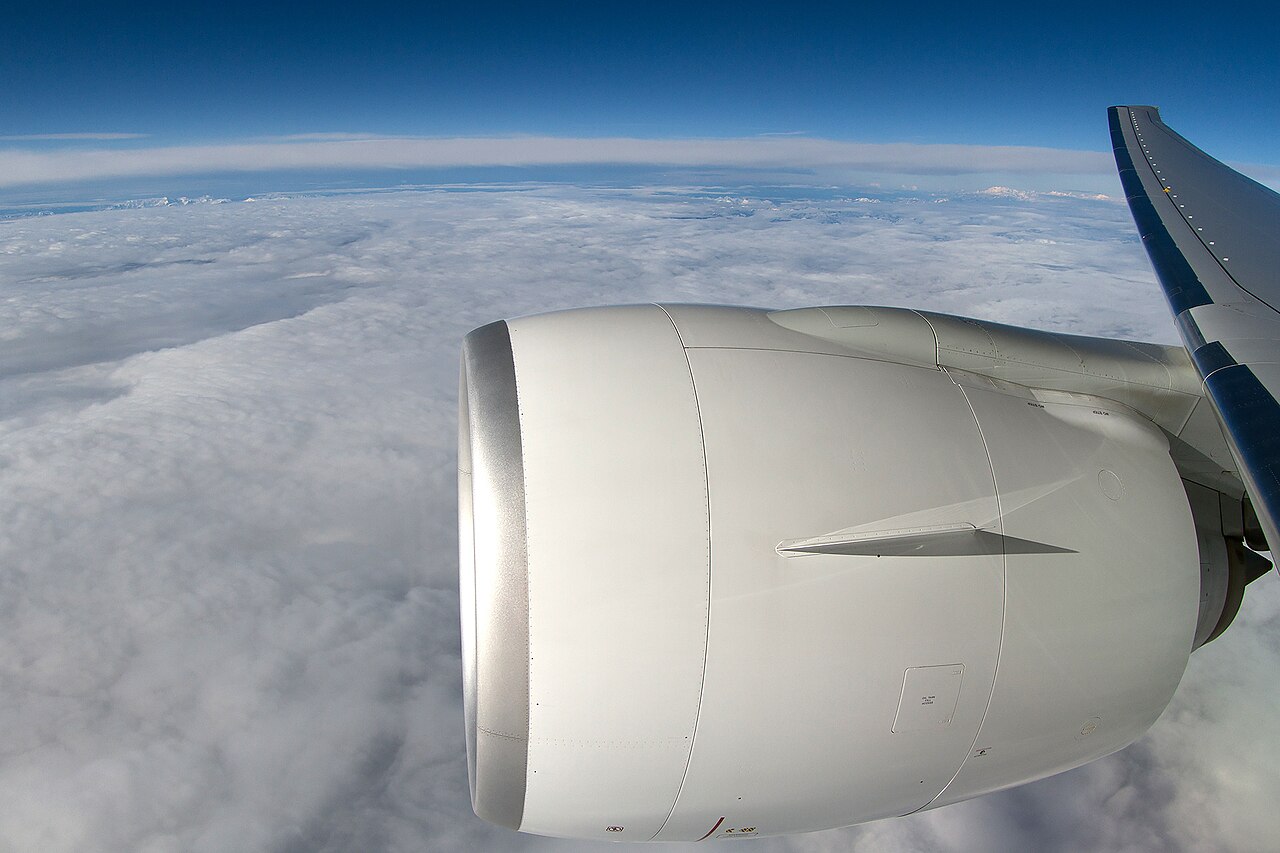
The GE90 was designed for a new generation of widebody airliners and became the exclusive engine for the Boeing 777 in several variants. Its large fan and turbofan architecture reflect the growing importance of cruise efficiency and high power for long-haul flights. The later GEnx was developed for the Boeing 787 and certain 747 versions. It incorporates material and design choices intended to reduce weight and fuel consumption, goals that still require validation and in-service monitoring.
The GE9X was developed for the Boeing 777X. The programme illustrates the duration and complexity of engine development: design, ground and flight testing, certification and industrialisation involve many teams. Engine choices must be integrated with the aircraft, and published performance depends on reference conditions. Industrial relationships can also involve international partners, as with CFM International, a GE–Safran joint venture distinct from GE Aerospace.
Mergers and acquisitions
For decades, GE’s aviation operations existed alongside businesses in energy, healthcare and industry. GE Aviation was the commonly used name for the engine business before the group’s reorganisation. In 2021, General Electric announced plans to separate its principal activities into distinct companies. This was a structural simplification, not the end of the aviation business’s programmes or industrial relationships.
The separation took effect in 2024, when GE Aerospace became an independent listed company, following the separate transactions involving GE HealthCare and GE Vernova. The new company retained engine, services and aerospace-systems activities. Military programmes remain subject to security and export-control rules, while civil engines are governed by certification and contracts with airframers and operators.
Today
GE Aerospace designs, manufactures and supports aircraft engines and related systems. In-service care includes inspections, repairs and a parts supply chain. Operators need technical data and maintenance networks to keep aircraft available, while airworthiness authorities govern modifications and repairs. These post-delivery activities are a lasting component of the engine makers’ business model.
The company continues work on engine efficiency and propulsion systems in a sector where environmental aims coexist with safety, cost and integration constraints. Results depend on flight cycle and aircraft configuration, so comparisons require stated conditions. GE Aerospace also works with Safran through CFM International. The propulsion feature outlines the general principles linking these programmes to the development of commercial aviation.
GE’s military portfolio also includes the F404 and F414 engine families for combat aircraft. The F404 has been associated with certain versions of the F/A-18, while the F414 powers later fighter variants. These programmes address requirements distinct from those of civil turbofans, including acceleration, afterburning and integration into tactical aircraft. Their place illustrates the coexistence of military and commercial markets in GE’s history.
GE Aerospace became the company’s name after the separation of the General Electric group. It followed the use of GE Aviation for the aerospace business before the reorganisation. In April 2024, GE Aerospace began operating as an independent company, while GE Vernova brought together the separated energy activities. This change of corporate structure and name did not erase existing engine programmes or support contracts with operators.
Notable aircraft
Other models
- J47
- J79
- CF6
- GE90
- GEnx
- GE9X
Sources
- Encyclopædia Britannica — History of flight
- Encyclopædia Britannica — GE Aerospace history
Related reading
Feature
From piston engine to turbofanAircraft
Boeing 787 DreamlinerAircraft
Airbus A300