Boeing 747
The first twin-aisle airliner, recognisable by its forward upper deck.
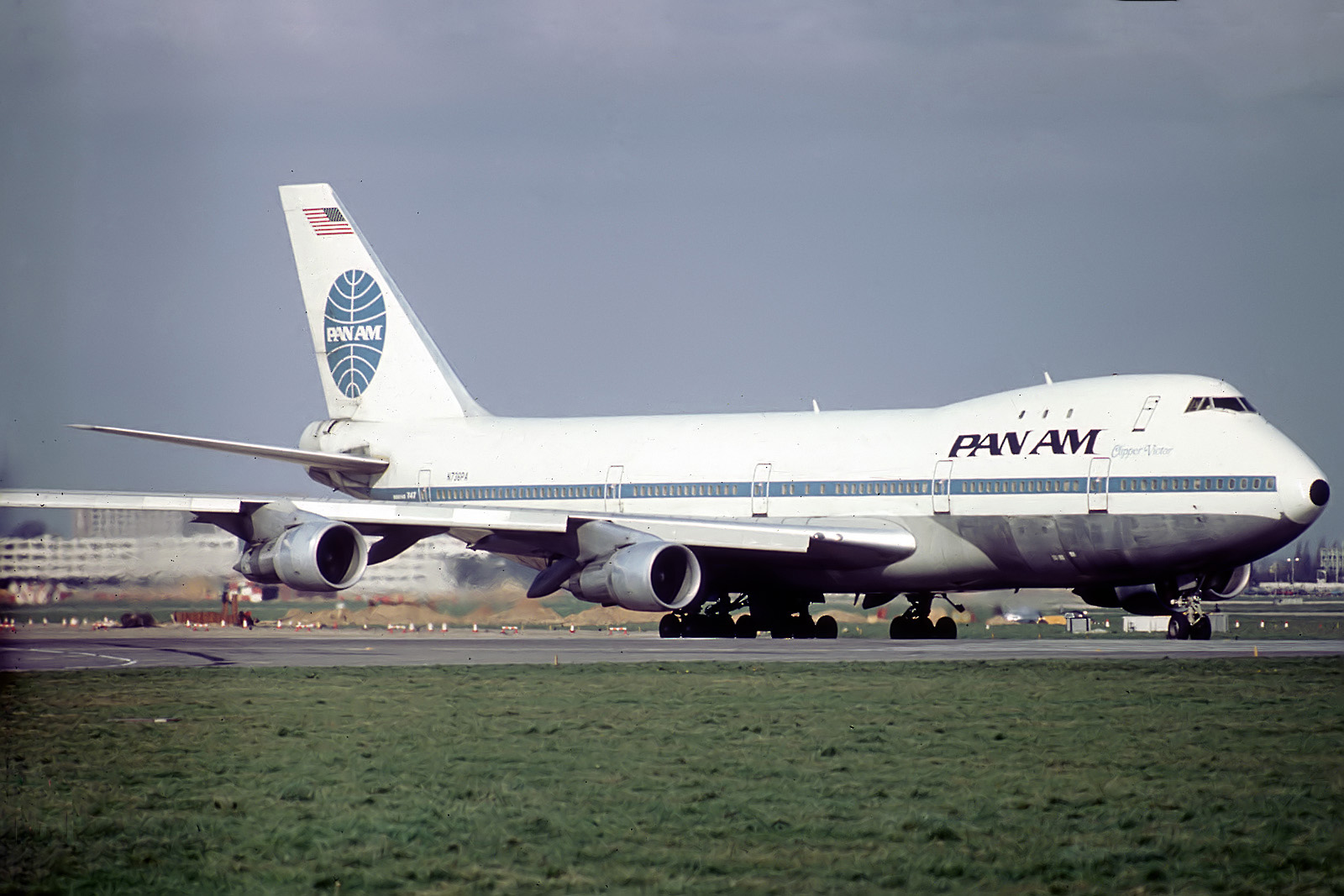
History
The Boeing 747 emerged during the 1960s, when traffic growth encouraged major airlines to seek greater capacity on busy routes. Pan American played a central part in defining the commercial project and placed an order accompanying its launch in 1966. Boeing had to design an aircraft much larger than the 707 while organising production at a new factory in Everett, Washington. The programme demanded substantial industrial investment. It also developed at a time when supersonic transport appeared likely to take part of the passenger market: the possibility of a freight career was therefore an important consideration. This combination shaped an aircraft intended to serve more than a single commercial role.
The wide fuselage accommodated two aisles, distinguishing the 747 from airliners then in service. The flight deck sat above the main deck; this arrangement allowed a nose opening to be provided on freight versions. The space behind the cockpit formed the characteristic upper deck. Four high-bypass turbofan engines supplied the thrust required for such a heavy airframe. The design also needed flight control systems and landing gear suited to its weight. The aircraft was consequently more than an enlarged fuselage: its development combined changes in propulsion, structure, cargo handling and airport organisation. These interacting requirements help explain the scale of the engineering effort behind its familiar external shape.
The first 747 made its maiden flight on 9 February 1969. A test programme supported development of the airframe and engines before operational introduction. Pan Am inaugurated commercial service in January 1970 between New York and London. Introduction was not free of technical difficulties, particularly involving the reliability of the early engines. Airports had to handle more travellers within a single aircraft movement, affecting gates, baggage processing and boarding. The capacity offered could reduce the cost per seat when enough seats were occupied, but it also increased the commercial risk of a poorly sold flight. Results therefore depended closely on the routes selected, rather than size alone guaranteeing an economic advantage.
The 747 became an important aircraft on the intercontinental networks of many airlines, including British Airways, Japan Airlines, Lufthansa and Singapore Airlines. Its use nevertheless extended beyond ocean crossings: in Japan, high-capacity versions also served heavily travelled domestic routes. Cabin layouts ranged from dense seating to arrangements featuring several classes and more generous spaces. Meanwhile, freight operators exploited its large volume and, on suitably equipped versions, nose loading. Aircraft also undertook government and scientific missions. NASA notably used modified 747s to carry space shuttles, in a role very different from airline transport. Such applications illustrate the distinction between the common airframe family and the equipment fitted for particular tasks.
The family included the 100, 200 and 300 series, together with the shortened 747SP, intended to extend range on particular missions. The 747-400 notably introduced a two-pilot flight deck and aerodynamic improvements; its winglets visually distinguished it from many earlier versions. The subsequent 747-8 received a stretched fuselage, a revised wing and newer engines, with passenger and freight variants. Capacities and dimensions therefore differed considerably between series. Mixed passenger-and-freight versions and conversions of passenger airframes added to this variety. They demonstrate how the available volume could be adapted to different markets throughout the life of a programme, rather than every aircraft retaining the cabin and mission of its original operator.
The final delivery took place in January 2023, following total production of 1,574 aircraft. This date marked the end of manufacturing, not the type's disappearance from commercial operations. Long-haul twinjets had gradually reduced its economic territory in passenger transport, while freight versions retained a distinct role. The historical assessment of the 747 consequently combines increased capacity on major routes with a lasting contribution to air cargo. It accompanied the expansion of international air travel without being its only cause. The prototype preserved at the Museum of Flight also recalls the experimental phase of a programme often known principally through several decades of airline service across the world.
Why it mattered
- The 747 introduced the twin-aisle fuselage into commercial service.
- Its capacity supported the growth of intercontinental transport.
- Its freight versions made a lasting contribution to air cargo.
Where to see it
- The Museum of Flight — Seattle, United StatesFirst 747 prototype.
Sources
- Boeing — History
- The Museum of Flight — Collections