Manufacturer
Rolls-Royce: aircraft engines
Rolls-Royce is a British engine manufacturer whose piston and later jet engines have powered major military and civil aircraft.
5 min read
Origins
Rolls-Royce began as a motor-car and engine manufacturer in the early twentieth century. Its aviation business took shape during the First World War, when Britain needed engines for military aircraft. The company’s first aircraft engine, the Eagle, was designed during the conflict. It subsequently developed piston engines alongside advances in metallurgy, cooling and supercharging. Engine design is an area in which choices of architecture, fuel, operating conditions and maintenance are closely connected.
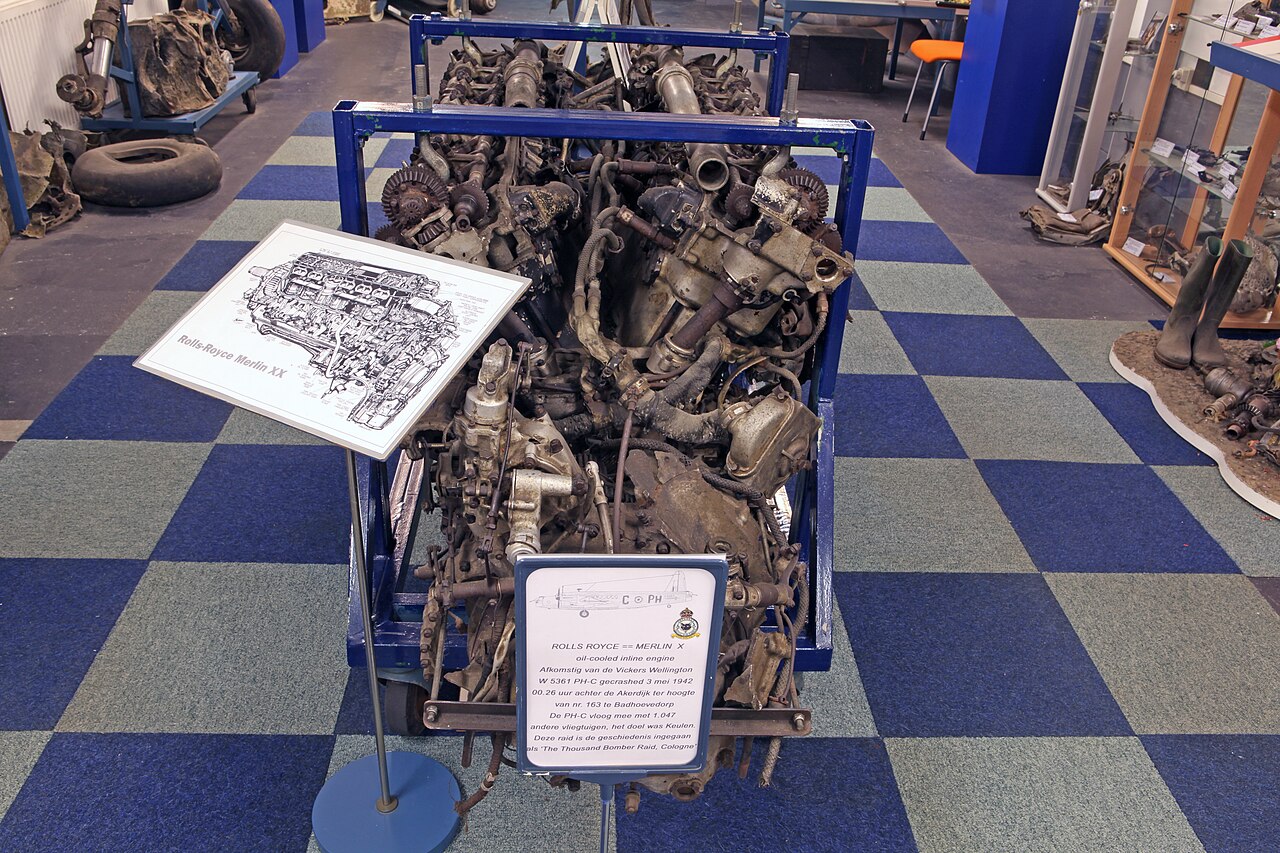
During the interwar years, Rolls-Royce developed several engine families and gained substantial experience through competition and military programmes. The Kestrel contributed to the company’s technical standing, while the Merlin, developed from the 1930s, became its best-known piston engine. British policy for engine development supported several companies, but design, production and installation in airframes remained distinct activities. An engine should therefore not be equated with the aircraft it powered.
The Second World War accelerated Merlin production and development. It powered the Supermarine Spitfire, among other Allied aircraft, and appeared in numerous versions. Successive adaptations addressed altitude, power and reliability requirements. Logistics, repair and licensed production in several countries also form part of its history. Experience with piston engines provided an industrial foundation, but did not remove the challenges of moving to jet propulsion.
Growth
After the war, Rolls-Royce invested in gas turbines and turbojets. The Welland powered the Gloster Meteor, Britain’s first operational jet aircraft, and the Derwent followed in that early generation. The Avon, first run in 1946 and entering service in 1951 on the Canberra, became an important engine family used on military and civil aircraft. These programmes demanded materials able to withstand high temperatures, precise manufacturing processes and a detailed understanding of rotational and fatigue stresses.
The Avon powered the de Havilland Comet 2, 3 and 4; the Comet 1, the first jet airliner to enter service, used de Havilland Ghost engines. Comet 1 accidents in the early 1950s revealed metal fatigue around openings in the pressurised fuselage. Investigations concerned the aircraft structure, not a failure attributed to the engine. This distinction matters: an aircraft programme’s history reflects interaction among airframe, propulsion, operations and maintenance. The Comet was subsequently redesigned, and the Avon family continued in service on other aircraft.
Rolls-Royce expanded into turboprops and engines for transport aircraft. The Dart powered airliners and regional transports, among other types. The company also participated in British and international military programmes, cooperating with airframe manufacturers and other engine firms. As aircraft became faster and heavier, propulsion had to balance thrust, fuel use, weight and service life. These trade-offs depended on mission and operating conditions rather than on a single measure of performance.
Major programmes
The Olympus programme illustrates the move into supersonic aircraft engines. The Olympus 593, produced jointly by Rolls-Royce and France’s Snecma, powered the Concorde. The companies brought their expertise to an Anglo-French programme in which supersonic flight imposed particular requirements for intake, combustion and thermal management. The engine could use afterburning during specified phases, including acceleration to supersonic flight. Its history is inseparable from Concorde’s, but industrial responsibility was shared.
The RB211 became a difficult turning point. Designed to meet the requirements of large transport aircraft, it introduced a three-shaft architecture; the Hyfil composite fan blades originally planned failed in testing, and production versions used titanium blades. The programme suffered cost overruns and severe financial problems. In 1971 Rolls-Royce went bankrupt and entered British receivership; the state nationalised the aero-engine business so it could continue. The car business was separated. The RB211 was eventually developed and delivered, then evolved into an engine family.
Later RB211 developments led to the Trent range, intended in particular for wide-body aircraft. Trent engines power different transport-aircraft versions, with variants adapted to each airframe’s requirements. Rolls-Royce supplied Trent engines for the Boeing 787 and Airbus A350, while other engine options power competing families. An aircraft manufacturer’s selection of an engine does not mean it powers every version. Long-term maintenance agreements have also increased the importance of in-service support in the industry’s business model.
Aircraft-engine development remains a long-cycle activity. Test-bed work, certification, operational reliability and repair are essential stages after design. Rolls-Royce has continued military, civil and defence programmes while relying on international partnerships. Development priorities include fuel consumption, emissions, noise and time between interventions, but any improvement must be demonstrated under applicable certification conditions. Propulsion is therefore both an engineering discipline and an industrial support activity.
Piston engines, turboprops and turbojets represent different architectures and applications. Rolls-Royce’s history is not a simple linear succession of models: several families coexisted, and licensing or cooperation agreements distributed production. Changes in corporate structure and business portfolios also affected programme management. A commercial designation alone does not always specify the differences in configuration, thrust or certification between variants.
Mergers and acquisitions
The 1971 bankruptcy led to the separation of the automotive and aerospace businesses. The nationalised aero-engine company was later returned to private ownership in 1987 as Rolls-Royce plc. This change did not erase expertise gained during public ownership or existing contractual commitments, but established a structure distinct from the company holding the car marque. Later mergers and acquisitions broadened turbine and systems capabilities while changing the group’s composition.
Rolls-Royce’s 1995 acquisition of Allison’s engine division strengthened its position in military and regional engines. The company has also formed partnerships with other groups and participated in joint ventures to share costs, risks and markets. Large civil engines are commonly developed in a competitive environment involving several suppliers and airframer-specific choices. Cooperation may cover design, component manufacturing or support without making partners interchangeable.
Rolls-Royce’s portfolio has changed through disposals and strategic shifts. The company has retained a major role in civil and military aircraft engines, as well as propulsion and power systems. Rolls-Royce plc should be distinguished from Rolls-Royce Motor Cars, which belongs to BMW, and from the Rolls-Royce name used under licence. This legal distinction avoids conflating two industrial histories that are now separate.
Today
Rolls-Royce plc continues to design, manufacture and support civil and military aircraft engines. Trent engines remain an important part of its civil business, alongside military ranges and related services. A growing part of the relationship with operators concerns maintenance, repair and availability management. Flight hours, operating conditions and airworthiness directives affect the monitoring of each engine; figures for a family do not necessarily describe every variant.
The company is also working on technologies intended to reduce environmental impacts and on new propulsion architectures. Tests and research announcements do not, by themselves, prove that an application is certified or in service. Development times and the need to demonstrate safety require a distinction between an objective, a demonstrator and an available product. Existing engines must meanwhile continue to meet operators’ reliability and maintenance requirements.
The engine maker’s history connects technical advances, financial crises and continuing market change. From Merlin to Trent, Rolls-Royce engines have powered different generations of aircraft, always through work involving engine makers, airframers, regulators and operators. Preserved aircraft and displayed engines allow the technical choices of their eras to be studied. Their conservation also reminds us that propulsion’s development depends on materials, processes and maintenance practices as well as an engine’s overall shape.
Notable aircraft
- Supermarine Spitfire
- de Havilland Comet
- Sud Aviation Caravelle
- Concorde
- Boeing 747
- Boeing 787 Dreamliner
- Airbus A350 XWB
- Airbus A380
Other models
- Merlin
- Avon
- Olympus 593
- RB211
- Trent 700
- Trent 1000
- Trent XWB
Sources
- Encyclopædia Britannica — History of flight
- Rolls-Royce — Our heritage
- Encyclopædia Britannica — Rolls-Royce plc
Related reading
Feature
From piston engine to turbofanAircraft
ConcordeAircraft
Supermarine Spitfire