Airbus A350 XWB
The Airbus A350 is a family of extensively composite long-haul twinjets that entered service in 2015.
History
The A350 emerged from changes in the long-haul market at the beginning of the twenty-first century. Airlines sought aircraft able to carry several hundred passengers over long distances while controlling fuel consumption and operating costs. Airbus initially studied a response related to the A330, then redefined the project around a new airframe. Presented in 2006 as the A350 XWB, meaning Extra Wide Body, the programme adopted a wider fuselage and a new wing. This decision committed the manufacturer to a separate development rather than a straightforward evolution of the existing model. It also responded to competition from the Boeing 787 and to the requirements of airlines operating widebody fleets.
The design makes extensive use of carbon-fibre composites in the fuselage and wings, alongside metallic alloys. Rolls-Royce Trent XWB engines were developed for the family. The wing and its control devices contribute to improved aerodynamic efficiency, while electronic flight controls continue an approach already established at Airbus. The cockpit retains principles shared with the manufacturer's other aircraft, helping to facilitate training pathways between types. The twin-aisle cabin is designed for long missions, but its arrangement, classes and seating capacity depend on the commercial decisions of each airline. Consequently, the same basic aircraft can provide different passenger environments without those differences representing a change in the underlying aircraft type.
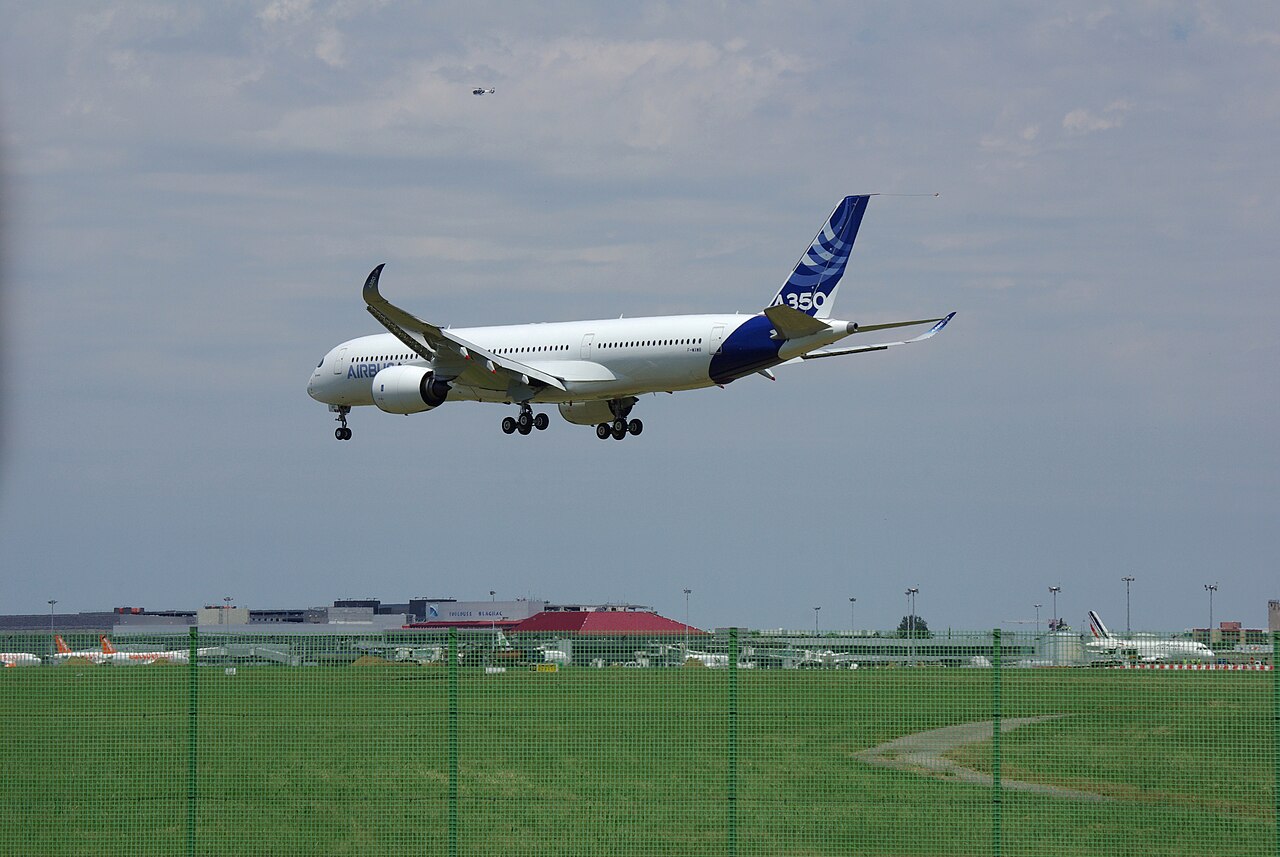
The first A350-900 flew at Toulouse on 14 June 2013. A flight-test campaign preceded European certification in September 2014 and delivery of the first aircraft to Qatar Airways in December. The first commercial service connected Doha with Frankfurt on 15 January 2015. These stages need to be distinguished: a maiden flight marks entry into flight testing, certification approves a defined type, and delivery does not necessarily mark the start of paying passenger operations. Introducing the aircraft also involved maintenance teams, pilots and cabin personnel. The programme thus moved from a group of instrumented prototypes to a transport aircraft used within a regular timetable and an established airline operating organisation.
The A350 subsequently joined airlines including Finnair, Singapore Airlines, Cathay Pacific, Lufthansa and Air France. These operators employ it on networks connecting Europe, Asia, the Americas and other regions, using cabin arrangements suited to their markets. Singapore Airlines notably uses an A350-900ULR version on nonstop services between Singapore and the United States. Such operations illustrate the importance of interior arrangements and operational preparation on very long missions. Available range alone does not define a route: crew rest, payload and the organisation of onboard service also belong to actual airline operation. A350 employment therefore covers distinct requirements within intercontinental transport rather than one uniform pattern shared by all of its operators.
The two principal passenger versions are the A350-900 and A350-1000. The latter has a stretched fuselage, a more powerful Trent XWB engine variant and adapted main landing gear, with six wheels on each main leg rather than four. Qatar Airways introduced the A350-1000 into service in 2018. The ULR version of the -900 addresses particularly long missions without becoming a new aircraft of different external dimensions. These distinctions matter when comparing capacities or performance: figures cannot be applied indiscriminately to every A350. Choices concerning seats, fuel and commercial payload also alter the practical employment of each aircraft within the family, even when the basic version designation remains the same.
The A350 belongs to the history of air transport in which twinjets perform a large share of intercontinental services. Its assessment is therefore not an account of retirement but of changes already visible: the spread of composites in widebody structures, engines adapted to lengthy missions and a family organised around different capacities. The programme also demonstrates the value of continuity with a manufacturer's other aircraft, particularly in training and flight procedures. Its historical interest lies in this combination of structural novelty and operational continuity. Services actually operated make it possible to describe its role without confusing established results with commercial announcements concerning other developments or with claims about aircraft that have not yet entered service.
Why it mattered
- The A350 combines a new, extensively composite airframe with Trent XWB engines.
- Its -900 and -1000 versions address different capacity requirements.
- The -900ULR version has enabled particularly long scheduled services between Singapore and the United States.
Where to see it
No example is known with certainty to be on display
Sources
- Airbus — Our history
- EASA — Type certificates
- Airbus — A350 Family