1990–2019
Globalisation and the digital age (1990–2019)
Liberalisation, global networks and digital design reshape aircraft, professions and the institutions of air transport.
5 min read
Historical context
Between 1990 and 2019, commercial aviation extended the widening access established during the preceding era, but changed its organisation. The disappearance of the Soviet bloc opened markets and reshaped European networks. In the European Union, liberalisation culminated in 1997 with the opening of cabotage to Community carriers. Airlines could now develop operations beyond their home country. Fares, frequencies and connecting services became more visible instruments of competition. This opening removed neither bilateral agreements with third countries, nor airport capacity constraints, nor differences between national markets. International flying remained an activity governed by permissions as well as commercial demand.
Low-cost airlines combined introductory fares, separately charged services, intensive aircraft utilisation and direct distribution. Their expansion changed leisure travel and some business journeys. Meanwhile, network carriers strengthened connections through their hubs, particularly in Europe, the Gulf and Asia. The attacks of 11 September 2001, epidemics and the financial crisis interrupted growth without removing the interdependence of economies. Air freight supported international production chains: its value lay less in the volume carried than in rapid delivery of components, perishable goods and urgent consignments. These different markets shared airports and airspace, but did not depend on exactly the same commercial cycles.
Technical advances
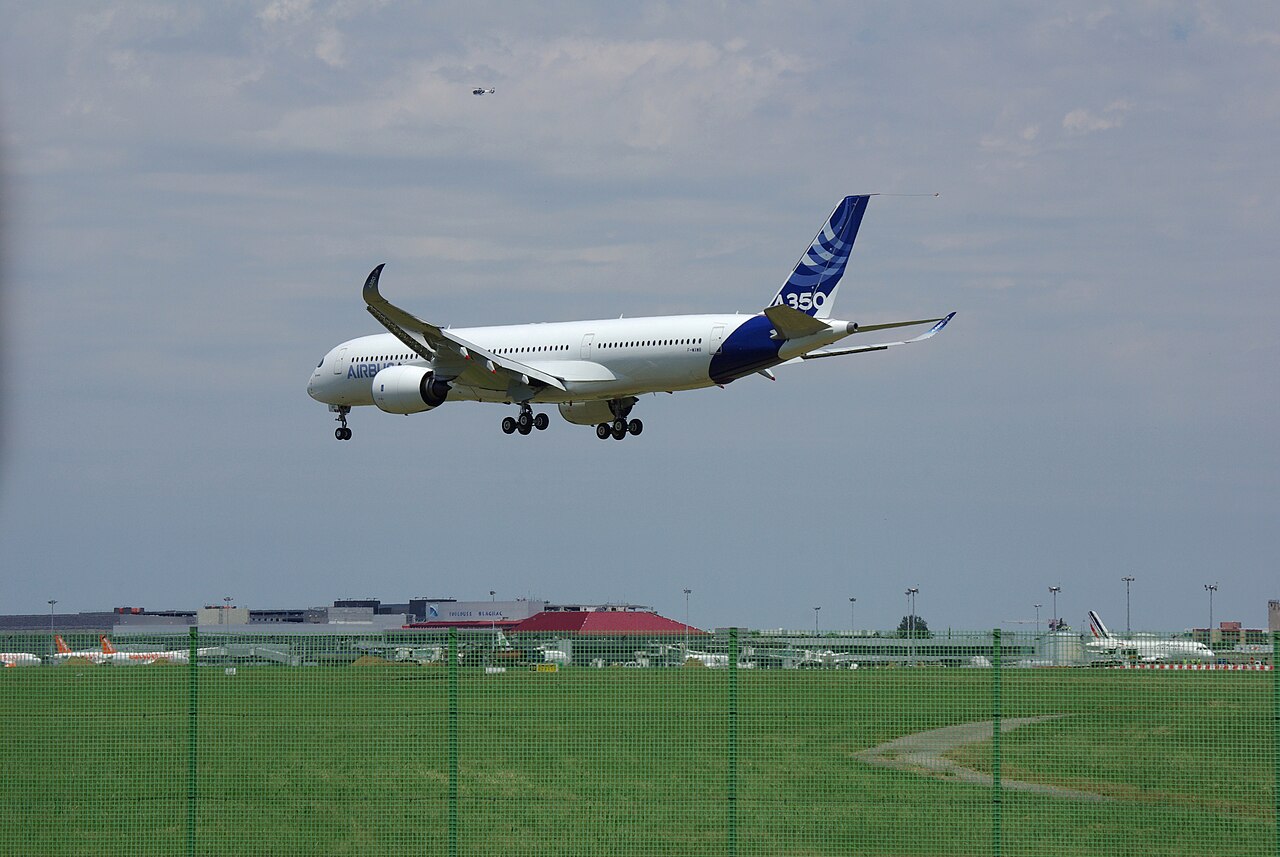
Digital design brought calculation, drawing and manufacturing closer together without eliminating physical testing. The Boeing 777 illustrated this development in the 1990s. Composites subsequently gained an important role in primary structures: the Boeing 787 flew on 15 December 2009 and the Airbus A350 on 14 June 2013. Weight savings came with new requirements for manufacture, lightning protection and repair. The A380, which first flew on 27 April 2005, entered service in 2007. Its two full-length decks addressed a different operating logic: concentrating large numbers of passengers on services between major hubs, where airport slots were particularly valuable.
Improvements in engines, aerodynamics and reliability favoured twinjets on long-distance routes. ETOPS approvals governed distance from diversion airfields; they were not simply a promise of mechanical robustness. Satellite navigation, collision-avoidance systems and ground-proximity warnings added layers of protection against accidents. However, the proliferation of automation changed flight crews' work. Understanding active modes, recognising erroneous information and retaining manual flying skills remained essential. The safety feature explains why equipment could replace neither training, nor procedures, nor organised operational feedback. Each innovation had to fit an existing system of people, operational practices and institutional responsibilities rather than work in isolation.
People
The history of this period cannot be reduced to aircraft manufacturers' executives. Pilots, controllers, cabin staff and ground teams operated increasingly dense networks. Technicians learned to diagnose electronic faults as well as inspect mechanical components. Qualifications and traceable interventions became particularly important when aircraft changed operator or work was entrusted to distant workshops. The maintenance feature explains this largely unseen activity. Cockpit cooperation and error reporting became explicit subjects of training in a profession where authority must not obstruct the circulation of information. Safe performance depended on everyday exchanges between specialists as much as on the capabilities of a new aircraft.
Individual careers nevertheless help explain technical choices. The legacy of Bernard Ziegler remained associated with Airbus fly-by-wire controls and debates over automatic protections. The position of women in aviation advanced without ending their underrepresentation in several technical and flying professions. In 2016, Bertrand Piccard and André Borschberg completed the staged round-the-world journey of Solar Impulse 2, powered by solar energy. The achievement depended on meteorology, engineering and operations teams. It demonstrated an experimental possibility, not the existence of an immediately available replacement for jet transport aircraft. Endurance, careful weather planning and limited payload were central to understanding what had actually been achieved.
Industry and airlines
Industrial consolidation reshaped balances inherited from the Cold War. Boeing absorbed McDonnell Douglas in 1997; Airbus became an integrated company in 2001. In the large commercial aircraft market, their competition concerned product families, operating costs and delivery schedules. It did not eliminate regional manufacturers: ATR aircraft, Embraer products and Bombardier aircraft occupied distinct segments. Suppliers expanded across several continents. Internationalisation distributed tasks and expertise, but also made programmes dependent on coordination between companies, component quality and timely deliveries. The location of final assembly therefore told only part of the story of how an aircraft was actually produced and supported throughout its life.
In July 2002, the establishment of EASA began a new stage of European regulatory integration. The agency progressively assumed certification responsibilities, while national authorities retained oversight and enforcement duties. Common rules for training, maintenance and airworthiness facilitated a transnational market without abolishing each participant's responsibilities. Among airlines, alliances, mergers and code sharing allowed networks to expand without operating every route directly. Internet booking changed distribution and price comparison. Behind a ticket sold under one brand there could therefore be several carriers and several passenger-handling systems. Commercial integration was not identical to operational integration, and responsibilities still had to be clearly identified.
Military aviation
Military aviation moved from confrontation between blocs to a variety of overseas engagements. The Gulf War of 1991 demonstrated the combination of reconnaissance, aerial refuelling, electronic warfare and guided weapons. Operations in the Balkans and subsequently Afghanistan and Iraq also showed dependence on bases, transport aircraft and surveillance assets. A weapon's precision guaranteed neither accurate intelligence nor the absence of civilian casualties. These conflicts showed that air power depended on logistical and political organisation rather than fighter performance alone. Supporting aircraft and ground personnel were essential to sustaining operations, even when public attention focused mainly on combat aircraft and their weapons.
In France, the Rafale progressively entered the armed forces in the early 2000s, undertaking air defence, attack and reconnaissance missions. The industrial legacy of Marcel Dassault now operated within an environment of international cooperation and competition. In the United States, stealth aircraft and remotely piloted aircraft gained a larger role in some operations. Remote piloting separated crews from the aircraft but did not remove operators, analysts and decision-making chains. Satellites and data links brought deployed units closer together while introducing additional technical dependencies. The language of networks thus spread through air forces as well as civil transport, although their purposes and operating constraints remained different.
Legacy
The commercial retirement of Concorde in 2003 marked a symbolic break. Supersonic speed had not become the ordinary model for intercontinental transport. Airlines more often prioritised capacity, range and cost per seat. Elsewhere in the network, the A320 and 737 demonstrated the importance of single-aisle aircraft produced in large numbers. Flying became familiar to a growing part of the world's population without becoming accessible to everyone. The contrast between that familiarity in some countries and the rarity of flying in others makes it impossible to equate the globalisation of networks with equal access to transport or equal opportunities to travel.
The balance therefore combined improved connectivity, safety advances and new vulnerabilities. Digital systems facilitated planning and maintenance but multiplied the interfaces requiring supervision. Fuel savings per aircraft were insufficient to describe the climate effects of expanding traffic. Noise, emissions and land use fuelled controversies around airports. At the turning point of 2019, these tensions joined questions of trust in certification and established, as existing historical problems rather than predictions, the themes of the following era. Aviation globalisation appears less as a completed condition than as a technical, economic and regulatory construction, dependent on institutions and workers as well as machines.
Milestones in this era
1992
Eurocopter is formed
12 June 1994
First flight of the Boeing 777
1 August 1997
Boeing and McDonnell Douglas merge
1999
Aérospatiale-Matra
10 July 2000
EADS is created
July 2002
EASA is established
2003
Concorde retired
27 April 2005
First flight of the Airbus A380
2007
The A380 enters service
15 December 2009
First flight of the Boeing 787
14 June 2013
First flight of the Airbus A350
2014
EADS becomes Airbus Group
2016
Solar Impulse 2 completes its round-the-world flight
2017
Airbus SE
July 2018
The CSeries becomes the Airbus A220
Sources
- EASA — The Agency
- EASA — Regulations
- OACI / ICAO — History of ICAO and the Chicago Convention
- NASA — NASA History
- Airbus — Our history
- Boeing — History
- Solar Impulse Foundation — Solar Impulse Foundation
- BEA — Bureau d'Enquêtes et d'Analyses