Boeing 737
A family of single-aisle twinjets developed through successive generations since the 1960s.
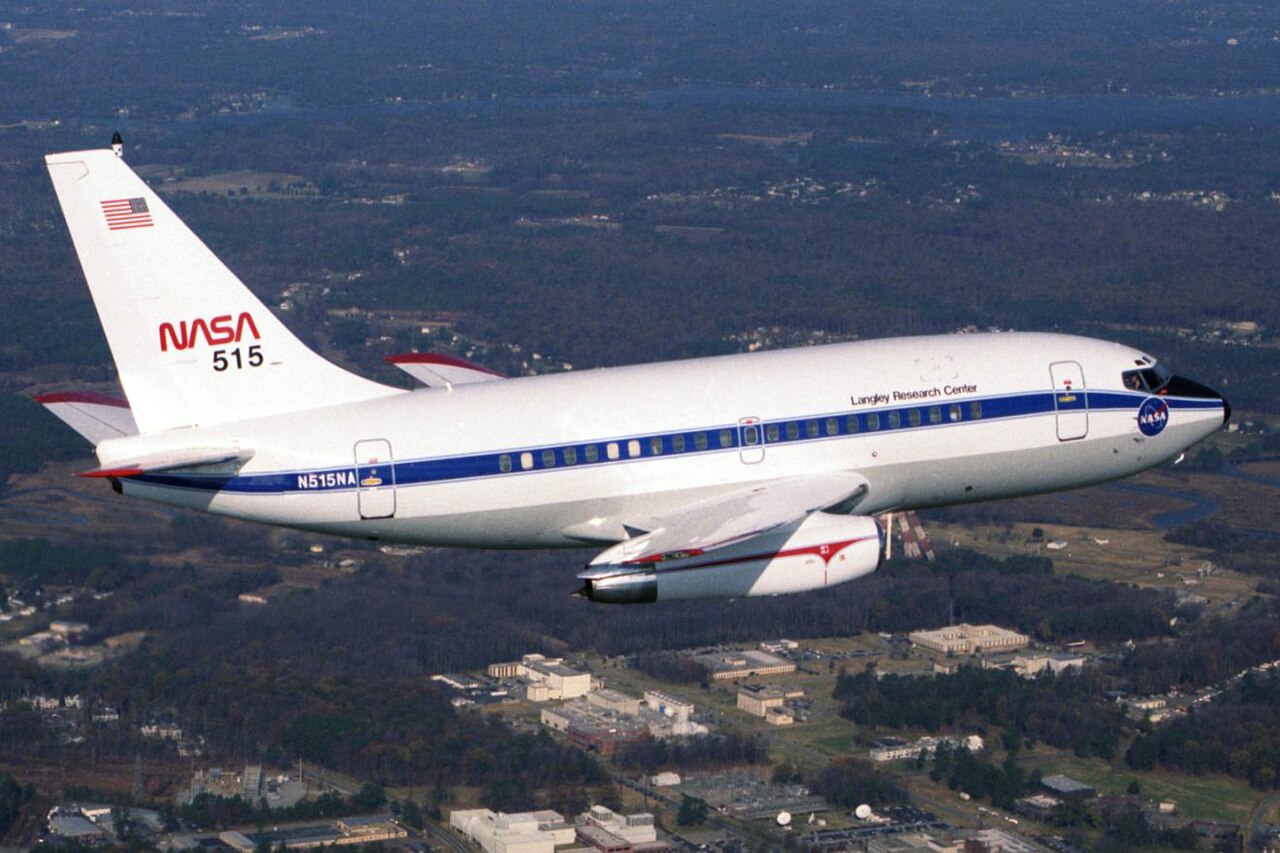
History
In the early 1960s, Boeing prepared a jet aircraft for shorter routes and smaller markets than those served by the 707. The 737 programme was launched in 1965, with Lufthansa as its launch customer. It complemented a range already including the 727, but adopted two engines instead of three. The project needed to accommodate frequent stops and the facilities available at the airports it would serve. Seeking industrial commonality with existing aircraft led Boeing to retain a fuselage cross-section allowing six seats abreast. The 737 consequently became the starting point for a family that would undergo several substantial technical renewals during its commercial career.
The configuration uses a low wing and two turbofan engines mounted beneath it, unlike the rear-mounted engines of the 727. The low fuselage height facilitates ground access to the cabin and baggage holds. It also imposes constraints when integrating larger-diameter engines in subsequent generations. The earliest aircraft used Pratt & Whitney JT8D engines. The flight deck was designed for two pilots. This broad architecture persists through the programme's evolution, but wings, engines, instrumentation and systems change sufficiently to require distinctions between generations rather than describing every 737 as the same aircraft. Continuity in the family name therefore should not be mistaken for an absence of technical change.
The first 737 flew on 9 April 1967. Lufthansa introduced the 737-100 into service in February 1968, while the stretched 737-200 joined operators including United Airlines. This initial expansion addressed different capacity requirements without abandoning the original model's general arrangement. The commercial career developed across domestic and regional networks and subsequently on international routes within the capabilities of the versions employed. Early aircraft possessed neither the engines nor the equipment of later generations. Their service-entry dates must therefore remain attached to the relevant models, rather than being assigned to the whole family as though its design had remained unchanged since the first flight in 1967.
Network airlines, leisure carriers and low-cost airlines have successively operated the 737. Southwest made it central to its fleet model, while Ryanair has made extensive use of later generations. The standardisation sought by airlines concerns training, spares, maintenance and operational organisation, without removing technical differences between series. Cabin arrangements vary between operators and markets. Some aircraft gain a second career carrying freight after conversion. This diversity explains the presence of the 737 in very different activities, from high-frequency passenger routes to cargo transport on specialised networks. Its operational history is therefore not limited to one airline business model or to one fixed seating arrangement across all operators.
The 737-300, 400 and 500, generally grouped under the Classic designation, received CFM56 engines. The Next Generation comprises the 600, 700, 800 and 900 and introduced, among other changes, a redesigned wing. The MAX adopted LEAP-1B engines and first flew in 2016 before entering service in 2017. In March 2019, 737 MAX aircraft were grounded after the crashes of Lion Air Flight 610 in October 2018 and Ethiopian Airlines Flight 302 in March 2019. This grounding concerned the MAX, not every 737 generation. Investigations and regulatory reviews identified issues including the MCAS system and led to changes in aircraft systems and pilot training requirements.
On 18 November 2020, the FAA rescinded its MAX grounding order while imposing conditions for return to service, including software changes and action concerning procedures, maintenance and training. Other authorities followed their own validation processes. This episode forms an integral part of the programme's history and must neither be confused with earlier generations nor separated from the evolution of certification. The 737 family has no single retirement date: older series are withdrawn according to operators' decisions. Its legacy combines continuity in a commercial aircraft architecture with the safety and oversight requirements accompanying its transformation, demonstrating why the history of a long-running programme includes regulatory developments as well as production milestones.
Why it mattered
- The 737 accompanies the development of short and medium-haul networks.
- Successive generations retain a general architecture while renewing engines and systems.
- The MAX grounding in 2019 after two accidents marks its regulatory and operational history.
Where to see it
- The Museum of Flight — Seattle, USAFirst Boeing 737 built.
Sources
- Boeing — History
- EASA — Type certificates
- Federal Aviation Administration — 737 MAX return to service — CAN-2020-24