Manufacturer
Boeing
Founded in Seattle, Boeing is an American manufacturer of civil, military and space aircraft and systems.
5 min read
Origins
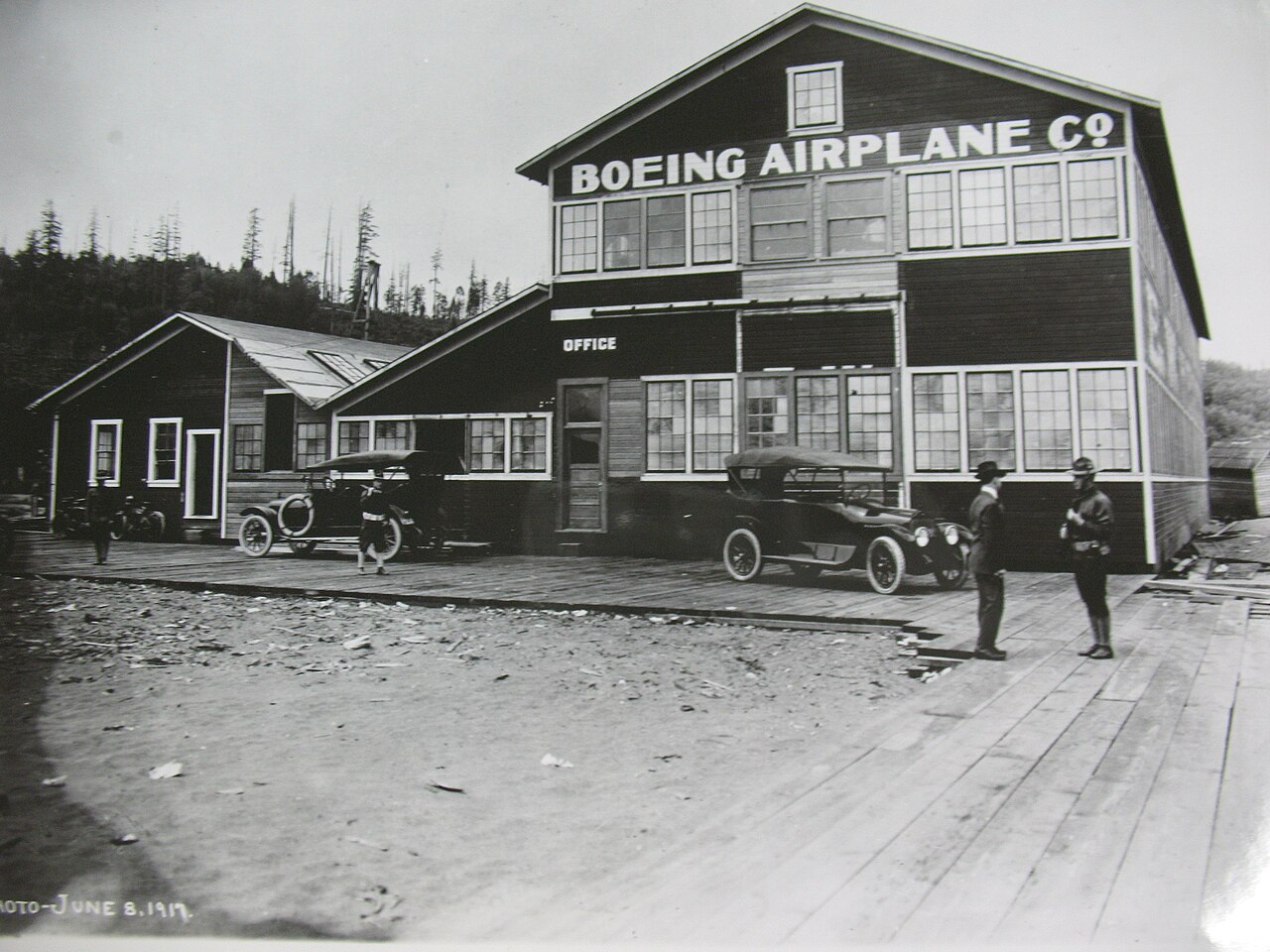
Seattle entrepreneur William E. Boeing designed his first seaplane (the B&W) with naval engineer George Conrad Westervelt, then founded Pacific Aero Products Co. on 15 July 1916. The B&W Seaplane was a wooden biplane flying boat designed for the emerging aviation industry of the north-western United States. In 1917 the company became the Boeing Airplane Company. Military demand during the First World War helped it get started, but the war’s end forced the manufacturer to seek other work and markets.
Between the wars, Boeing expanded into manufacturing, air transport and airmail. Its Model 40 helped carry mail within the American air-mail network. In 1929 the holding company United Aircraft and Transport Corporation brought together several aviation businesses. Antitrust legislation led to the separation of its activities in 1934, and Boeing again operated as an independent aircraft manufacturer. The reorganisation reflected the growing importance of public procurement, regulation and airlines in the industry. The growth of commercial aviation belongs to the interwar period.
The Model 247 entered service in 1933 with an all-metal structure, retractable landing gear and radial engines. It marked a step in modern airliner design, although it was built in limited numbers compared with the Douglas DC-3. During the Second World War Boeing built, among other aircraft, the B-17 and B-29 bombers. Military orders expanded its industrial capacity and workforce and helped establish large-scale production. The company also maintained engineering and research activities.
Growth
After 1945 Boeing applied experience from bomber programmes to civil and military projects. The B-47 Stratojet and then the B-52 introduced swept wings and jet propulsion to American strategic aviation. These efforts developed technologies useful to transport aircraft, although military and civil designs faced different requirements. Boeing also developed missiles and participated in US space programmes, extending its expertise beyond airliners.
The 707 prototype first flew in 1954, and the type entered commercial service in 1958. Boeing’s first major jetliner success helped make faster transcontinental and transatlantic travel more widely available. Its four-engine configuration and cabin design reflected airline requirements of the period. The 707 established a long line of jet transports, as the transition to the jet age changed airline networks and the economics of air travel.
Boeing broadened its range with the 727, a trijet suited to varied airports and routes, and then the 737, a narrow-body whose first flight took place in 1967. Successive 737 versions became a major commercial-aircraft programme. The 747, which first flew in 1969, was designed as a high-capacity wide-body. Its partial upper deck and wide fuselage accommodated more passengers and freight than earlier aircraft. Each programme generated numerous variants, with technical changes introduced over several decades.
Growth was not continuous. Launching the 747 required substantial investment, and fluctuations in orders exposed the company to cycles in air transport. Boeing nevertheless maintained a major presence in civil aircraft, military aircraft, helicopters and space activities. Its historic Seattle base remained central to engineering and production, while the group established sites and partnerships elsewhere in the United States and abroad.
Major programmes
From the 1990s, the 777 was designed for long-distance routes, combining two engines with substantial capacity. It entered service in 1995 and was Boeing’s first airliner with fly-by-wire controls. Its design involved extensive consultation with airlines and international supplier cooperation. The programme illustrates the shift towards twin-engine aircraft capable of serving routes once associated with four-engine types, within applicable diversion rules.
The 787 Dreamliner first flew in 2009 and entered service in 2011. It introduced an airframe made largely from composite materials and a systems architecture distinct from earlier generations. Its international supply chain and production of major sections in several countries required complex coordination. Development delays and production difficulties affected the programme. The 787-8, -9 and -10 variants offer different capacities and ranges. The programme is an example of the globalisation of the aerospace industry.
Boeing has also designed military aircraft, including patrol and transport types, and remains a supplier to NASA and the US Department of Defense. Its space division has taken part in launch-vehicle, satellite and human-spaceflight programmes. These activities have a complex organisational history, shaped by the integration of different companies and capabilities. Commercial and technical outcomes depend on engineering choices as well as certification, in-service support and relationships with public and private customers.
The 737 MAX crises, following two accidents in 2018 and 2019, led to the worldwide grounding of the model and reviews of certification and oversight. Authorities later lifted restrictions through their respective procedures. The case brought design safety, training, transparency and reporting culture into public debate. Investigation findings, regulatory decisions and subsequent measures should be distinguished as separate documented processes.
Mergers and acquisitions
Boeing merged with McDonnell Douglas in 1997. The transaction brought together two major American manufacturers with different histories and product portfolios. McDonnell Douglas contributed civil and military programmes, including the MD-11 and F/A-18 fighters. The combined company retained the Boeing name. The transaction reshaped the US aerospace industry, placing design, production, defence and services activities under one corporation. It was separate from Boeing’s 1996 acquisition of Rockwell Aerospace.
The corporate headquarters moved from Seattle to Chicago in 2001, and from Chicago to Arlington, Virginia, in 2022. These administrative moves did not relocate all industrial operations. Factories and engineering teams remained distributed across multiple sites, including the Seattle region. Executive offices, production activities and research centres should therefore be considered separately when describing the company’s geographical footprint.
The company has undergone governance changes and internal reorganisations, notably in the separation of commercial aircraft from defence, space and security. Acquisitions broadened some capabilities, but Boeing also relied on contracts, joint ventures and supplier networks. This reflects an industry in which major programmes involve many participants and expertise in software, electronics, engines and materials often comes from specialist partners.
Today
Boeing remains a major manufacturer in commercial aviation and defence, while its activities face sustained regulatory and public scrutiny. Aircraft certification, industrial quality and incident follow-up involve authorities, airlines and suppliers. Safety and production crises have reinforced oversight requirements and the need for accurate information. These are enduring concerns, not isolated episodes in the company’s history.
The civil range includes narrow-bodies and wide-bodies, with programmes from different generations operating concurrently. Customers select aircraft according to routes, capacity, operating costs, availability and regulatory requirements. Maintenance and in-service modifications are part of an aircraft’s life cycle, alongside crew training and parts availability. Industrial decisions also depend on engines and suppliers, and on the ability to maintain production rates without compromising quality.
Comparison with Airbus takes place in a global market where airlines often divide orders among manufacturers. The two groups have different institutional histories but face common constraints: safety, certification, decarbonisation and industrial continuity. For Boeing, Seattle’s legacy, the McDonnell Douglas merger and the headquarters moves describe distinct stages in a company whose operations are geographically dispersed.
Notable aircraft
Other models
- Boeing 247 (1933)
- Boeing 307 Stratoliner (1938)
- Boeing 727 (1963)
- Boeing 777 (1995)
Sources
- Boeing — History
- Encyclopædia Britannica — Boeing Company
Related reading
Aircraft
Boeing 747Aircraft
Boeing 787 DreamlinerFeature
Toulouse, aerospace capitalManufacturer
Airbus