Boeing 707
The Boeing 707 helps establish commercial jet services across major international networks.
History
The Boeing 707 emerged when commercial aviation was seeking to exploit jet engines. Britain's Comet had already opened that path, while Boeing possessed experience with large swept-wing military aircraft. In 1952 the company committed its own resources to a demonstrator, the Model 367-80, generally called the 'Dash 80'. It was intended to demonstrate the possibilities of a new generation of transports and attract both military customers and airlines. It flew in 1954. The production 707 developed from it but was not identical to the demonstrator: its fuselage and accommodation answered commercial requirements. Distinguishing the two aircraft is essential when dating the history of the airline model.
The aircraft adopted a swept wing and four engines mounted in pods beneath it. This arrangement separated the powerplants from the fuselage and became characteristic of many jet transports. The 707's pressurised cabin allowed six-abreast seating in economy class. Early aircraft received Pratt & Whitney turbojets; subsequent versions benefited from turbofan engines. The design also had to incorporate evacuation procedures, fuel management and equipment required for high-altitude flight. The flight deck retained a flight engineer, responsible in particular for monitoring and managing systems during the journey. The new propulsion system therefore changed operating conditions without removing the need for a specialised crew member dedicated to the aircraft's machinery.
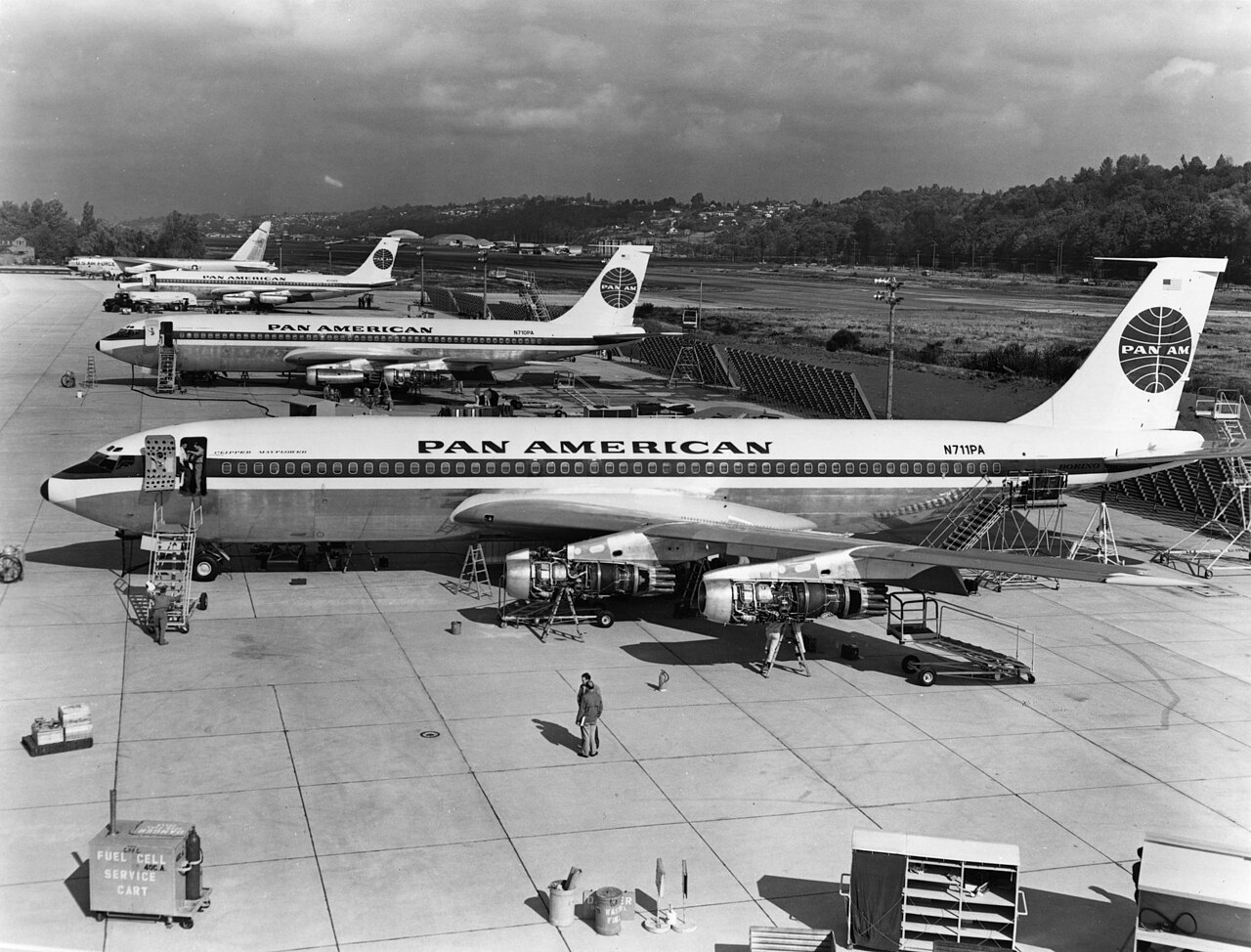
The first production 707 flew from Renton on 20 December 1957. That date, rather than the Dash 80's first flight, marks the commercial model's initial flight. Following testing and certification, Pan American opened its service on 26 October 1958 between New York and Paris, with a stop at Gander. Initial operations demonstrated the value of jet speed but also the range limitations of the earliest versions. Airlines had to prepare their personnel, facilities and maintenance methods. Introducing the aircraft consequently involved an entire transport system, from reservations to airport operations, rather than simply substituting one type of aeroplane for another on an unchanged timetable.
The 707 joined the fleets of airlines including Pan American, TWA, American Airlines, Air France and Qantas. Longer-range versions served major international routes, while other configurations answered continental requirements. Journey times fell compared with piston-powered four-engine aircraft, and commercial schedules were reorganised. Success did not depend on the aircraft alone: economic expansion, airports and sales networks also contributed to traffic growth. The Douglas DC-8 was a direct competitor. Together, these American transports accompanied a lasting transformation of the market, without making the 707 the first jet airliner. Its historical significance rests on its widespread adoption and operation, rather than on a claim to that earlier milestone.
The series included the 707-120 and 707-320 Intercontinental, which did not have identical dimensions or capabilities. Turbofan versions improved operating economics compared with the early turbojet models. The 707-320C could be configured to carry freight and had a door suited to that task. The Boeing 720 was a derivative intended for shorter missions. Airframes related to the 707 also provided the basis for specialised military aircraft, including the E-3 airborne surveillance aircraft. Despite sharing development ancestry through the Dash 80, the KC-135 is a separate family and should not be counted as an ordinary converted civilian 707. These distinctions matter when describing the type's production and applications.
As new aircraft arrived, airlines replaced their 707s on passenger services. More recent designs offered capacities, fuel consumption and noise levels better suited to changing markets and operating rules. Some 707s continued their careers in freight work and government or military missions. Commercial withdrawal therefore occurred at different times according to country and operator, rather than on one worldwide date. Preserved examples and manufacturer archives document the transition to networks dominated by jet propulsion. The type's legacy lies as much in its international operation as in the industrial and technical organisation needed to support a large commercial fleet. Its history connects aircraft design with the practical expansion of scheduled air travel.
Why it mattered
- The 707 expands commercial jet operation across international networks.
- Turbofan versions improve operating economics.
- The family provides a basis for specialised military platforms.
Where to see it
- The Museum of Flight — Seattle, USAVC-137B presidential Boeing 707, SAM 970.
Sources
- Boeing — History
- Smithsonian National Air and Space Museum — Collections
- Boeing — Boeing Marks 50th Anniversary of 707 First Flight