1939–1958
The Second World War and the jet (1939–1958)
From wartime mobilisation to the first jet services: innovation, reconstruction and shared rules transform aviation.
6 min read
Historical context
On 27 August 1939, the Heinkel He 178 made its first flight, a few days before war broke out in Europe. This demonstrator did not immediately transform operations: air forces fought mainly with propeller-driven aircraft. Drawing on interwar research, these machines became faster, more heavily armed and manufactured in large production runs. War mobilised factories, laboratories and subcontracting networks, but also displaced populations and coerced workers. The history of technical advances therefore cannot be separated from the destruction, forced labour and violence accompanying this industrial mobilisation. Aircraft production was part of a wider war economy whose human costs extended well beyond the battlefield.
After 1945, transport reconstruction took place in a world soon shaped by the Cold War. States retained a decisive role in airline financing, military procurement and the allocation of traffic rights. Signed on 7 December 1944, the Chicago Convention established the framework for international civil aviation; ICAO became a permanent organisation in 1947. It developed common standards without removing state sovereignty over national airspace. The restoration of services did not yet mean universal access to travel: fares remained high, and networks reflected older imperial connections as much as new economic exchanges. International cooperation and national commercial interests developed alongside one another.
Technical advances
The turbojet emerged from research pursued notably by Frank Whittle in Britain and Hans von Ohain in Germany. A compressor supplies a combustion chamber; the gases drive a turbine and then provide thrust through their exhaust. This arrangement makes it possible to move beyond the limitations of propellers at high speeds, but requires heat-resistant materials and precision manufacturing. Early engines consumed substantial fuel and had limited operating lives. The propulsion feature places this development within a longer history: piston engines and turboprops also continued to improve and find commercial applications. Jet propulsion was not an immediate replacement for every existing form of aircraft power.
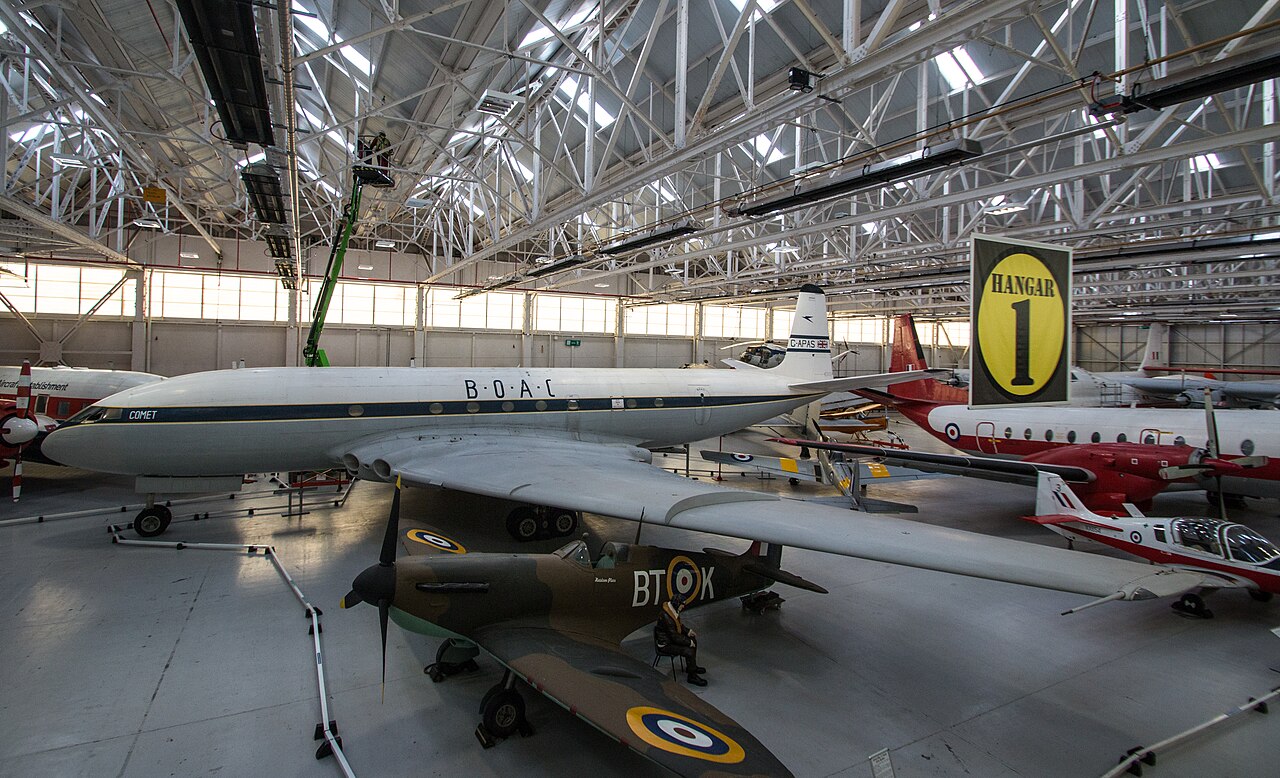
On 14 October 1947, Chuck Yeager exceeded the speed of sound in level flight aboard the rocket-powered Bell X-1. This experiment should not be confused with the arrival of supersonic passenger transport. For airliners, endurance, reliability and comfort at altitude were the priorities. The Comet flew on 27 July 1949 and entered service in 1952. Its in-flight breakups in 1954 led to investigations and extensive testing of fatigue, particularly under repeated pressurisation cycles. They demonstrated that static strength alone could not guarantee structural integrity throughout an aircraft's operating life. Repeated loading needed to be understood as a central design and inspection problem.
People
The public figures of flight testing reveal work that was fundamentally collective. Yeager relied on engineers, mechanics and instrumentation specialists who prepared the X-1 and interpreted its measurements. Wind tunnels, calculations and experimental flights complemented one another; no isolated achievement resolved every difficulty of the transonic regime. Pilots had to learn to recognise unfamiliar behaviour, while ground teams developed their monitoring methods. This organisation gradually turned testing into a documented process in which an anomaly had to be described and reproduced before a modification was accepted. Risk remained real, even when experiments were carefully prepared and supported by substantial resources. Public accounts of individual courage capture only part of that process.
In 1953, Jacqueline Cochran became the first woman to exceed the speed of sound. The career of Jacqueline Auriol, a test pilot and record holder, also illustrates women's entry into this predominantly male environment. The women and aviation feature nevertheless shows that celebrated careers did not amount to professional equality. During the war, women ferried aircraft and worked in factories without everywhere receiving the same status as men. In French industry, Marcel Dassault resumed work after returning from deportation. His career links industrial reconstruction with the design of military jets, including the Ouragan, which made its first flight in 1949.
Industry and airlines
Post-war commercial transport initially depended on propeller-driven aircraft. The DC-3 remained useful on regional routes, while the Constellation and Douglas DC-6 served longer journeys. Airlines organised intermediate stops, maintained spare-parts stocks and trained crews to operate more complex systems. Pressurisation allowed travel at higher altitudes, but did not remove the need for route preparation or attention to weather. Regular service therefore depended on an interconnected system of ground services, communications and airport facilities. The prestige of a new aircraft should not obscure this infrastructure, necessary to turn technical performance into an everyday service. Purchasing aircraft was only one element of building a dependable transport network.
In France, nationalised companies and private firms rebuilt design and production capabilities. At Toulouse, SNCASE developed the Caravelle, which first flew on 27 May 1955. Its two rear-mounted engines illustrated the adaptation of jet propulsion to medium distances, distinct from large intercontinental four-engine jets. Exchanges between airframe manufacturers, engine makers and equipment suppliers already crossed national borders. For airlines, ordering a jet also meant investing in runways, workshops and training. The transition was consequently gradual: for several years, piston aircraft, turboprops and jets coexisted in fleets serving different needs. Technical innovation had to be matched to operating costs and to the routes each airline could actually support.
Military aviation
During the Second World War, fighter operations, bombing, reconnaissance and transport became complementary activities within extensive military organisations. The Spitfire belonged to a defence system that also included radar, observers and ground control. Strategic bombing caused massive destruction and heavy civilian casualties; the atomic attacks of August 1945 opened another dimension of aerial warfare. A historical approach must distinguish an aircraft's technical capabilities from the political and operational decisions governing its use. It must also consider crews, logistics and production conditions rather than reduce campaigns to comparisons of performance. Aircraft acquired meaning through the organisations that deployed them and the consequences of the missions they undertook.
The Messerschmitt Me 262 entered service in 1944, but its performance could not compensate for shortages, maintenance difficulties and Germany's strategic situation. After the war, the United States and Soviet Union developed their own jet forces while also drawing on German knowledge and personnel. The Korean War brought combat between swept-wing fighters, notably the F-86 and MiG-15. Meanwhile, long-range bombers and aerial refuelling became elements of nuclear deterrence. The Mirage III, which first flew in 1956, belonged to this new generation of supersonic projects, although their development did not eliminate the constraints of maintenance and operation. Speed remained only one requirement among many.
Legacy
By the end of the period, the jet aircraft was no longer solely a military or experimental instrument. Its commercial use nevertheless depended on difficult lessons. The Comet accidents strengthened attention to structural testing, failure analysis and in-service monitoring. Aviation safety developed through rules, investigations and successive corrections, not through abstract confidence in progress. Maintenance became inseparable from design: inspections, operating limits and traceable interventions helped preserve safety margins. Accumulated experience also showed that an improvement in one area could shift problems to other systems and needed to be assessed as a whole. Reliable operation required continued attention after an aircraft had left the factory and entered an airline's fleet.
The transition to the age of mass air transport therefore rested on several legacies: turbine engines, aerodynamic research, regulatory cooperation and industrial organisation. In 1958, the Boeing 707 entered service, marking a further stage without making earlier technologies disappear. The boundary between these two eras is a reading guide rather than an instantaneous rupture. Improvements in speed shortened journeys, but the social spread of travel still depended on prices, incomes and rights of movement. Understanding these years consequently requires connecting the history of machines with that of institutions and populations, while retaining the memory of war's human costs. Technical continuity and political change must be considered together.
Milestones in this era
27 August 1939
First flight of a jet aircraft
1944
The Me 262, first jet fighter in service
7 December 1944
Chicago Convention, birth of ICAO
14 October 1947
The sound barrier is broken
27 July 1949
First flight of the Comet
2 May 1952
First jet airliner passenger service
August 1953
Jacqueline Auriol breaks the sound barrier
27 May 1955
First flight of the Caravelle
17 November 1956
First flight of the Dassault Mirage III
1957
Sud Aviation is formed
Sources
- OACI / ICAO — History of ICAO and the Chicago Convention
- IWM — Imperial War Museums
- Science Museum — Collections
- Smithsonian National Air and Space Museum — Collections
- NASA — NASA History
Related reading
Aircraft
de Havilland CometAircraft
Sud Aviation CaravelleFeature
Aviation safetyPioneer
Jacqueline AuriolEra
The golden age of air transport (1958–1990)