Bell X-1
In 1947 the Bell X-1 makes the first instrumentally established piloted supersonic flight in level flight.
History
The X-1 programme began during the Second World War, when rising aircraft speeds revealed the difficulties of the transonic region. Near the speed of sound, shock waves and changes in airflow could cause vibration, increased drag and reduced control effectiveness. Wind-tunnel data were insufficient to resolve every problem. American authorities therefore wanted a research aircraft capable of studying these conditions directly in flight. Bell worked with the air services and the National Advisory Committee for Aeronautics, or NACA. The aim was to obtain usable measurements, not immediately to develop a fighter for an operational unit. That experimental purpose determined the aircraft's unusual configuration and the organisation of its flights.
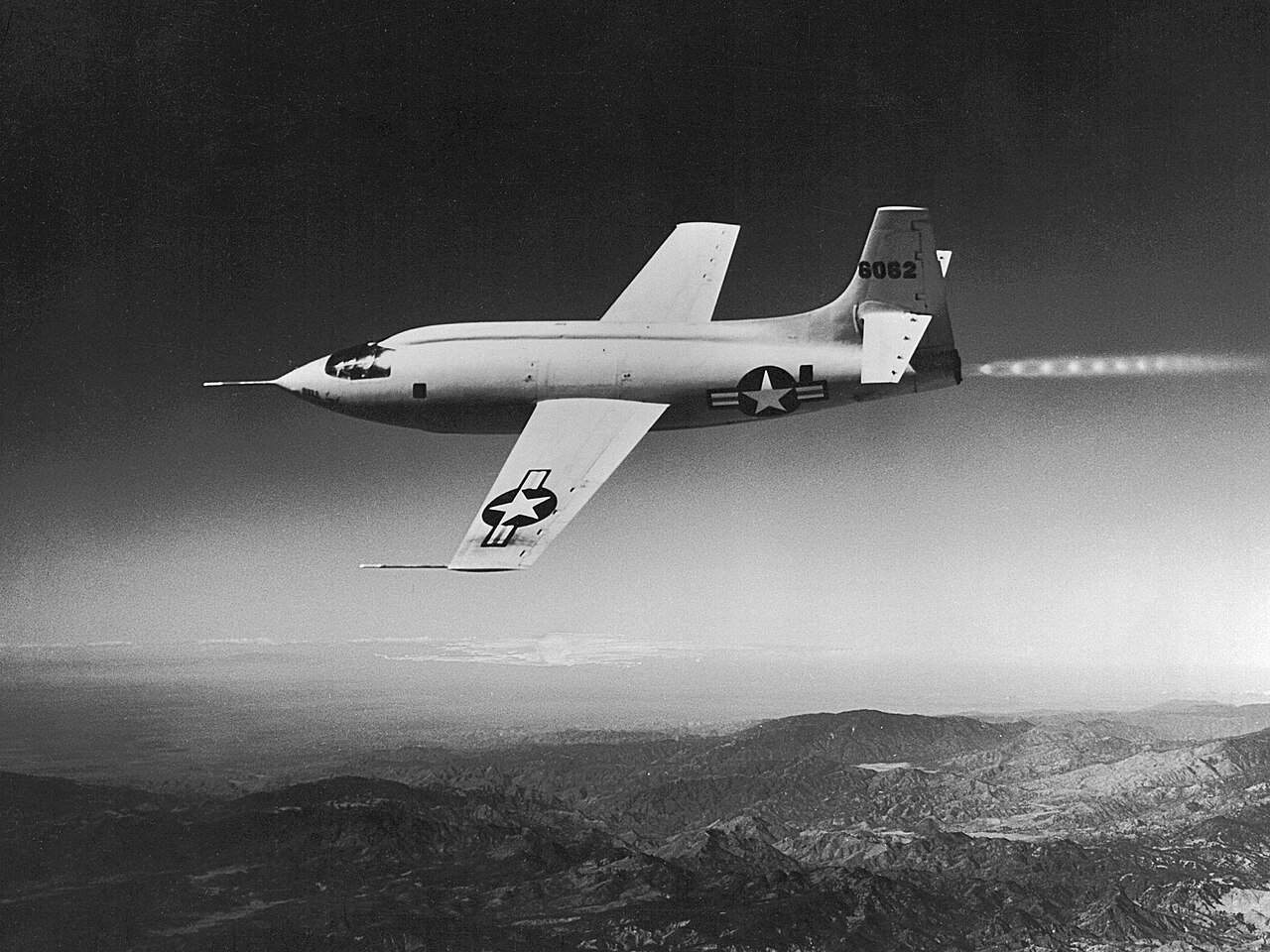
The X-1 received a compact fuselage inspired by a projectile's shape, thin wings and a four-chamber rocket engine. The engine used liquid oxygen and alcohol-based fuel; unlike a turbojet, its operation did not depend on outside air. Powered endurance remained brief. To conserve propellants and reach the initial test conditions, the aircraft was generally carried beneath a bomber and released at altitude. After its powered sequence, it returned as a glider. Measuring flight parameters, preparing the release and recovering the aircraft were consequently essential parts of every sortie, alongside flying itself. The carrier aircraft was therefore an integral element of the experimental system rather than merely a convenient means of transport.
The first glide flight took place on 25 January 1946, with Jack Woolams at the controls. Powered tests followed during the same year. The programme progressively increased speeds and examined control behaviour as Mach 1 approached. On 14 October 1947, Charles 'Chuck' Yeager flew the aircraft named 'Glamorous Glennis' above California. Released from a B-29, it reached Mach 1.06 in level flight. The event provided an instrumented demonstration of piloted supersonic flight in level conditions. This result rested on a progression of tests, instrumentation and ground-team work, rather than an isolated attempt without technical preparation. The celebrated flight belonged to a continuing research campaign with carefully developed procedures.
Use of the adjustable horizontal stabiliser played an important part in controlling the aircraft near the speed of sound. Tests allowed researchers to examine longitudinal control when compressibility effects changed the action of the elevators. Air service and NACA pilots, engineers and technicians continued flying to gather information about loads, stability and performance. The X-1 did not enter commercial or military service in the sense of a production aircraft assigned to routine missions. Its career consisted of successive experimental campaigns, whose results helped explain phenomena encountered by future high-speed aircraft and guide their development. Its achievements must therefore be understood as research results rather than as evidence of operational combat capability.
The programme extended beyond the aircraft flown in October 1947. Other airframes contributed to research, and several developments received the designations X-1A, X-1B, X-1D and X-1E. These aircraft differed in equipment, arrangements or the questions being investigated. The X-1E resulted from converting an early-series airframe, while other versions were separate developments. Work addressed subjects including higher speeds and aerodynamic heating. Accidents and technical difficulties demonstrated the risks involved in this research. It is consequently necessary to distinguish the history of the first X-1 from that of all the aircraft carrying related designations within the experimental programme. Their shared name does not imply identical configurations or interchangeable performance figures.
Yeager's aircraft was transferred to the Smithsonian in 1950 and preserved at the National Air and Space Museum. Its preservation connects a widely known date with the material realities of testing: a confined cockpit, brief powered endurance and dependence on a carrier aircraft. NACA research continued with other aircraft and methods, subsequently within NASA. The X-1 supplied data about crossing the transonic region and controlling an aircraft at high speed. Its legacy is not a universal answer to every difficulty of fast flight, but a measured and documented stage in expanding experimental aerodynamic knowledge. The surviving aircraft makes that distinction visible by preserving the actual machine used for the research.
Why it mattered
- The X-1 establishes through instrumentation the feasibility of piloted supersonic level flight.
- Testing documents longitudinal control in the transonic region.
- The programme brings together pilots, engineers and public research organisations.
Where to see it
- National Air and Space Museum — Washington, DCThe aircraft 'Glamorous Glennis' flown on 14 October 1947.
Sources
- Smithsonian National Air and Space Museum — Collections
- NASA — NASA History
- Smithsonian National Air and Space Museum — Chuck Yeager Broke the Sound Barrier in the Bell X-1