Dassault Mirage III
The Mirage III combines a delta wing and Atar engine in a widely exported family of supersonic fighters.
History
The Mirage III originated in French research during the 1950s into a lightweight interceptor. Authorities wanted to answer the improving performance of bombers while controlling fighter weight and cost. Dassault studied the MD 550, subsequently called Mirage I, combining a delta wing with two small jet engines. This initial arrangement revealed limitations and led to a reconsideration of both dimensions and propulsion. The Mirage III was a larger development powered by a single Atar engine. It retained the delta wing but represented a new stage in the search for an aircraft capable of supersonic interception. The shared name therefore covers an evolving project rather than one unchanged prototype.
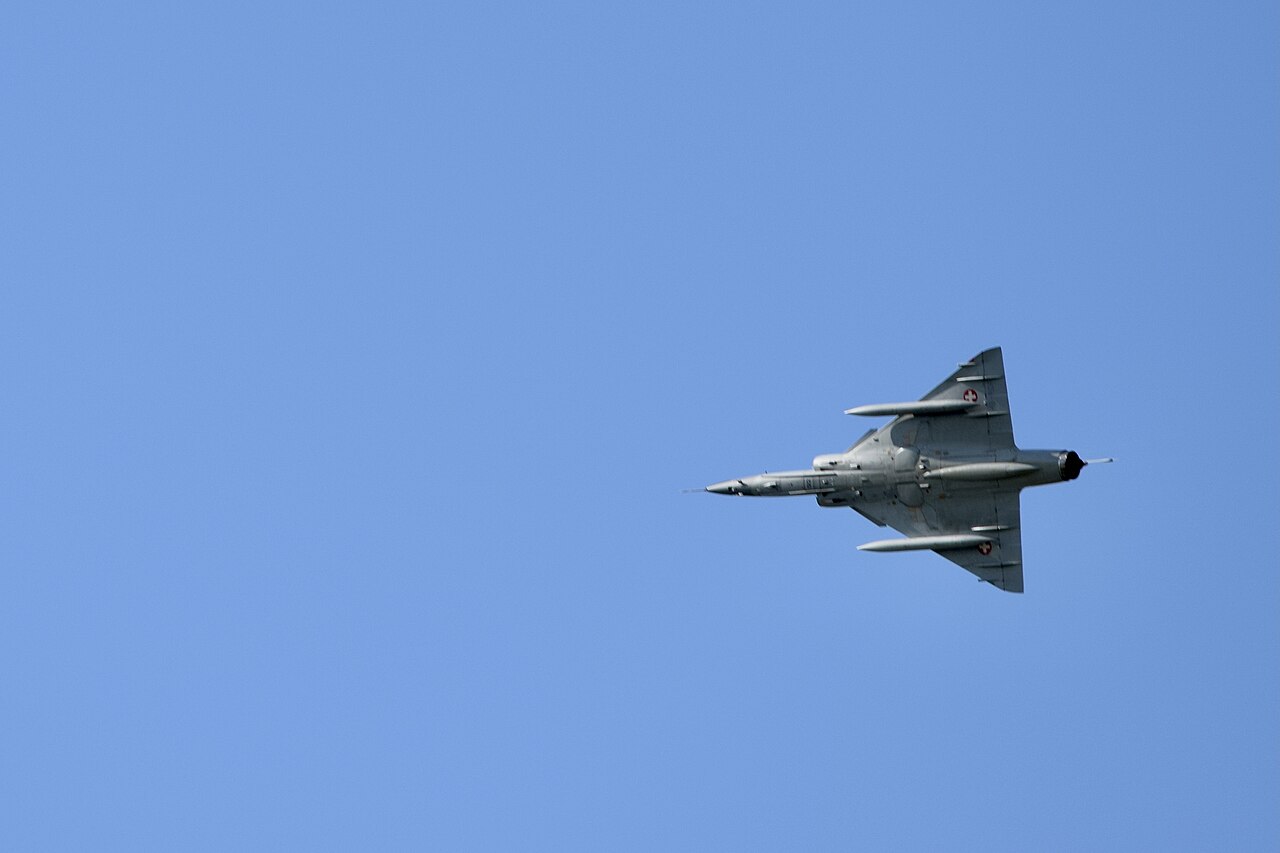
The triangular wing provided a structure suited to high speeds and useful volume for fuel. There was no separate horizontal tail: elevons performed the functions of elevators and ailerons. The fuselage incorporated the area rule to limit drag in the transonic region. The SNECMA Atar engine had an afterburner, and certain configurations could receive an auxiliary rocket intended to improve climb performance. These decisions had consequences for handling and operation, particularly at low speeds. Approach procedures and training had to account for the delta's particular characteristics, without confusing its advantages with an absence of constraints. High-speed capability and practical operation on an airfield remained connected design considerations.
The Mirage III prototype made its first flight on 17 November 1956, flown by Roland Glavany. Testing led to the Mirage III A pre-production aircraft and the exploration of speeds reaching Mach 2. This progression required work on propulsion, air intakes and equipment. The Mirage III C entered French Air Force service in 1961 as an interceptor. Its radar and armament formed part of an air-defence system that also included ground-based detection and guidance. Aircraft performance alone therefore does not describe an interception mission, which also depends on unit organisation and preparation. The operational introduction brought together the aircraft, trained personnel and supporting infrastructure.
The aircraft was adopted outside France by several air forces, including those of Israel, Switzerland, Australia and Pakistan. Contracts could include national adaptations or licensed manufacture. Israeli operations, including those during the 1967 war, made the type particularly visible, but its history cannot be reduced to a single conflict. Depending on user and version, it performed air defence, ground attack or reconnaissance. Engine maintenance, training and spare-parts availability shaped this career as much as published performance. Exporting the Mirage III consequently involved lasting industrial and technical relationships between the manufacturer, its partners and the operating forces. These arrangements differed among customers rather than following one universal pattern.
Variants answered distinct requirements. The Mirage III C emphasised interception, while the Mirage III E had a modified fuselage and equipment suited to more varied missions. Mirage III R and RD aircraft specialised in photographic reconnaissance, carrying cameras in the nose. Two-seat versions supported pilot conversion among other tasks and differed from single-seaters in their internal arrangements. The Mirage 5 extended the lineage with an initial emphasis on ground attack. These designations must be distinguished in production figures: a total combining Mirage III, Mirage 5 and Mirage 50 does not represent Mirage III manufacture alone. Family resemblance should not obscure differences in equipment, mission or the scope of numerical totals.
In France, the last aircraft of this lineage left operational units in the mid-1990s, with some continuing in test activities afterwards. Foreign withdrawals followed different schedules, and several users modernised their aircraft before replacement. Preserved examples allow museums to present the delta structure, reconnaissance equipment and differences between versions. The Mirage III occupies a place in French industrial history through the spread of its airframe and derivatives. Its legacy also includes methods of support and export cooperation. It illustrates how an aerodynamic configuration can be adapted to varied missions without making every aircraft in a family identical. Understanding that variety is essential to describing both its service history and its industrial significance.
Why it mattered
- The Mirage III established the delta configuration in a family of French Mach 2 fighters.
- Its variants cover interception, attack and reconnaissance.
- Its exports include adaptations and licensed production.
Where to see it
- Musée de l'Air et de l'Espace — Le Bourget, France
Sources
- Dassault Aviation — Histoire
- Musée de l'Air et de l'Espace — Collections
- Dassault Aviation — Mirage III: origins, characteristics and performance data