Manufacturer
Dassault Aviation
A French aircraft manufacturer descended from Marcel Bloch’s workshops, Dassault has developed civil and military aircraft, from early jets to the Mirage and Rafale programmes.
3 min read
Origins
Marcel Bloch, an engineer trained at the École supérieure d’aéronautique, worked on propeller design during the First World War. In 1929 he founded the Société des Avions Marcel Bloch, which designed and built aircraft in the interwar years. Its activity formed part of the growth of French civil and military aviation during the interwar period.
The firm expanded its activities and produced transport aircraft and bombers, among other types. The nationalisation of the French aircraft industry in 1936 transferred Bloch’s factories to state-owned companies, including the Société nationale de constructions aéronautiques du Sud-Ouest. Bloch retained design activities and continued working under conditions transformed by the war. The founder’s history is linked to Marcel Dassault.
Reconstruction and jet aircraft
After the Liberation, Marcel Bloch resumed private industrial activity. He adopted the name Marcel Dassault in 1949, and the company became Générale aéronautique Marcel Dassault. Its first major post-war success was the Ouragan, the first French jet aircraft to enter series production. It entered service with the French Air Force in 1952 and led to a family of faster, more capable fighters.
The Mystère aircraft, notably the Mystère IV, were developed in the 1950s and served with several air forces. These programmes established the company among Europe’s major combat-aircraft manufacturers. The transition from piston engines to the turbojet required new design and testing methods. The aircraft met national requirements amid rearmament and rapid change in military aviation.
Mirage and civil aviation
From the late 1950s, Dassault developed the Mirage aircraft, several delta-wing versions of which were exported and used in many countries. The Mirage III became a prominent member of the family, with an extensive operational career. The delta-wing design and integration of supersonic propulsion shaped later projects, including the Mirage 5 and Mirage 2000.
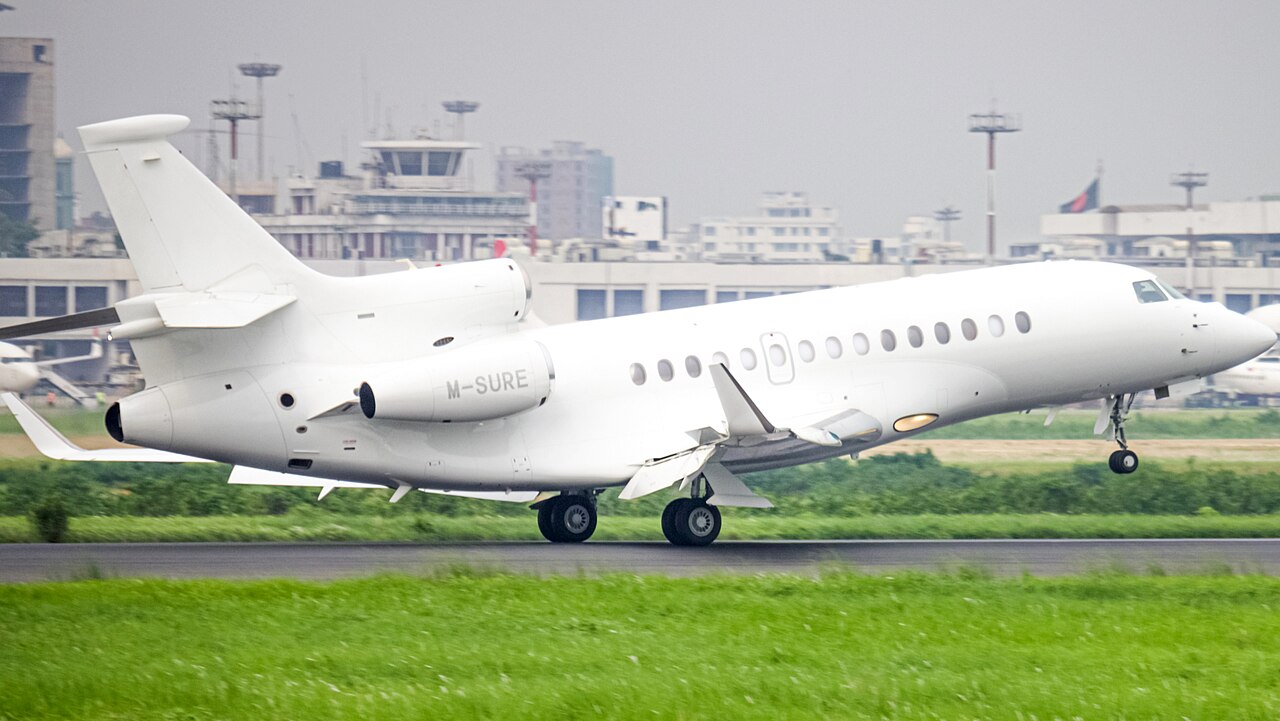
At the same time, the company entered business aviation with the Falcon range. The Falcon 20, which first flew in 1963, began a line of civil twinjets designed for business travel and specialised roles. The coexistence of civil and military activities became a lasting feature. Falcon aircraft follow a different design logic from fighters, emphasising range, cabin comfort and operation from a variety of airports.
The Mirage IV, a delta-wing bomber designed to carry France’s nuclear weapon, first flew in 1959 and entered service in 1964 with the Strategic Air Forces. In business aviation, the range later expanded to three-engined aircraft, beginning with the Falcon 50, designed for longer stages than the Falcon 20.
Mergers and later programmes
In 1971, the merger of Dassault and Breguet created Avions Marcel Dassault-Breguet Aviation, soon known as AMD-BA. The combination brought together French capabilities and programmes as European cooperation expanded. The company took part in national and international military programmes while continuing to develop business aircraft.
The Rafale was designed as a multirole combat aircraft intended to replace several types in French service. Dassault led the programme alongside industrial partners and government organisations. The aircraft first flew in 1986; first deliveries took place in 2001 (Navy), with operational service following in 2004 for the Navy and 2006 for the Air Force. The Rafale was subsequently exported. Its design allows one aircraft type to perform several missions, without removing the operational demands associated with each role.
Breguet brought with it the Breguet Atlantic maritime patrol aircraft and its share in the Jaguar, developed with BAC through the Anglo-French company SEPECAT. The swept-wing Mirage F1 was one of the combat aircraft families of the 1970s. The Mirage 2000, which first flew in 1978, returned to the delta wing and combined it with fly-by-wire flight controls; it was ordered by the French Air Force and by several foreign countries.
Activities and continuity
The name Dassault Aviation was adopted in 1990. The company retains two principal fields, combat aircraft and business aviation, and continues design, assembly and support activities. The Falcon range has evolved through successive generations, while military programmes involve sophisticated onboard systems and complex industrial supply chains.
The company’s history reflects changes in the French aircraft industry: partial nationalisation of production facilities in 1936, a return to private ownership after the war, and later industrial combinations and international cooperation. Its aircraft belong to a wider system involving manufacturers, suppliers, armed forces and certification authorities at different stages. Its milestones run from Marcel Bloch’s workshops to contemporary combat aircraft and business jets operated across several continents.
Notable aircraft
Other models
- Ouragan (1949)
- Mystère II (1954)
- Falcon 20 (1963)
- Mirage 2000 (1978)
Sources
- Dassault Aviation — Dassault Aviation
- Encyclopædia Britannica — Marcel Dassault
Related reading
Aircraft
Dassault Mirage IIIAircraft
Dassault RafaleManufacturer
AérospatialePioneer
Marcel Dassault