Dassault Rafale
A French combat aircraft family comprising land-based and carrier-based versions.
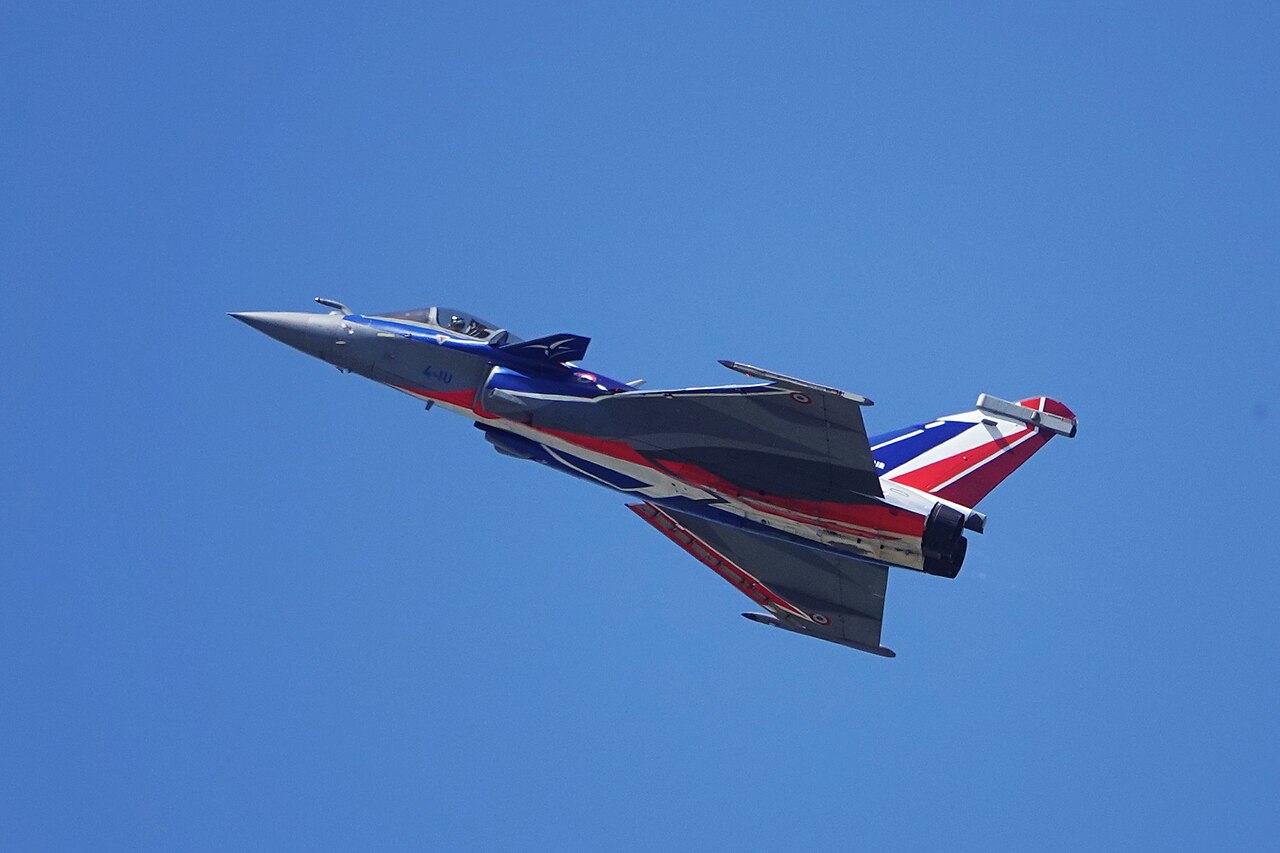
History
The Rafale originated in the renewal of French combat aircraft towards the end of the Cold War. Requirements concerned both the Air Force and the Navy, covering missions previously divided between several aircraft types. After European discussions failed to produce a common programme including France, the country continued along a national path. Dassault Aviation developed the Rafale A demonstrator to explore the project's aerodynamic and technical choices. This experimental aircraft must be distinguished from production machines: the year 1986 refers to the demonstrator's first flight, not to the fighter's operational availability within French forces. The shared name therefore covers separate stages in the development of the programme.
The configuration combines a delta wing with close-coupled canard foreplanes and fly-by-wire flight controls. Two jet engines provide propulsion. The Rafale A demonstrator used General Electric F404 engines, whereas production aircraft received Safran M88s. The weapon system combines radar, sensors, electronic warfare equipment and weapons integrated under successive standards. The design addresses several missions, including air defence, ground attack, reconnaissance and maritime attack. This versatility depends on specific equipment and clearances: it does not mean that every aircraft, at every date, automatically possesses all the capabilities developed during the programme. Describing a particular Rafale therefore requires identifying its version and the equipment standard applicable to it.
The Rafale A made its first flight on 4 July 1986. Prototypes representative of combat versions began flight testing in 1991. Development continued through test campaigns, engine development and systems integration. The Navy declared its first Rafale squadron operational in 2004; the Air Force brought its first squadron into operational service in 2006. These milestones should not be confused with earlier deliveries or evaluations. They demonstrate the interval separating an aerodynamic demonstrator from an aircraft system usable by an operational unit, complete with weapons, technical support and trained crews. The transition involved much more than reproducing the outward shape of the experimental aircraft in production form.
In French service, the Rafale operates from land bases and, in its M version, from the aircraft carrier Charles de Gaulle. It has participated in operations in Afghanistan, Libya and the Levant, in different contexts and configurations. Its career also includes air policing, presence missions and training. Export operators include Egypt, Qatar and India, subsequently joined by countries including Greece and Croatia. Countries that have signed orders must be distinguished from those that have actually received aircraft. Export aircraft do not necessarily reproduce every item of equipment or every mission assigned to French aircraft. Their operational history must consequently be considered within the requirements of each customer.
The family comprises the single-seat land-based Rafale C, the two-seat land-based Rafale B and the single-seat carrier-based Rafale M. The latter incorporates adaptations needed for catapult launches and arrested landings; it is not simply a land-based aircraft assigned to a ship. Successive standards expand the weapon system's capabilities. The early naval F1 standard concentrated on air defence, while subsequent developments added or expanded other functions. F3, F3-R and F4 represent distinct stages of integration and modernisation. Active-array radar and integrated weapons must therefore be associated with the relevant configurations rather than attributed retrospectively to the 1986 demonstrator or assumed to apply identically to every operational aircraft.
The Rafale has no general withdrawal date to assign to its historical record. Its history is traced through documented deliveries, upgrades and operational employment. The demonstrator and combat aircraft represent different phases that their shared name should not obscure. The programme's legacy lies in bringing land-based and carrier requirements together within a common family, alongside French development of its principal systems. It also shows that military aircraft versatility is built progressively through testing, software, equipment and clearances, rather than through airframe shape or a commercial designation alone. The relevant historical milestones consequently include the development of operational capabilities as well as the first flights of individual prototypes.
Why it mattered
- The programme brings land-based and carrier aviation requirements together in one family.
- Its capabilities develop through successive weapon-system standards.
- The demonstrator’s first flight in 1986 must be distinguished from combat aircraft entry into service.
Where to see it
- Musée de l'Air et de l'Espace — Le Bourget, FranceRafale A (prototype); not a production Rafale.
Sources
- Dassault Aviation — Histoire
- EASA — Type certificates
- Dassault Aviation — Rafale