1958–1990
The golden age of air transport (1958–1990)
Jets, widebodies and European cooperation expand air transport amid growth, crises and changing professional practices.
6 min read
Historical context
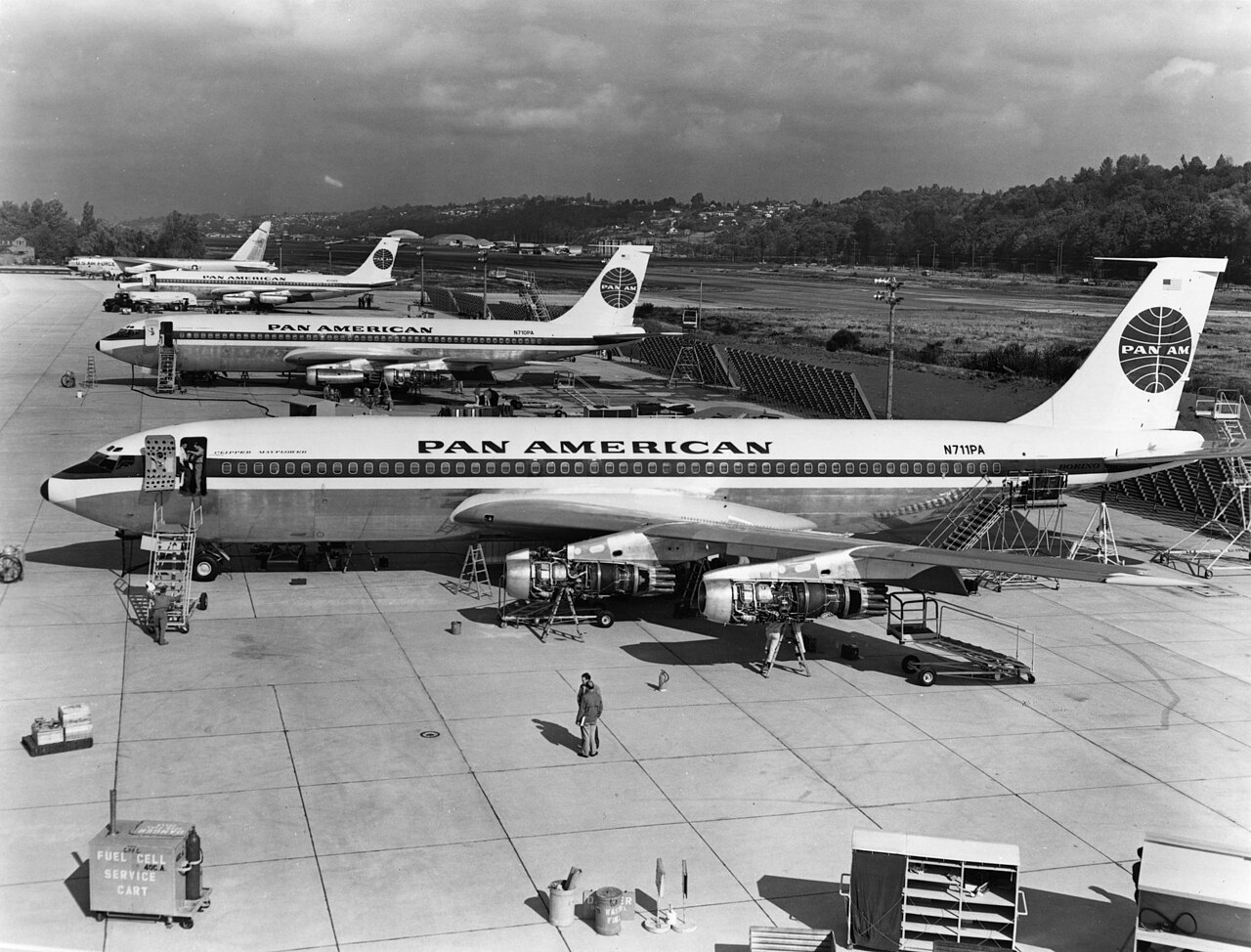
In 1958, the entry into service of the Boeing 707 illustrated the transition to extensive commercial jet operations. Air travel did not immediately become accessible to everyone: it remained closely related to income, business needs and relations between states. Yet increasing capacity and shorter journey times gradually changed travel practices. Package holidays, business trips and family visits sustained different markets. Airports expanded, while air routes increasingly connected economic centres. The name 'golden age' therefore describes a period of substantial expansion, not an experience equally favourable to every population or every airline. The benefits of mobility were unevenly distributed, even as flying became more familiar to a growing number of travellers.
This growth passed through crises. The oil shocks of the 1970s made fuel more expensive and strengthened interest in economical aircraft. In the United States, the 1978 deregulation act gradually transformed competition and fare-setting in the domestic market. Airlines reorganised networks around connecting hubs, although they did not all adopt precisely the same model. In Europe, market opening began more cautiously in the late 1980s. National frameworks and bilateral agreements continued to matter. The development of travel therefore belongs to an economic and political history, not merely to the succession of first flights shown in the milestones. Changes in regulation could alter the conditions under which technical advances became commercially useful.
Technical advances
The turbofan, particularly with a high bypass ratio, improved the propulsive efficiency of large subsonic aircraft. The Boeing 747, which flew on 9 February 1969, combined these engines with a high-capacity cabin. The Airbus A300, the first twin-engine widebody, made its first flight on 28 October 1972. Engine count alone is insufficient for comparing aircraft: weight, route distance, load factor and maintenance organisation all affect route economics. High-lift devices reconciled a wing suited to cruise with take-off and approach requirements. Progress resulted from a combination of choices rather than a single invention. Each design required compromises between aerodynamic performance, structural weight and the practical demands of airline service.
Two other paths reveal the diversity of research. Concorde flew on 2 March 1969, then opened commercial services on 21 January 1976. Its delta wing and propulsion enabled supersonic cruising, with particular constraints involving fuel consumption, noise and operation. By contrast, the A320, whose first flight took place on 22 February 1987, renewed the handling of a subsonic medium-haul airliner. Its digital fly-by-wire controls transmitted commands through computers and incorporated flight-envelope protections. Electronic displays reorganised the information available to crews; they removed neither the need for training nor the importance of understanding automation modes. These projects addressed different transport needs rather than representing consecutive steps towards a single ideal aircraft.
People
André Turcat and Brian Trubshaw personified the French and British sides of Concorde testing. Their work depended on teams measuring loads, investigating heating and preparing certification. The supersonic flight feature places their flights within this collective undertaking. At Airbus, Bernard Ziegler participated in testing and played an important role in adopting fly-by-wire controls. Introducing computers into the flight-control chain required dialogue between aerodynamicists, systems specialists and pilots. An innovation had to be explained, verified and translated into usable procedures. Disagreements about handling qualities or the presentation of warnings therefore belonged to development just as much as flight-test results. Engineering choices needed to account for how crews would actually use the aircraft.
Within airlines, occupations changed with the machines. Two-pilot flight decks spread on new aircraft, while flight engineers retained their place on many older models. Cabin crews performed safety and service duties in aircraft carrying more passengers. On the ground, technicians, airport staff and controllers contributed to the regular operation of larger systems. Women gradually gained access to more pilot positions at major airlines during the 1970s, following earlier precedents. The women and aviation feature highlights persistent obstacles to recruitment and career progression. Technical modernisation therefore did not automatically produce equal careers. The organisation of work, training opportunities and employment practices remained important parts of aviation history alongside the development of aircraft and engines.
Industry and airlines
Established in December 1970, Airbus Industrie organised cooperation between European partners around the A300. Industrial work-sharing connected several sites and relied on transporting large components to final assembly. Toulouse became a centre of this organisation without encompassing the entire programme. Public support, airline choices and the quality of after-sales service mattered as much as technical design. Competing with established American manufacturers, Airbus had to persuade customers that a new industrial organisation was viable. Cooperation did not remove national interests: it coordinated them around a shared product. This structure helped reshape competition in the airliner market. Commercial credibility depended on delivering aircraft and supporting their operation, not merely on demonstrating a promising prototype.
Fleets diversified according to their markets. The Boeing 737 met short- and medium-haul needs, while widebodies served dense corridors and many intercontinental routes. Regional aircraft retained a distinct place: the Franco-Italian ATR partnership developed a turboprop family, whose ATR 42 flew in 1984. A low cost per available seat was advantageous only when capacity matched demand. Airlines therefore balanced frequency, aircraft size and connecting opportunities. Their activities also included sales and reservations, which became increasingly computerised. The travel industry consequently brought together manufacturers, carriers, airports and commercial intermediaries whose interests did not always coincide. The success of an aircraft type depended partly on the wider network in which it was employed.
Military aviation
The Cold War sustained investment in speed, electronics and intervention capabilities. Supersonic fighters, including the Mirage III, combined high performance with increasingly important detection and weapons systems. Specialised reconnaissance aircraft such as the SR-71 met needs different from those of civil transport. Military development contributed to some shared knowledge, but constraints differed: a combat mission was not assessed by the same criteria as a scheduled commercial route. Conflicts also demonstrated the importance of helicopters, transport aircraft and aerial refuelling. The period's aviation history therefore cannot be reduced to an exclusive race for maximum speed. Operational effectiveness depended on systems, support and tactics as well as on the aircraft's individual performance.
Nuclear deterrence, surveillance and conventional operations shaped expensive fleets supported by bases and logistical networks. Onboard electronics transformed navigation and weapons employment; fly-by-wire controls also found military applications before spreading commercially. In France, the Rafale A demonstrator flew in 1986 and prepared a programme distinct from previous fighter generations. This demonstrator should not be confused with entry into operational service. Transfers between civil and military sectors remained selective: certification requirements, costs and operating conditions demanded adaptation. This distinction helps explain why a technology available in one field did not immediately become standard in every other. Similar technical principles could serve different purposes and require different levels of redundancy, testing and support.
Legacy
By the late 1980s, the commercial jet formed a mature system, though one still exposed to economic crises and accidents. ETOPS rules progressively extended certain twin-engine operations far from diversion airfields, under conditions concerning the aircraft, its maintenance and its operation. They were not simply a permission based on engine count. The safety feature also emphasises investigations and crew cooperation. Automation shifted some tasks towards monitoring and systems management. It provided new tools while requiring sustained attention to understanding information and coordinating people. Reliable airline operation continued to depend on organisational practices as well as equipment, and experience in service remained essential to identifying problems that design work alone could not eliminate.
The legacy of these decades was material and social: large airports, connecting networks, European industrial cooperation and broader access to long-distance travel. It also included noise, increased fuel consumption and persistent inequalities of access. Maintenance and infrastructure remained indispensable behind the image of travel becoming ordinary. The following era of globalisation extended transformations already underway rather than inventing them. Looking back to the emergence of the jet also reveals continuity in learning: gains in capacity and regularity depended on accumulated testing, rules and collective work. The assessment cannot be reduced either to Concorde's prestige or to the number of seats in widebody aircraft. Both belonged to a much wider transformation of mobility.
Milestones in this era
1958
The Boeing 707 enters service
22 December 1964
First flight of the Lockheed SR-71
April 1967
McDonnell Douglas is formed
9 April 1967
First flight of the Boeing 737
9 February 1969
First flight of the Boeing 747
2 March 1969
First flight of Concorde
1 January 1970
Aérospatiale is created
January 1970
The Boeing 747 enters service
18 December 1970
Airbus Industrie is formed
28 October 1972
First flight of the Airbus A300
May 1974
The A300 enters service with Air France
21 January 1976
Concorde enters commercial service
1977
British Aerospace is formed
16 August 1984
First flight of the ATR 42
4 July 1986
First flight of the Rafale A
22 February 1987
First flight of the Airbus A320
Sources
- OACI / ICAO — History of ICAO and the Chicago Convention
- Smithsonian National Air and Space Museum — Collections
- Musée de l'Air et de l'Espace — Collections
- Aeroscopia — Collections
- NASA — NASA History
- Airbus — Our history
- Boeing — History
Related reading
Aircraft
Boeing 747Aircraft
ConcordeAircraft
Airbus A300Pioneer
Bernard ZieglerFeature
From piston engine to turbofanEra
Globalisation and the digital age (1990–2019)