Feature
Toulouse, aerospace capital
From Montaudran to Blagnac, a history of factories, airmail and European cooperation, preserved at L'Envol des Pionniers and Aeroscopia.
5 min read
Montaudran: a factory before the route
Toulouse's aviation history did not begin with Airbus. During the First World War, Pierre-Georges Latécoère, an industrialist with a background in railway manufacturing, established a factory at Montaudran to fulfil military orders. In 1917, the site brought workshops and an airfield together: aircraft could be built, assembled and tested within a single complex. This physical proximity mattered. It gathered workers, mechanics, engineers and pilots around a manufacturing activity that required new skills. The city therefore acquired an aviation industry before becoming a centre for air transport.
The end of the war raised the question of civilian markets. Latécoère envisaged a mail connection to Spain, Africa and South America. On 25 December 1918, he travelled from Toulouse to Barcelona in an aircraft flown by René Cornemont. This reconnaissance flight was not yet a regular service extending to Buenos Aires. It began a process involving negotiations, trials and successive improvements to ground facilities. The Aéropostale emerged from this gradual construction, rather than from a founding flight that immediately connected the two continents.
The city at the start of the mail route
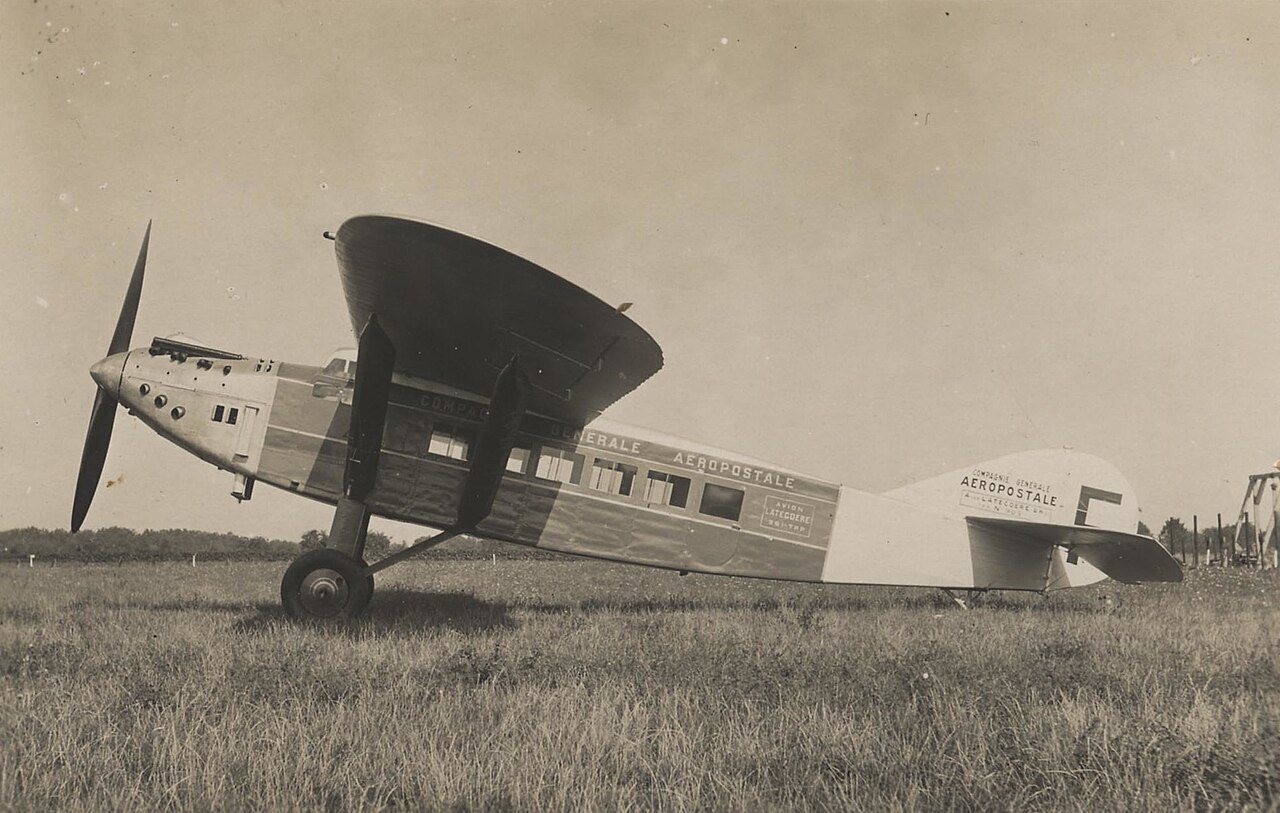
During the interwar years, Montaudran became a departure and maintenance base for the mail route. Aircraft followed Mediterranean and then African stages, while the workshops repaired airframes and engines. Reliability depended on tasks less visible than flying: preparing aircraft, sorting bags, supplying stations and passing on weather information. Didier Daurat organised operations with a discipline that left a lasting mark on the teams. Toulouse therefore belonged to a network of complementary places; its role cannot be understood without the overseas stations that made each successive stage possible.
The careers of Jean Mermoz and Antoine de Saint-Exupéry gave this history a human and literary dimension. The Latécoère 28 also illustrates the technical adaptations required for mail transport and early transatlantic connections. Yet remembrance of the pilots should not obscure ground personnel or the company's economic constraints. After the routes were incorporated into Air France in 1933, Montaudran retained an aviation role. Its airfield and buildings embedded this continuity in the urban landscape, extending well beyond the celebrated pioneering years of the mail service.
From nationalisation to the Caravelle
Toulouse's industry did not follow a single legal line of descent. Companies, factories and teams were reshaped by orders and reorganisations. The nationalisations of 1936 contributed to the formation of regional aircraft manufacturing companies. After the Second World War, Toulouse acquired an important place in French civil programmes. Sud Aviation, formed in 1957 through the merger of SNCASE and SNCASO, brought several of these legacies together. This industrial history must be distinguished from that of the airlines: building an aircraft and operating a route were different businesses, even when they served closely related purposes.
The Caravelle embodied the transition to jet transport. Its prototype first flew at Toulouse on 27 May 1955, before Sud Aviation was created. Rear-mounted engines left the wings clear and changed the cabin experience. The aircraft entered commercial service in 1959. Its development involved design offices, testing teams, workshops and sustained relationships with customer airlines. In the history of the jet age, Toulouse thus became a place where design, production and development testing came together around aircraft intended for an international market rather than solely for domestic requirements.
Concorde: Toulouse within a partnership
The Franco-British agreement of 1962 committed the two countries to the Concorde programme. Work was shared among manufacturers, engine companies and establishments on both sides of the Channel; Toulouse was not its only centre. It nevertheless hosted assembly of the French prototype and a major part of the testing. On 2 March 1969, Concorde 001 took off from Toulouse with André Turcat at the controls. This first flight was one stage in a lengthy development process: demonstrating that an aircraft could fly did not establish its suitability for scheduled passenger transport.
Tests examined behaviour at different speeds, systems and operating procedures. Supersonic transport imposed particular compromises between performance, fuel consumption, noise and operating conditions. Commercial service began in 1976. Concorde gave Toulouse international visibility, but its history cannot be reduced to an isolated technical achievement: it also depended on public decisions, finance and accessible markets. This experience of cooperation formed part of the European context in which Airbus emerged, although the two programmes should not be confused in their objectives or organisation. Their commercial circumstances were also distinctly different.
Airbus: a centre within a European system
The A300 launch agreement was signed in 1969; Airbus Industrie was established in 1970, the year Aérospatiale was created. The first A300 flew at Toulouse on 28 October 1972. This widebody twinjet represented an industrial choice different from Concorde's: meeting airline demand on busy routes. Final assembly in Toulouse depended on major sections manufactured elsewhere in Europe. The city therefore did not produce the aircraft alone; it hosted an integration stage within a production chain spread across several countries, requiring shared standards of quality and coordination between distant factories and their specialist teams.
The A320, which first flew in 1987, extended this history through electrical flight controls and a new cockpit concept. Bernard Ziegler was among those involved in this transformation. The A380 and A350 programmes continued Toulouse's assembly and testing role, following different schedules and serving different markets. The activity also involved suppliers, research, training and maintenance. Calling Toulouse an aerospace capital therefore describes a concentration of functions, not technical or economic independence from the wider global industry on which its factories and engineering organisations continued to depend.
Preserving places, explaining the work
Opened at Blagnac in 2015, Aeroscopia makes this history accessible through preserved aircraft, including the Caravelle, Concorde and A300B. Bringing them together reveals differences in size, layout and use that dates alone cannot show. A museum is not, however, a production line frozen in time: each airframe has its own career, sometimes associated with testing rather than commercial service. Observation must distinguish between the programme, the model and the aircraft on display. The collections give material form to technical choices without replacing the study of archives and working conditions.
At Montaudran, L'Envol des Pionniers, opened in 2018, places the mail service within its buildings and industrial surroundings. Reading these two sites together avoids reducing Toulouse to a succession of celebrities or prototypes. It connects the departure of mailbags to workshop practices and then to international production networks. This history includes breaks, vanished companies and programmes with contrasting outcomes. Its continuity rests above all on the transmission of skills, equipment and working communities. That historical depth gives a precise meaning to the description of Toulouse as an aerospace capital.
Sources
- L'Envol des Pionniers — L'aventure de l'Aéropostale
- Aeroscopia — Collections
- Airbus — Our history
- Musée de l'Air et de l'Espace — Collections
- Gallica — BnF — Presse et revues aéronautiques numérisées
Related reading
Feature
The Aéropostale (1918–1933)Aircraft
Sud Aviation CaravelleAircraft
ConcordeAircraft
Airbus A300Pioneer
Bernard ZieglerManufacturer
Sud AviationManufacturer
Aérospatiale