Sud Aviation Caravelle
The French twinjet that popularised engines mounted at the rear of the fuselage.
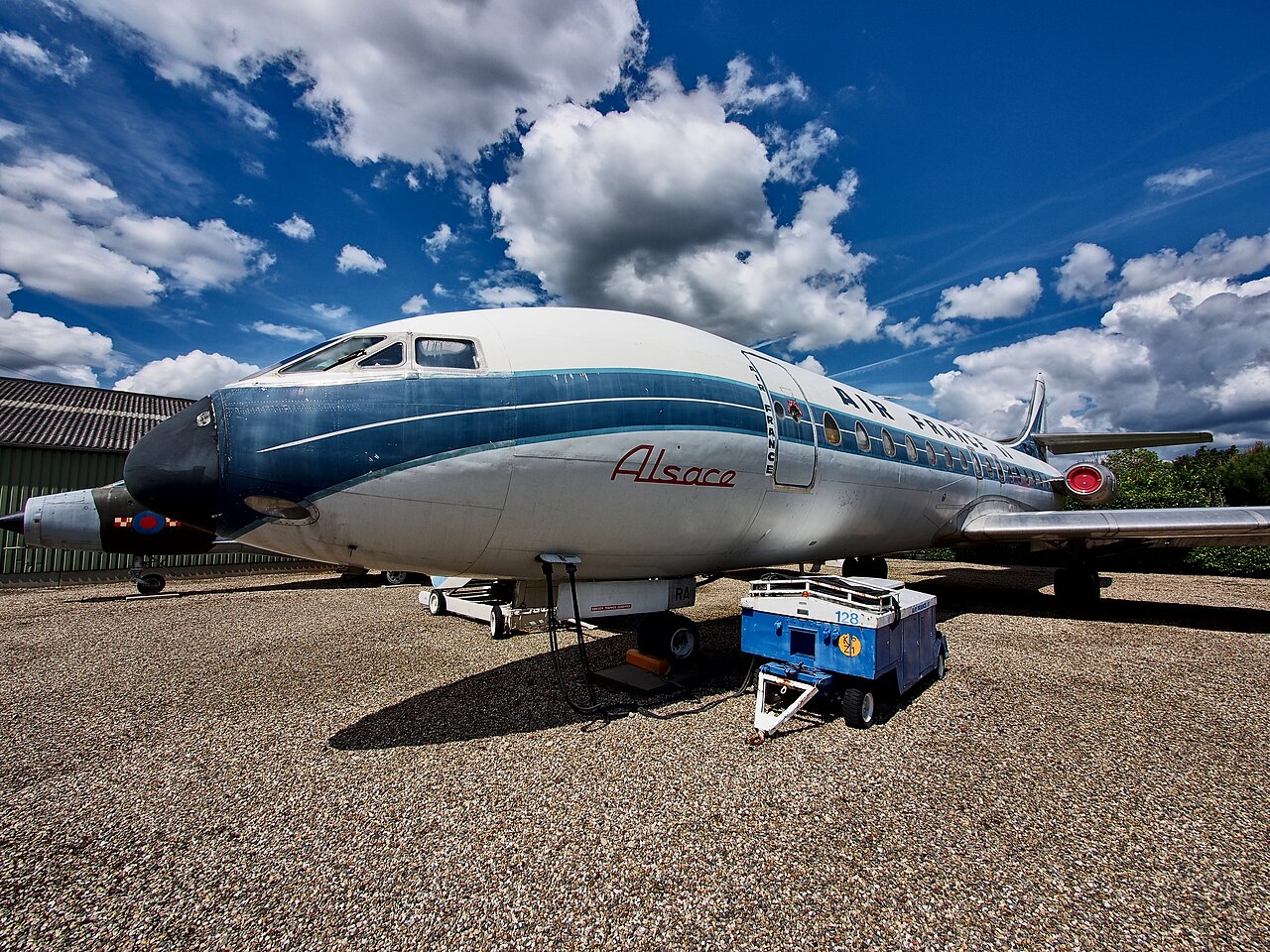
History
In the early 1950s, France sought to replace the transport aircraft serving European and Mediterranean routes. The first commercial jets promised faster journeys, but their suitability for medium distances still needed to be demonstrated. A national programme defined the requirement for an aircraft carrying several dozen passengers on sectors shorter than the major intercontinental crossings. SNCASE developed the project that became the Caravelle. This state-owned company brought together skills established during the reconstruction of the French aircraft industry. Its programme targeted an international market: airlines needed to introduce jet travel without accepting the size or capacity of the forthcoming American four-engine airliners.
The defining technical choice was to install two engines on either side of the rear fuselage. The wing remained clear of engine nacelles, while passengers in the forward rows sat well away from the engines. This arrangement nevertheless required particular attention to weight distribution, structural loads and balance. Early versions used Rolls-Royce Avon engines, a British design already developed for other applications. Cooperation with de Havilland also allowed elements of the Comet's forward section to be incorporated. The Caravelle was therefore not an isolated creation: it combined its own configuration with established equipment and engineering solutions. Its rounded triangular windows became a distinctive feature of the passenger cabin.
The first prototype took off from Toulouse on 27 May 1955. Testing had to establish handling qualities, performance and the operation of aircraft systems before certification and deliveries. The creation of Sud Aviation in 1957 brought the continuing programme under a new industrial name, without altering its origins at SNCASE. Commercial service began in 1959 with the first operators, including SAS and Air France. For travellers, the contrast with piston aircraft meant a higher cruising speed and a different acoustic environment. For airlines, introducing the type also required crew training and a maintenance organisation equipped to support jet engines. Bringing these arrangements into everyday operation was as important as demonstrating the prototype.
The Caravelle's career soon extended beyond the French market. SAS employed it on its European network, while Air France made it an important aircraft on regional and medium-distance international services. Other European airlines adopted the type, and United Air Lines introduced it in the United States. This American presence provided a significant commercial reference for a French manufacturer. Operating conditions varied considerably between networks, temperatures and runway lengths. Through subsequent sales, the aircraft also reached charter companies and airlines with more limited resources. Its geographical spread reflected these second careers as well as the original orders placed by major national carriers, rather than a single uniform pattern of operation.
The family developed in stages, with differences in engines, weights and cabin arrangements. The initial Avon-powered series were followed by versions tailored to particular requirements, including those ordered for the American market. The Caravelle 10 and 12 used Pratt & Whitney JT8D turbofans; the Series 12 also received a stretched fuselage. These changes offered more seats and different operating characteristics without removing every constraint of the original airframe. The performance of a particular version must therefore be distinguished from that of the family as a whole. Some airframes eventually underwent freighter conversions or entered specialised employment after their passenger careers, extending the uses of an aircraft originally designed around scheduled airline transport.
Production amounted to 282 aircraft, including prototypes. Fleet renewal gradually reduced the Caravelle's place, as newer aircraft appeared and requirements concerning noise and fuel consumption became more demanding. A few operators nevertheless prolonged its use into the early 2000s. Its legacy involves more than the engine arrangement subsequently adopted on other transports: the programme also consolidated design, testing and commercial support skills in Toulouse. It belongs to the industrial history that later led to the Concorde and Airbus partnerships, without being their sole origin. Preserved aircraft offer a direct view of the engineering choices behind a medium-haul airliner from the early years of commercial jet transport.
Why it mattered
- The Caravelle established a French presence in the international jet airliner market.
- Its rear-engine configuration helped spread this arrangement in commercial transport.
- The programme strengthened industrial and commercial expertise in Toulouse.
Where to see it
- Musée de l'Air et de l'Espace — Le Bourget, France
Sources
- Musée de l'Air et de l'Espace — Collections
- Aeroscopia — Collections