Airbus A380
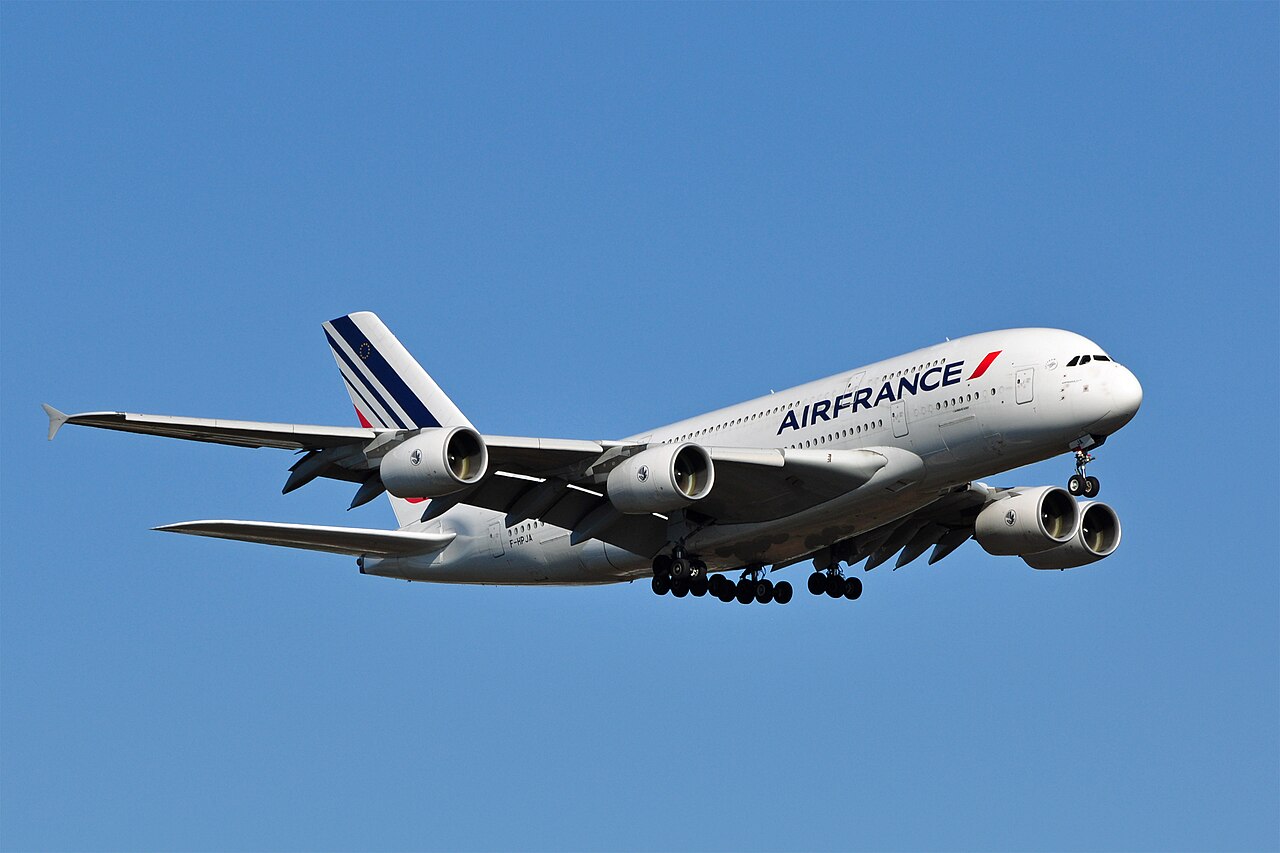
The first airliner with two passenger decks along the full length of the fuselage.
History
The A380 originated in Airbus studies during the 1990s into very large transport aircraft. The commercial reasoning favoured links between major connecting hubs, where traffic growth encountered limits in slots and infrastructure. An aircraft carrying more passengers per movement appeared able to address this constraint. The programme, long designated A3XX, was launched under the A380 name in December 2000. It involved a European industrial chain and substantial investment by the manufacturer and its suppliers. The intention was not simply to replace an existing aircraft: it was to offer greater capacity on a selection of routes with strong demand, within an airline market expected to continue expanding.
The aircraft has two passenger decks along the main length of the fuselage and four turbofan engines. Airlines choose between the Rolls-Royce Trent 900 and Engine Alliance GP7200. Fly-by-wire controls and the flight deck extend principles already used by Airbus, while adapting them to a much larger airframe. Manufacturing involves several countries; major assemblies reach Toulouse through a transport chain using sea, river and road. The dimensions also require airport adaptations, particularly for ground movement and boarding. Actual capacity depends heavily on the selected interior: two decks therefore do not mean an identical seat count for every operator. The distinction between the basic airframe and customer-selected accommodation is important when comparing aircraft.
The first flight took place at Toulouse on 27 April 2005. Testing covered performance, systems, structure and the operating conditions of an aircraft of this size. The programme also encountered industrial difficulties, particularly in wiring installation, which contributed to delivery delays. Singapore Airlines received the first commercial aircraft and inaugurated passenger service on 25 October 2007 between Singapore and Sydney. Operational introduction therefore followed a development and preparation period longer than originally expected. Airlines and airports had to coordinate ground handling procedures, equipment and training to use the capacity offered in everyday operations. Delivering the aircraft was only one stage in establishing a workable service around it.
Emirates became by far the largest customer and operator of the A380, incorporating it into its network centred on Dubai. Other airlines, including Singapore Airlines, Qantas, Lufthansa, British Airways and Air France, used it on selected major routes. Interiors reflected different strategies, with several classes and sometimes distinctive communal spaces. Such installations were not, however, universal equipment for the type. The aircraft's economics depended on occupancy and demand on each route, as well as fuel, maintenance and airport handling costs. High capacity offered an advantage in certain circumstances but made it harder to adjust supply when demand was insufficient or changed rapidly. Operational success therefore varied between networks rather than following automatically from aircraft size.
The A380-800 was the only commercial version produced. Proposed variants, including a freighter, were studied but did not create a production family comparable to the 747's. These proposals must be distinguished from aircraft actually delivered. Differences between individual aircraft principally concerned engines, equipment and the cabins requested by customers. Meanwhile, long-haul twinjets gained capacity and range, allowing airlines to serve more routes without concentrating so many travellers on a single departure. This development did not remove every use for very large airliners, but it reduced the number of markets where their benefits outweighed their constraints. Sales remained below the manufacturer's original expectations despite the aircraft finding a substantial role with its largest operator.
Airbus announced the end of the production programme in 2019 and delivered the final aircraft to Emirates in December 2021. The total reached 251 aircraft delivered to airlines. This commercial count must be distinguished from airframes reserved for development and testing. The pandemic brought extensive fleet groundings; some operators subsequently returned aircraft to service, while others retired them. The end of production consequently does not represent a single retirement date for the type. The A380 retains a place in the history of high-capacity aircraft architecture and European industrial cooperation. Its career also shows that technical achievement and the existence of a few suitable networks do not alone guarantee a market large enough to sustain manufacturing.
Why it mattered
- The A380 brought operation of two passenger decks to a new scale.
- It required extensive industrial and airport coordination.
- Its career illustrates the commercial limits of very high capacity against long-haul twinjets.
Where to see it
- Musée de l'Air et de l'Espace — Le Bourget, FrancePrototype MSN4, F-WWDD.
Further reading
- Airbus Encyclopedia — A380-800
Sources
- Airbus — Our history
- Aeroscopia — Collections