Manufacturer
Airbus
Emerging from European industrial cooperation, Airbus became an integrated group active in commercial aircraft, helicopters, defence and space.
6 min read
Origins
Airbus Industrie was established in 1970 as an economic interest grouping, enabling European companies to develop and market civil aircraft together. The initiative responded to American dominance in the large-airliner market and to the difficulty each European national industry faced in bearing the cost of a major programme alone. It was not yet an integrated company: partners retained their own structures and divided design and production work.
The national partners included Aérospatiale in France, Deutsche Airbus (including MBB) in Germany and CASA in Spain, which joined in 1971. In the United Kingdom, Hawker Siddeley took part in the A300 programme, first under the 1967 government framework and then privately as wing subcontractor after the British government withdrew in 1969. BAe later took over Hawker Siddeley’s aviation activities and joined the consortium in 1979. Responsibilities were organised around industrial capabilities, with final assembly in Toulouse. Cooperation required complex logistics and the movement of sections between countries.
The first aircraft, the A300, made its maiden flight in 1972 and entered service in 1974. It was designed as a twin-engine wide-body, unlike the four-engine aircraft then common on long-haul routes. Its size and capacity targeted high-density markets. The A300 demonstrated that the partners could design a competitive aircraft and support it in airline service. It opened the way to a diverse family, including the types covered in the A300 and A320 profiles.
The Airbus project formed part of a broader political and industrial effort to retain European expertise in materials, engines, avionics and assembly. Dividing work among countries pooled investment but required compromises in methods and schedules. The model relied on government decisions, initial orders and a commercial market whose growth could not be taken for granted when the programme began.
Growth
The launch of the A320 in 1984 marked another stage. This narrow-body entered service in 1988 and adopted digital fly-by-wire controls and a sidestick, technologies integrated into the cockpit and flight-control systems. The A320 became the basis for a family of variants with different capacities. It competed directly with American models in short- and medium-haul airline markets. Commonality among variants facilitated some aspects of training and operations, without eliminating differences specific to each version.
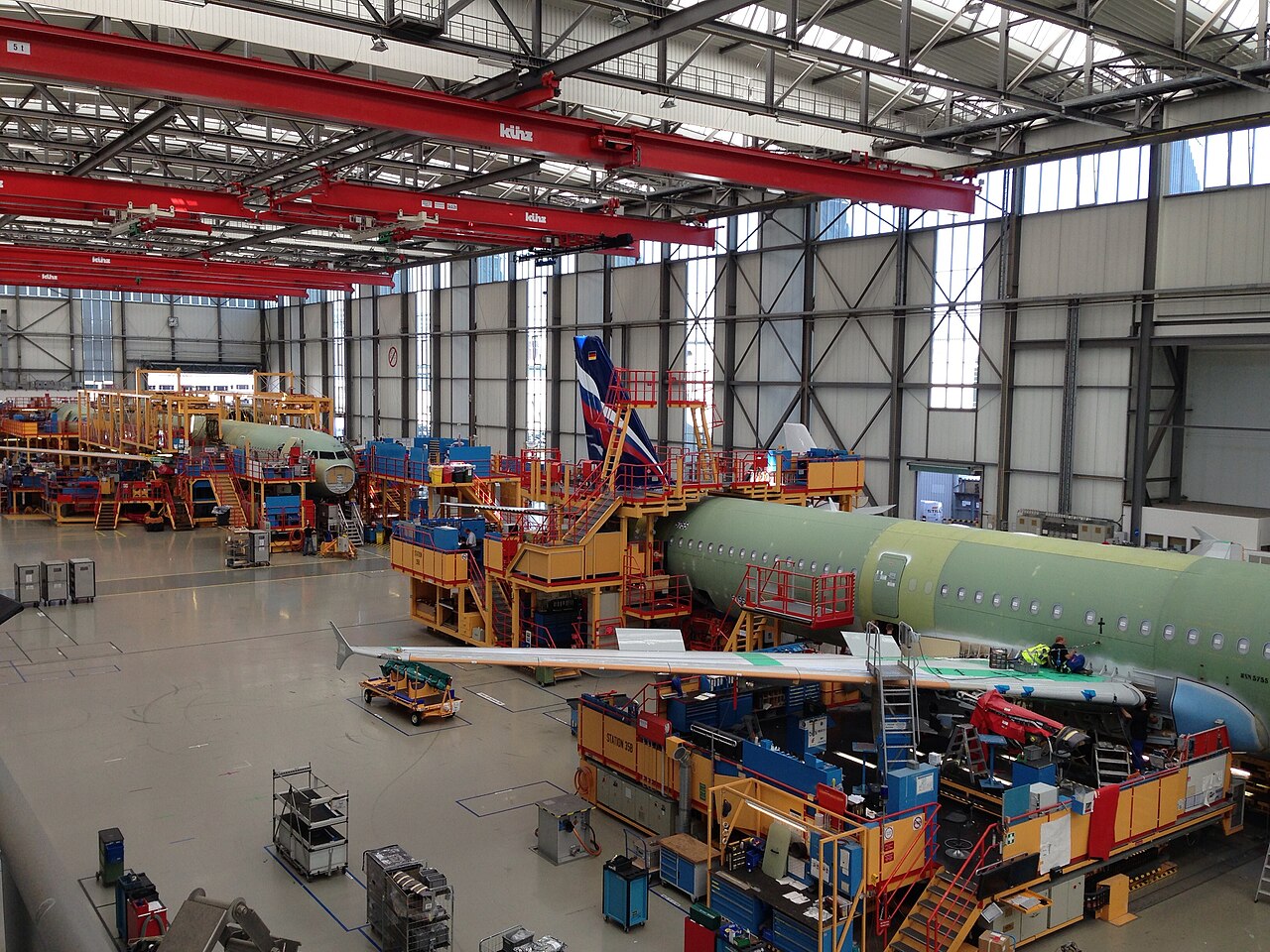
Airbus then broadened its range with the A330 and A340 wide-bodies, followed by progressive improvements in engines, cabins and aerodynamics. The twin-engine A330 and four-engine A340 addressed different route configurations. Aircraft design relied on a European network of sites and suppliers. Major sections travelled to assembly lines, where aircraft were equipped, tested and prepared for delivery. This industrial organisation was gradually adapted to higher output and a wider product range.
In 2000 the European company EADS was created, bringing together aerospace and defence interests in France, Germany and Spain, among others. Airbus remained an operating unit within a cooperative structure at that point. In 2001 Airbus became an integrated company, replacing the economic interest grouping with a unified corporate organisation. The change simplified the manufacturer’s governance and accompanied evolving production and management methods, without ending the national sites inherited from the consortium.
The narrow-body and wide-body range was complemented by programmes with different aims. The A380, launched in 2000, first flew in 2005 and entered service in 2007. This very large aircraft, with two full-length passenger decks, was designed to carry many passengers on high-demand routes. Developed later, the A350 made extensive use of composite materials and entered service in 2015. The programmes coexisted as different approaches to capacity, networks and fuel use per seat.
Major programmes
A320 variants multiplied, including the lengthened A321, designed to carry more passengers. The A321XLR, a longer-range development, received type certification from the European Union Aviation Safety Agency in 2024 and was delivered to its first customer that year. It is intended for routes longer than those usually associated with narrow-bodies, but operations depend on regulatory approvals, airline configuration and the characteristics of each route. The programme illustrates the expanding missions assigned to modern single-aisle aircraft.
In 2014 EADS adopted the name Airbus Group. In 2017 the company took the legal name Airbus SE. These name changes accompanied the transformation of a European grouping into an international corporation with distinct divisions for commercial aircraft, defence and space, and helicopters. The European company remains registered in the Netherlands. Leiden is its registered office, while Toulouse is the group’s operational centre and the headquarters of its commercial-aircraft business. These terms describe different functions.
Airbus also developed military transport aircraft and space systems alongside commercial aircraft. The A400M was designed through a multinational programme to meet the needs of several air forces. Defence and space activities have been reorganised over the decades, including through combinations with other European companies. In all these fields, certification procedures, public contracts and customer requirements differ from the airliner market, although some industrial capabilities overlap.
In 2018 Airbus acquired a majority stake in Bombardier’s C Series programme, renamed the A220. The aircraft retains a technical identity rooted in the Canadian programme while being marketed and developed within Airbus’s portfolio. Assembly takes place in Mirabel, Quebec, and a second assembly line was established in Mobile, Alabama. The integration expanded the group’s presence in the smaller narrow-body segment. The programme’s history shows how partnerships and acquisitions can carry a project beyond its original company.
Mergers and acquisitions
The creation of EADS in 2000 was a major step in European consolidation, but it did not immediately eliminate national entities. Airbus became an integrated company in 2001. Governance changed more than once, with responsibilities shared among major partner countries and adjustments to ownership. Airbus’s institutional history is therefore not a single merger: it combines a consortium, operational integration, a European company and successive structural and name changes.
The change to Airbus Group in 2014 and then Airbus SE in 2017 accompanied organisational and institutional simplification. The group has also acquired businesses and strengthened its position in services, defence and space. The 2018 C Series acquisition is a distinct example: Airbus took commercial and industrial control of an aircraft programme not originally designed by the European consortium. Acquisitions complement partnerships and cooperation agreements rather than replacing them.
Contemporary production is organised internationally. Sites in Toulouse, Hamburg, Tianjin and Mobile take part in final assembly of different aircraft, while other plants make sections and equipment. This arrangement can bring production closer to some customers and distribute capacity, but it requires close coordination of standards, transport and quality. The manufacturer also depends on independent suppliers for engines, systems and many components. Managing this supply chain is central to its industrial model.
Today
Airbus is one of the world’s two leading commercial-aircraft manufacturers and also operates in defence, space and helicopters. Its portfolio spans different capacities, from narrow-bodies to very large aircraft, although production decisions and changing demand lead to adjustments in the range. Competition with Boeing shapes part of the market, but outcomes also depend on airlines, suppliers, authorities and international economic conditions.
Growth in the global fleet creates demand for maintenance, spare parts, training and technical support. These activities extend the relationship between manufacturer and operator beyond delivery and are governed by airworthiness rules. Safety remains the fundamental framework for design and operation. Certification files, airworthiness directives and inspections fall under the competent authorities, while manufacturers provide the required documentation and technical follow-up.
Reducing emissions is a long-term challenge. Lower fuel use can result from engine efficiency, aerodynamics, reduced weight and aircraft operations. Sustainable aviation fuels can reduce some lifecycle emissions, but their availability and overall impact depend on how they are produced. Airbus also studies new configurations and technologies, whose results must be judged according to their maturity and certification requirements. Ongoing research should be distinguished from aircraft actually in service.
The group’s present identity retains traces of its cooperative origins: an integrated organisation, sites across several countries and programmes dependent on a large industrial network. Leiden and Toulouse perform different headquarters functions, while teams and factories operate in many territories. This structure enables international activity but makes coordination and industrial responsibility especially important. Airbus’s history remains linked to European integration and the evolution of global air transport.
Notable aircraft
Other models
- Airbus A310 (1983)
- Airbus A330 (1994)
- Airbus A340 (1993)
- Airbus A220 (2018)
Sources
- Airbus — Our history
- Encyclopædia Britannica — Airbus
- Encyclopædia Britannica — European Aeronautic Defence and Space Company
Related reading
Aircraft
Airbus A300Aircraft
Airbus A320Aircraft
Airbus A350 XWBFeature
Toulouse, aerospace capitalManufacturer
EADSManufacturer
Aérospatiale