Airbus A321XLR
The Airbus A321XLR is an A321neo version equipped with an integrated tank for extended-range missions.
History
The A321XLR continues a development that began with the A320 family and proceeded through the A321neo and A321LR. Airbus presented the version at the Paris Air Show in 2019 to address long-route requirements with less capacity than conventional widebodies. The project does not rely on an entirely new airframe: it adapts a single-aisle aircraft already in production and service to missions requiring more fuel. That origin matters historically because airlines can place the aircraft within a familiar family. The programme therefore concerns the expansion of an existing aircraft's missions as much as the appearance of a new designation in the manufacturer's catalogue of commercial transport aircraft.
The central modification is a rear tank integrated into the fuselage, known as the Rear Centre Tank, or RCT. It increases available fuel while requiring changes to structure, systems and protection. The aircraft also incorporates modifications addressing its weight and operating conditions, notably in the landing gear and high-lift devices. The cockpit retains the logic of the A320 family, while the cabin can receive an arrangement suited to long flights. Manufacturer range claims remain figures associated with particular payload and mission assumptions; they do not automatically describe every route operated or every commercial configuration. The relationship between fuel, passengers and equipment therefore remains important when considering the practical employment of the aircraft.
The first A321XLR took off from Hamburg-Finkenwerder on 15 June 2022 for a test flight lasting more than four hours. The certification campaign examined, among other things, the changes distinguishing the XLR from earlier versions. On 19 July 2024, EASA certified the version powered by CFM LEAP-1A engines. The agency explained that it had established special conditions for the new tank to address occupant protection, fire safety and accident-related risks. This example demonstrates that a derivative can require substantial regulatory assessment even when it retains much of the airframe and systems of an already certified family. Common ancestry does not remove the need to assess the consequences of a significant design change.
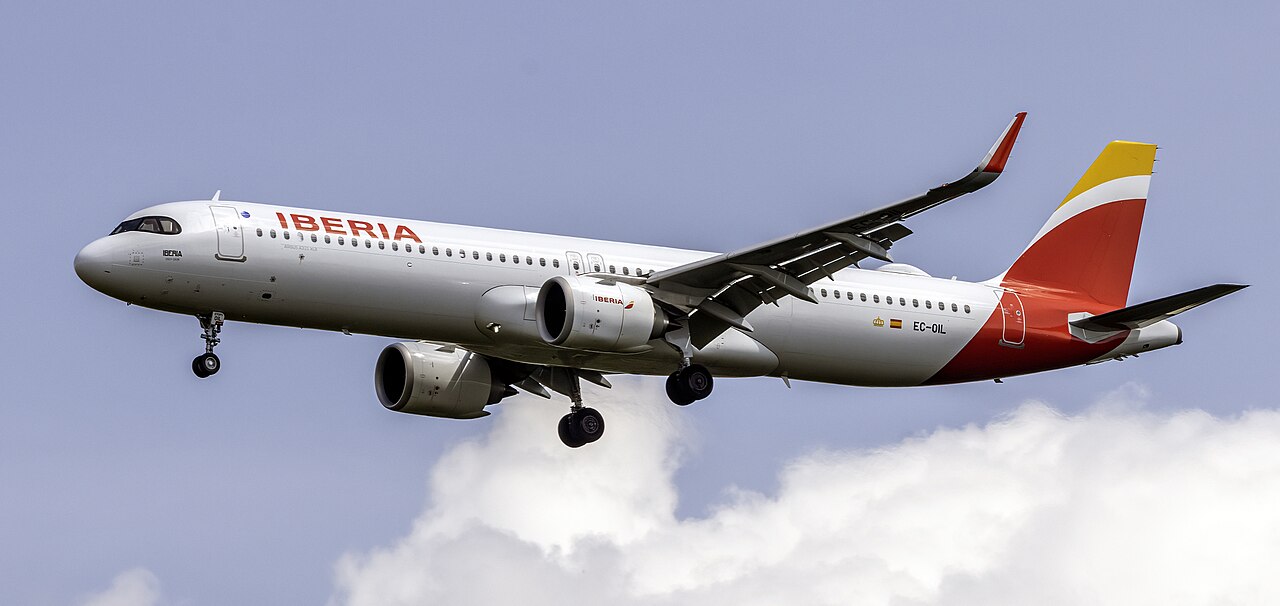
Iberia received the first aircraft on 30 October 2024 and began commercial operation in November. The Spanish airline initially used its aircraft on European services before employing it across the Atlantic, notably between Madrid and Boston. Its first example has a 182-seat cabin divided into two classes, with business-class seats that convert into beds. This arrangement belongs to a particular operator rather than being a mandatory definition of the model. Moving into long missions also requires arrangements for rest, refuelling, maintenance and cabin service. The technical ability to cover a given distance does not replace that operational preparation or determine by itself how an airline schedules and equips a particular service.
The XLR belongs to the A321neo family but should not be confused with the A321LR. Both address increased range, yet their fuel-storage arrangements and approved characteristics differ. Like other family members, the XLR is associated with two engine families, the CFM LEAP-1A and Pratt & Whitney PW1100G-JM, whose versions involve separate certification files. In recounting the programme's beginnings, the European approval of July 2024 specifically concerns CFM power. The date of one particular approval should therefore not become a single date supposedly covering every configuration without distinction. Commercial capacities also vary with the cabins and payloads selected, making careful identification of the version and operating assumptions necessary when comparing published information.
The A321XLR's historical interest lies in the already realised extension of a single-aisle aircraft's missions into long services, including transatlantic routes. It does not mark the invention of long-haul single-aisle flying: other aircraft, notably the Boeing 757, had previously performed such services. Rather, it represents another stage in adapting an established family to these uses. Its history combines industrial continuity with technical changes concentrated on fuel, weight and safety. Initial deliveries and Iberia's services constitute established results; they allow its significance to be explained without predictions about networks, sales or the future replacement of other aircraft. This approach keeps the distinction between an operational achievement and a manufacturer's broader commercial ambitions.
Why it mattered
- The A321XLR extends the long-range missions of the A321neo family.
- Its integrated tank required special certification conditions addressing safety.
- Iberia received the first example in October 2024 and introduced it into operation in November.
Where to see it
No example is known with certainty to be on display