Manufacturer
CASA
Founded in 1923, CASA combined licensed production, transport aircraft and European cooperation before joining EADS in 2000.
4 min read
Origins and early production
Construcciones Aeronáuticas SA, generally known as CASA, was founded in Spain in 1923 at the initiative of José Ortiz-Echagüe. Getafe, near Madrid, became its first industrial location. The company developed in a country where military requirements played an important role in aircraft orders. Its early business included building foreign designs under licence, among them Breguet aircraft. This work enabled the local production of existing designs and the formation of teams able to manufacture, test and maintain them. The company therefore did not begin with the turboprop transports with which its name would later become associated in the international aircraft market.
Licensed manufacture remained an important strand of this history. It linked the Spanish factory with foreign design offices while requiring local production facilities and skilled personnel. CASA built a version of the Junkers Ju 52, designated CASA 352. This three-engined transport, with its corrugated metal covering, belonged to an earlier generation than modern regional aircraft. Spanish production extended the industrial life of the German design. Such licensed work should be distinguished from the later development of CASA’s own aircraft: these were different industrial arrangements, although they drew on many of the same manufacturing skills and workshop practices.
Growth in light transports
The C-212 Aviocar gave CASA a transport designed for several different missions. This twin-turboprop aircraft made its first flight in 1971. Its high wing, fixed undercarriage and rear access addressed requirements for carrying both passengers and freight. The aircraft was suited to short runways and to operating conditions unlike those found at major airline airports. It attracted civilian and military users and also provided the basis for surveillance variants. The relationship between a basic transport aircraft and a specialised mission platform became a recurring feature of the Spanish product range, rather than being confined to one particular customer or service.
The C-212 occupied a different segment from commercial jet airliners. Its capacity, performance and cabin arrangements addressed local transport, access to less developed airfields and government requirements. CASA built design, integration and support capabilities around this aircraft family. Export activity also involved user training and the supply of spare parts over the aircraft’s operating life. Moving beyond the licensed manufacture that had characterised its early years, the company therefore maintained complementary activities: designing its own transports, participating in international cooperation and supplying components for larger programmes. These activities coexisted within the same company rather than following a simple replacement of one business by another.
CN-235 and C-295
The CN-235 resulted from cooperation with the Indonesian manufacturer IPTN. The programme brought two national industries together around a turboprop transport larger than the C-212. It first flew in 1983. The partners manufactured the aircraft in their respective countries, so the cooperation concerned a complete aircraft rather than merely the supply of components to a foreign prime contractor. Like the C-212, the CN-235 was offered in transport and special-mission configurations, including maritime surveillance. Rear access helped loading operations and allowed the cabin to accommodate different kinds of cargo. Its development added an international partnership to CASA’s experience in designing and producing transport aircraft.
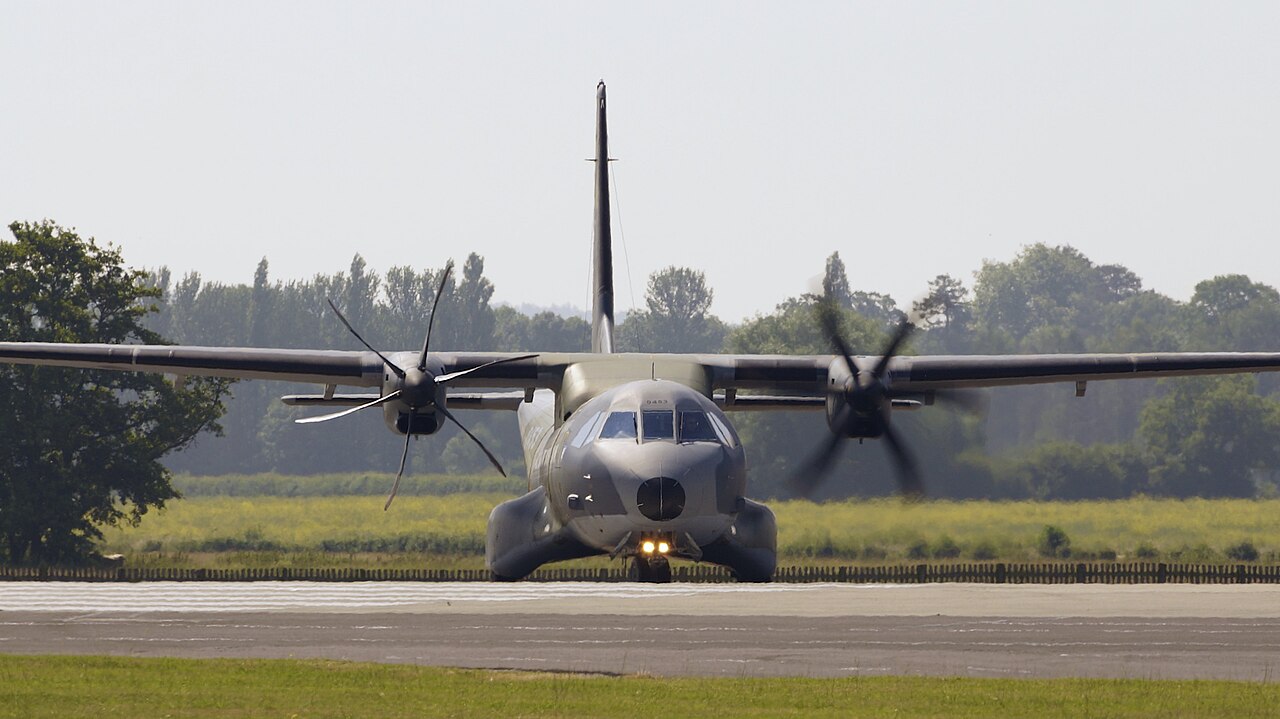
The C-295, which first flew in 1997, continued this line of transport aircraft. Longer than the CN-235, it retained a high-wing arrangement and a rear loading ramp. Missions included tactical transport and, depending on the version, surveillance and maritime patrol. These programmes explain the importance of transport aircraft within the Spanish operations subsequently integrated into Airbus. They should not be confused with the consortium’s airliners: their markets, industrial organisation and operating requirements belonged to another part of the group. The shared corporate framework did not make a military transport and a commercial passenger jet interchangeable products or identical industrial undertakings.
An Airbus partner and then part of EADS
CASA joined Airbus Industrie in 1971. Spanish participation extended a partnership initially organised around French and German companies. The Airbus A300 was the first aircraft produced through this industrial arrangement. CASA contributed structural components and subsequently developed its role in tail assemblies. Participation did not mean that the company independently assembled a complete Airbus aircraft. Instead, it entered a production system distributed across several countries, with components transported to final assembly lines. The French partner Aérospatiale belonged to the same organisation, with responsibilities allocated within the consortium. This placed Spanish production within an international airliner programme while CASA continued its other aircraft activities.
Integration and the Spanish legacy
In 2000, CASA became part of EADS, alongside Aérospatiale-Matra and DASA. The combination brought together civil aircraft, military aircraft, space activities and helicopters. The EADS CASA designation continued to be used for Spanish military transport operations. Subsequent reorganisations and the adoption of the Airbus name changed corporate names and divisional boundaries. Today, CASA’s legacy remains within Airbus in Spain, particularly in military aircraft, structures and tail assemblies. Getafe remains an industrial location for the group, while Seville has a role in military transport assembly. This is continuity of programmes, facilities and industrial expertise inside an integrated organisation, rather than the survival of CASA as an independent aircraft manufacturer.
Notable aircraft
Other models
- CASA 352
- C-212 Aviocar
- CN-235
- C-295
Sources
- Airbus — Our history
- Airbus — 100 years of aerospace progress in Spain
- Airbus — Commercial Aircraft in Spain
Related reading
Manufacturer
AirbusManufacturer
EADSManufacturer
DASA / MBBAircraft
Junkers Ju 52