Junkers Ju 52
Initially a single-engine aircraft, the Junkers Ju 52 became a three-engine civil and military transport, also built in France and Spain.
History
The Junkers Ju 52 emerged in an air transport industry still divided between commercial ambition and economic difficulties. By the late 1920s, operators needed less a demonstration aircraft than a machine capable of regular work, with accessible maintenance and suitable carrying capacity. Junkers already had experience with metal aircraft and civil transport. The new project continued that tradition while seeking more practical operation. The economic crisis did not remove these requirements, but sharpened attention to service costs, aircraft availability and their use on routes where ground facilities remained very uneven. A transport's usefulness therefore depended on more than the performance figures established during an individual test flight.
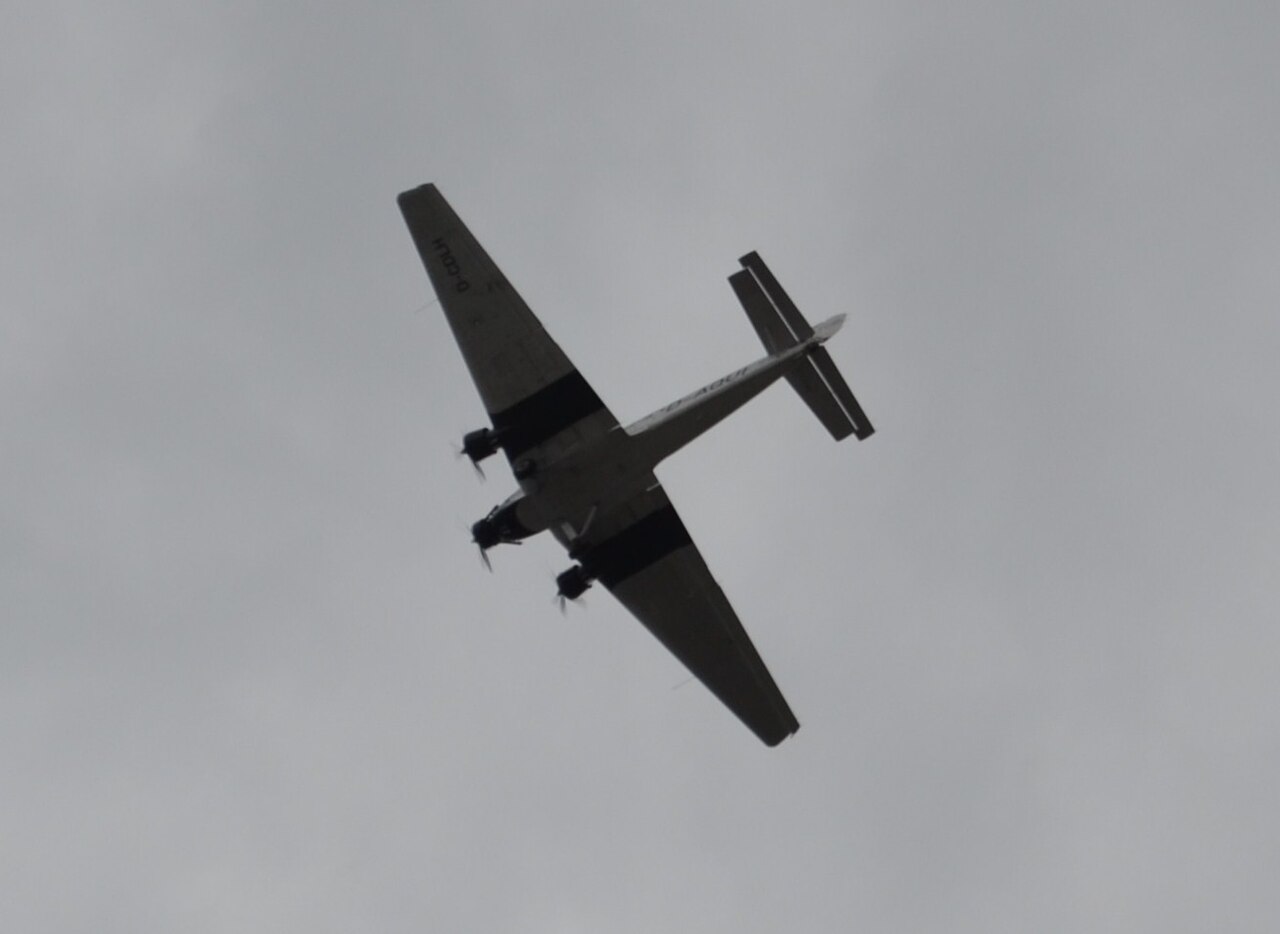
Metal construction and corrugated sheet covering gave the Ju 52 an immediately recognisable appearance. Its low wing carried auxiliary surfaces behind the trailing edge, a characteristic Junkers arrangement contributing to low-speed handling. The main undercarriage remained fixed, favouring simplicity at the cost of greater drag than on more recent transports. The airframe accommodated freight as well as passengers. In its three-engine form, two engines were installed on the wings and a third in the nose. That arrangement defines the familiar image of the type, but it was not the configuration of the original prototype, an important distinction when explaining the aircraft's early development and first-flight date.
The first flight on 13 October 1930 concerned the single-engine Ju 52, designated Ju 52/1m. That date must therefore not be attributed directly to the production trimotor. The Ju 52/3m followed and entered service in 1932. Adding wing-mounted engines changed the model's operating possibilities and answered the requirements of many operators more effectively. Deutsche Lufthansa made it an important aircraft on its network, while other airlines adopted it abroad. The transition from a transport prototype to a family operating regular services was thus a development of the programme, rather than a single event adequately described only by the year 1930.
The civil career expanded across Europe and other regions, including South America. Requirements ranged from passenger carriage and freight to serving poorly equipped airfields. The Ju 52 also entered military employment, including use as a bomber in some early applications. During the Second World War its principal Luftwaffe role became transport: supplying forces, moving troops, dropping parachutists and evacuating personnel. Operations exposed a relatively slow aircraft severely to opposing defences. Losses of transports and crews demonstrated that carrying capacity and suitability for basic airfields were not enough to ensure survival in contested airspace. Civil operating virtues did not automatically translate into protection during wartime missions.
Variants within the family reflected different engines, equipment and missions. Some machines received floats or special installations, while military versions adapted their cabins and access arrangements to the loads carried. Production was not confined to Germany. In France, the Colombes workshops continued construction under the designation AAC.1 Toucan; in Spain, CASA produced the model 352. These aircraft belong to the family's industrial history, but their origin should be specified when describing a preserved example. A German colour scheme applied during restoration does not turn a French Toucan or a Spanish CASA into an airframe built by Junkers before the war, regardless of how familiar the markings appear.
After 1945, surviving aircraft and licensed production extended the type's career in civil and military service. Faster transports better suited to developing networks gradually replaced the trimotor on regular routes. Some examples subsequently survived in collections or undertook heritage flying. The Ju 52 allows several histories to be traced together: the spread of metal transport aircraft, the needs of interwar airlines, the military mobilisation of transports and the continuation of manufacturing after the conflict. This diversity makes it necessary to distinguish consistently between the single-engine aircraft of 1930, the commercial trimotor and the many machines built or converted for other uses during the family's long service life.
Why it mattered
- The Ju 52/3m spread metal transport aircraft across numerous civil networks.
- Its military career illustrates both the capabilities and vulnerability of slow wartime transports.
- French and Spanish production extended the model's industrial history after 1945.
Where to see it
- Deutsches Technikmuseum — Berlin, GermanyA 1930s Ju 52 in the permanent aviation exhibition.
Sources
- Deutsches Museum — Sammlungen
- Musée de l'Air et de l'Espace — Collections
- Deutsches Museum — Flugzeug Junkers Ju 52 (AAC 1 Toucan)