1914–1939
The Great War and the interwar years (1914–1939)
From industrial mobilisation in 1914 to the networks of the 1930s, aircraft became military tools and transport services whose reliability depended on organisation on the ground as much as in flight.
6 min read
Historical context
In 1914, aviation moved beyond public demonstrations to become an instrument of warfare used on a large scale. Armies initially employed aircraft to identify enemy movements and direct artillery fire. These missions required crews, maps, workshops and communications as much as capable machines. Military orders accelerated the manufacture of engines and airframes, but losses remained heavy, both in combat and during training. The break with the age of the pioneers therefore lay less in any single invention than in organising the human and industrial resources needed to sustain daily operations across several fronts throughout a prolonged conflict.
The armistice of 1918 left factories, trained pilots and numerous aircraft without an immediate military market. Converting them was not enough to establish regular transport: airfields, timetables, revenue and common rules were also necessary. The Paris Convention of 1919 affirmed state sovereignty over national airspace while providing a framework for international navigation. Routes developed in a world shaped by national rivalries, colonial empires and economic difficulties. Mail often offered a stronger justification than passenger traffic alone. Aviation's expansion consequently remained closely connected to public policy and the geography of power, rather than simply following the technical possibilities of the aircraft available.
Technical advances
The transition from wartime biplanes to the commercial aircraft of the 1930s remained gradual. Wood, fabric and metal coexisted for a long time; metal construction did not automatically produce better operating results. Engineers worked on aerofoil sections, cooling and the reduction of drag. Cantilever wings, retractable undercarriages and fairings reduced resistance, while flaps allowed wings suited to faster cruising to remain usable at lower speeds. Stressed-skin structures, of which the monocoque is one form, distributed loads differently from earlier frameworks. These solutions were adopted according to operational requirements, costs and the capabilities of individual manufacturers and maintenance workshops.
The Douglas DC-3, which first flew on 17 December 1935, brought together several increasingly complementary developments: metal construction, an enclosed cabin, retractable undercarriage and powerful engines. Its commercial value also depended on capacity and daily utilisation, not simply speed. Radio, ground aids and gyroscopic instruments made flights less dependent on outside visibility alone. Instrument flying nevertheless required specific training and shared procedures. Weather forecasting, route surveys and the work of mechanics remained essential parts of this developing system. No item of equipment removed the dangers posed by icing, thunderstorms or mechanical failures, particularly on routes with few suitable alternative landing grounds.
People
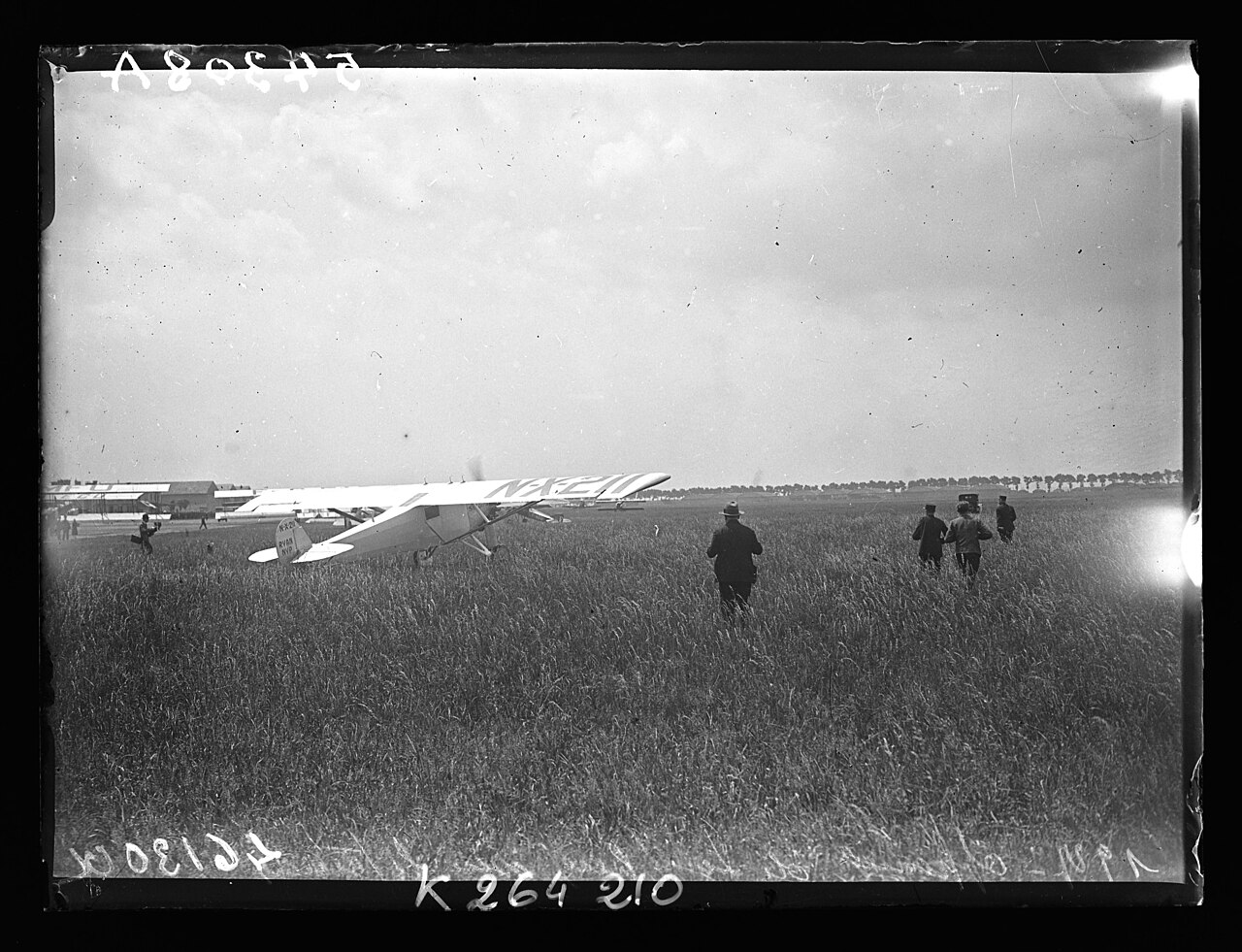
Ocean crossings demonstrated both the possibilities of flight and the distance between an exceptional achievement and a service. In June 1919, John Alcock and Arthur Whitten Brown crossed the Atlantic nonstop from Newfoundland to Ireland in a modified Vickers Vimy. In May 1927, Charles Lindbergh flew from New York to Paris alone and nonstop in the Spirit of St. Louis. This was therefore not the first aerial crossing of the ocean. Fuel planning, navigation and pilot endurance mattered as much as the aircraft itself. The fame of these flights encouraged interest in aviation without yet proving that a scheduled route could operate successfully.
Other careers reveal the diversity of aviation work and the barriers to entering it. Amelia Earhart crossed the Atlantic alone in 1932; Hélène Boucher set speed records in 1934. Their careers, considered within the history of women in aviation, should not obscure continuing professional restrictions. On the mail routes, Jean Mermoz, Henri Guillaumet and Antoine de Saint-Exupéry became public figures. Their accounts also describe ground teams, waiting and accidents. Behind every celebrated name worked mechanics, radio operators, meteorologists and station staff on whom the continuity of the network depended, often far from the attention given to record flights and their pilots.
Industry and airlines
In 1918, the foundation of Lignes aériennes Latécoère marked a stage in building mail connections from Toulouse. The network extended towards Africa and then South America, requiring continual development of staging points and repair facilities. The Aéropostale took over this undertaking, combining aircraft, ships and ground infrastructure. In May 1930, Mermoz made a mail crossing of the South Atlantic in a float-equipped Latécoère 28. This achievement did not immediately eliminate the use of ships on the ocean sector. The reliability of a transport chain had to be judged over months of operation rather than from the successful arrival of a single flight.
Airlines emerged through mergers, public support and agreements over routes. Air France was formed in 1933 by bringing together several French companies; elsewhere, KLM, Imperial Airways, Lufthansa and Pan American developed networks within different political frameworks. The Junkers Ju 52 illustrates the use of the metal trimotor on numerous routes. Flying boats served some journeys without large land airfields, but still required facilities and suitable water conditions. Tickets remained expensive and the customer base limited. Workshops had to track parts, inspect engines and prepare departures: service quality depended on an industrial organisation as much as on the performance of an individual machine.
Military aviation
During the Great War, reconnaissance and artillery observation remained fundamental despite the attention given to fighter combat. Aerial photography helped armies interpret the front, while radio links gradually improved the transmission of intelligence. Fighters sought to protect these missions or prevent the enemy from carrying them out. Synchronising gunfire through the propeller disc was one technical response to this struggle. Bombing affected military installations but also towns and their inhabitants. The creation of the Royal Air Force in 1918 reflected aviation's growing institutional standing, without ending debates about how air forces should operate alongside armies on the ground and navies at sea.
Between the wars, doctrines contrasted or combined ground cooperation, air defence and long-range bombing. Aviation also took part in operations enforcing colonial rule, whose violence cannot be reduced to a technical history. The Spanish Civil War exposed the effects of air attacks on populations and provided operational experience for intervening powers. By the late 1930s, fast monoplanes with retractable undercarriages, such as the Supermarine Spitfire, still served alongside older aircraft. Their effectiveness depended on training, maintenance, communications and warning arrangements. Comparing speeds alone therefore cannot explain the capabilities of an air force or the conditions under which its aircraft could be used.
Legacy
On the threshold of 1939, aircraft belonged to organised networks rather than solely to the world of exceptional feats. Enclosed cabins, instruments and metal construction had changed the experience of travel, but pressurisation was not yet general airline practice. Flight remained sensitive to weather and the limitations of staging points. Postal services had learned to coordinate distant operations, and administrations had begun defining common requirements for aircraft and their crews. This infrastructure, less spectacular than records, formed an essential legacy of the period: it made journeys repeatable without guaranteeing safety or profitability everywhere, or making air travel accessible to the wider population.
The history of these years thus followed no uniform progression from biplane to modern aircraft. Older solutions remained useful, companies disappeared or merged, and technical choices answered both civilian and military orders. The same skills served transport, exploration and war. The period explored subsequently in the jet age drew on this industrial and operational experience while belonging to different conflicts and different means of propulsion. Understanding this inheritance requires attention to preserved aircraft, company archives and the experiences of personnel and people beneath the routes alike. No individual record can summarise a transformation involving so many institutions, workplaces and lives.
Milestones in this era
1914–1918
The aircraft in the Great War
15 July 1916
William Boeing founds Pacific Aero Products
1918
Lignes aériennes Latécoère founded
June 1919
Alcock and Brown cross the Atlantic
1919
First regular commercial air services
May 1927
Lindbergh flies New York to Paris
May 1930
Mermoz crosses the South Atlantic
20–21 May 1932
Amelia Earhart flies the Atlantic solo
7 October 1933
Air France is founded
1934
Hélène Boucher and women's speed records
17 December 1935
First flight of the Douglas DC-3
5 March 1936
First flight of the Supermarine Spitfire
Sources
- Smithsonian National Air and Space Museum — Collections
- Musée de l'Air et de l'Espace — Collections
- IWM — Imperial War Museums
- Science Museum — Collections
- Gallica — BnF — Presse et revues aéronautiques numérisées
- L'Envol des Pionniers — L'aventure de l'Aéropostale
- Encyclopædia Britannica — History of flight
Related reading
Aircraft
Douglas DC-3Aircraft
Latécoère 28Pioneer
Amelia EarhartFeature
The Aéropostale (1918–1933)Feature
Women in aviationEra
The Second World War and the jet (1939–1958)