Supermarine Spitfire
Entering service in 1938, the Spitfire developed from a Merlin-powered fighter into numerous combat and reconnaissance versions.
History
The Supermarine Spitfire emerged from the renewal of British fighter aviation during the 1930s. Reginald Mitchell's experience with racing seaplanes provided a culture of aerodynamic investigation, without making the future fighter a straightforward conversion of a racing machine. Following the Type 224, which received no production order, the Supermarine team continued with a more developed design. A Rolls-Royce Merlin engine, retractable undercarriage and enclosed cockpit formed part of that evolution. Military requirements also demanded armament and production arrangements that distinguished the programme from sporting aircraft. Development therefore depended on an industrial team and public procurement, rather than solely on the isolated work of one designer.
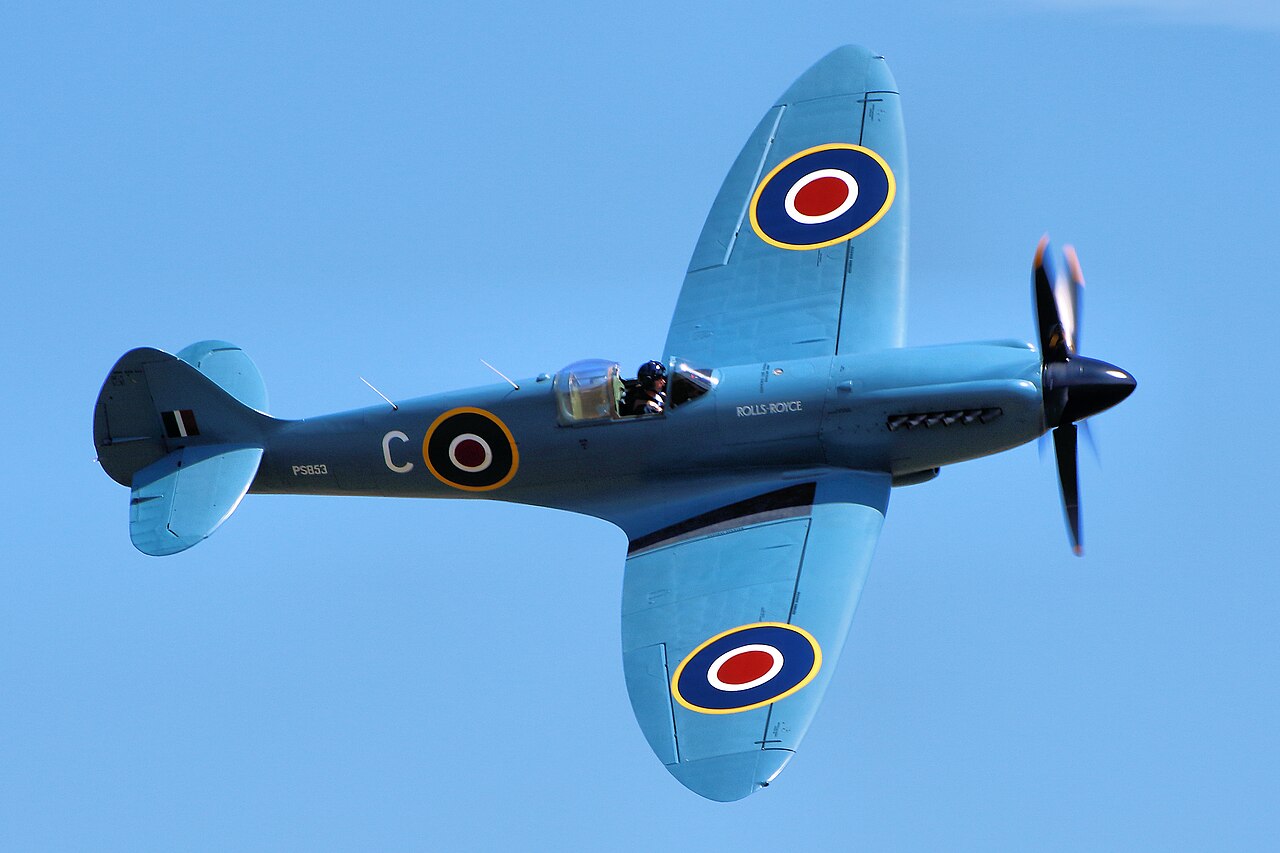
The metal airframe combined a low wing with a streamlined fuselage. The elliptical wing outline became its characteristic visual feature, but its purpose was not merely aesthetic: it contributed to a thin wing and limited drag while accommodating the weapons. Early aircraft carried eight machine guns. The liquid-cooled engine required radiators whose integration mattered to the overall balance of the design. Propellers, protection and equipment evolved rapidly. It would therefore be misleading to attribute identical performance, detailed appearance or armament to all Spitfires on the basis of either the prototype's characteristics or those of a late version. The family must be understood as a sequence of changing configurations.
Prototype K5054 flew on 5 March 1936 with Joseph Summers at the controls. Testing led to adjustments before production and squadron deliveries. The first unit equipped was No. 19 Squadron at Duxford in 1938. Moving into substantial manufacture presented industrial difficulties while the international situation increased the urgency of deliveries. When war began in September 1939, the type was already serving with several fighter units. Its first-flight date places it in the interwar period, although most of its operational career and much of its technical development belonged to the world conflict and the years that followed. The date of introduction alone cannot describe that subsequent evolution.
During the Battle of Britain, the Spitfire fought alongside the Hawker Hurricane and within the wider British air-defence system. Radar, observers, communications, airfields and ground control all contributed to operations; the outcome cannot be reduced to a duel between two aircraft models. The Spitfire subsequently served on several fronts, in Europe, the Mediterranean and Asia. Pilots and units of many nationalities operated it. Missions included air superiority, escort and ground attack, depending on the period and version. Photographic reconnaissance aircraft occupied a distinctive place because they exploited endurance, altitude and speed rather than a standard fighter armament, adapting the basic design to a different operational requirement.
Successive variants accompanied changes in engines and opposing aircraft. Merlin-powered versions included the Mk I, V and IX; the latter answered the need for improved performance against newer German fighters. Griffon-powered variants brought another development of propulsion and airframe. Wings, tail surfaces, canopies and equipment differed between series. The Seafire was a related naval adaptation with requirements specific to carrier operation, and should not be confused with a maritime colour scheme on an otherwise unchanged land fighter. Two-seat training versions also appeared. These transformations make accurate model identification necessary whenever a surviving example is described or photographed, rather than assuming that the familiar name establishes every technical detail.
After the war, the Spitfire remained in use with several air forces, but the development of jet fighters gradually changed its position. The RAF still flew an operational reconnaissance mission with the type over Malaya in 1954. Aircraft were subsequently preserved in museums or maintained in flying condition. The RAF Museum displays examples allowing different stages of this development to be compared. The Spitfire's legacy concerns that adaptability as well as its association with 1940. Its career shows how an airframe designed before the war could be repeatedly transformed, without removing the limitations and particular requirements of each individual version within the wider family.
Why it mattered
- The Spitfire contributed to Britain's defence in 1940 within a collective system.
- Successive adaptations supported fighter and reconnaissance missions.
- The family illustrates an airframe's development from Merlin to Griffon engines.
Where to see it
- RAF Museum — LondonSeveral versions are preserved in the museum collections.
Sources
- RAF Museum — Collections
- Imperial War Museums — Collections
- RAF Museum — The first flight of the Spitfire