1908–1934
Hélène Boucher
A French pilot of the interwar years, Hélène Boucher built a brief professional career around air racing and speed records.
3 min read
Life
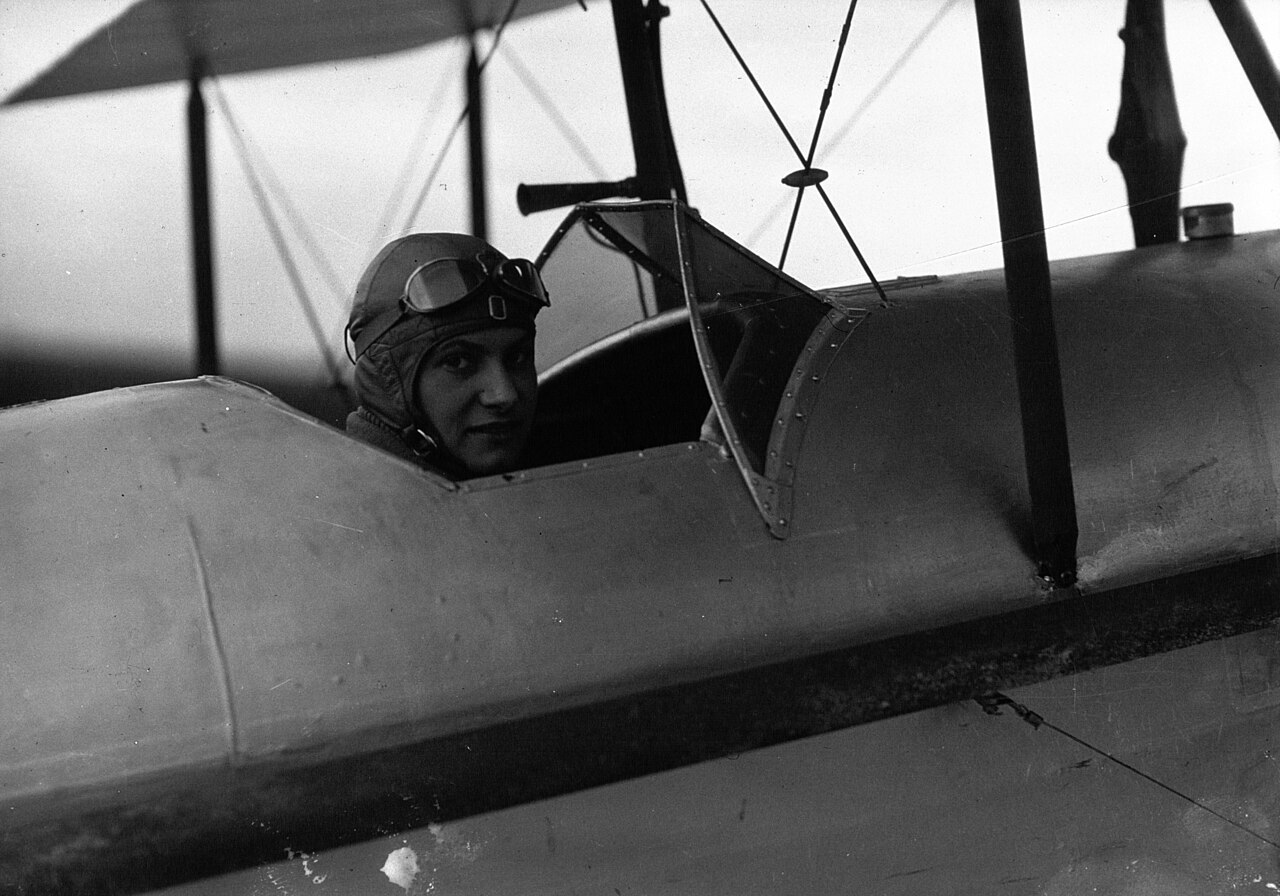
Born in Paris to a family whose father was an architect, Hélène Boucher took up flying when air displays were bringing aviation before a widening public. After a first flight at Orly, she trained with Henri Farbos at Mont-de-Marsan and gained her licence in 1931. Rather than remaining an amateur, she set out to earn her living as a pilot. Her career developed in the interwar years, when races, public displays and long-distance journeys offered routes into a profession that still provided few opportunities for women. Flying skill alone did not guarantee a secure income.
Boucher bought a light aircraft, gained navigation experience and obtained her commercial licence in 1932. A journey towards the Middle East exposed her to the demands of flying from stage to stage and to mechanical trouble far from her home base. Financial pressures mattered as much as technical ones: buying, maintaining and operating an aeroplane was expensive. She subsequently entered competitions and developed her aerobatic skills with Michel Détroyat. This varied apprenticeship preceded her employment by Caudron. Her later records were therefore the outcome of accumulated experience rather than a sudden emergence from obscurity through newspaper coverage.
Achievements
In 1934 her association with Caudron-Renault gave her access to aircraft designed for speed. Their performance depended on a combination of carefully shaped airframes, low drag and suitable engines. The pilot had to make effective use of those qualities under the particular conditions of a competition. Boucher competed in the Twelve Hours of Angers and then undertook a series of record attempts. These flights demonstrated her ability to handle fast aircraft over prescribed courses. They were a specialised form of flying, distinct both from carrying passengers and from the routine operation of a scheduled airline service.
Her flights in the summer of 1934 brought several women’s speed records. These categories should be distinguished from outright records, and performances over different distances should not be reduced to a single figure. Newspapers made her name a symbol of modernity, but the records also depended on a manufacturer, mechanics and collective preparation. Like Amelia Earhart in a different national setting, Boucher turned sporting achievement into public visibility. The feature on women in aviation places that visibility within the wider history of unequal access to professional flying, rather than treating celebrity as proof that such barriers had disappeared.
Legacy
On 30 November 1934 Boucher died during a training flight at Guyancourt. She was twenty-six. Her short career and the recent prominence of her successes gave her death national significance. She was awarded the Legion of Honour posthumously. Yet an account of her life should not allow its tragic ending to obscure her work: the progression from initial training through competition to employment with a manufacturer reveals a sustained professional commitment. Understanding that achievement does not require a speculative reconstruction of the accident. What can be established about her flying career matters more than an imagined account of its final moments.
Schools and streets preserve her name. Public remembrance often emphasises youth and courage; the history of interwar aviation can add the practical conditions of work, the search for funding and the contribution of technical teams. Boucher neither founded an airline nor established a lasting commercial route. Her contribution lay in recognised performances and in the visible example of a woman pursuing demanding professional work. The later career of Jacqueline Auriol, in a different technical environment, offers a way of extending that discussion without presenting the two pilots as inevitable stages in a smooth, continuous advance towards equal opportunity.
Sources
- Musée de l'Air et de l'Espace — Collections
- Gallica — BnF — Presse et revues aéronautiques numérisées
- FranceArchives — Hélène Boucher
- Bibliothèque nationale de France — Boucher, Hélène (1908-1934)