Ryan NYP Spirit of St. Louis
The Ryan NYP enabled Charles Lindbergh to fly solo and nonstop from New York to Paris on 20–21 May 1927.
History
Spirit of St. Louis was built for a specific journey: a nonstop flight from New York to Paris. The prize offered by Raymond Orteig stimulated several projects at a time when aircraft had already crossed the Atlantic, notably with Alcock and Brown in 1919. Charles Lindbergh, an airmail pilot, chose to attempt the route alone. Financial backers in St. Louis enabled him to commission a machine suited to that ambition. The objective was therefore neither to open an immediate passenger service nor to make the first aerial crossing of the ocean, but to connect two cities under the prize conditions and with a single pilot aboard.
Ryan Airlines in San Diego built the NYP under the technical direction of Donald Hall, working closely with Lindbergh. The design drew on experience with Ryan monoplanes while adapting it to long endurance. The choice of the Wright Whirlwind radial engine was central to the design. The cabin accommodated only one pilot, and fuel tanks occupied a substantial proportion of the available space. A tank ahead of the cockpit prevented a direct forward view; Lindbergh used side openings and, among other aids, a periscope. Every item of equipment had to be assessed for its weight, usefulness and relationship to the quantity of fuel required to complete the crossing.
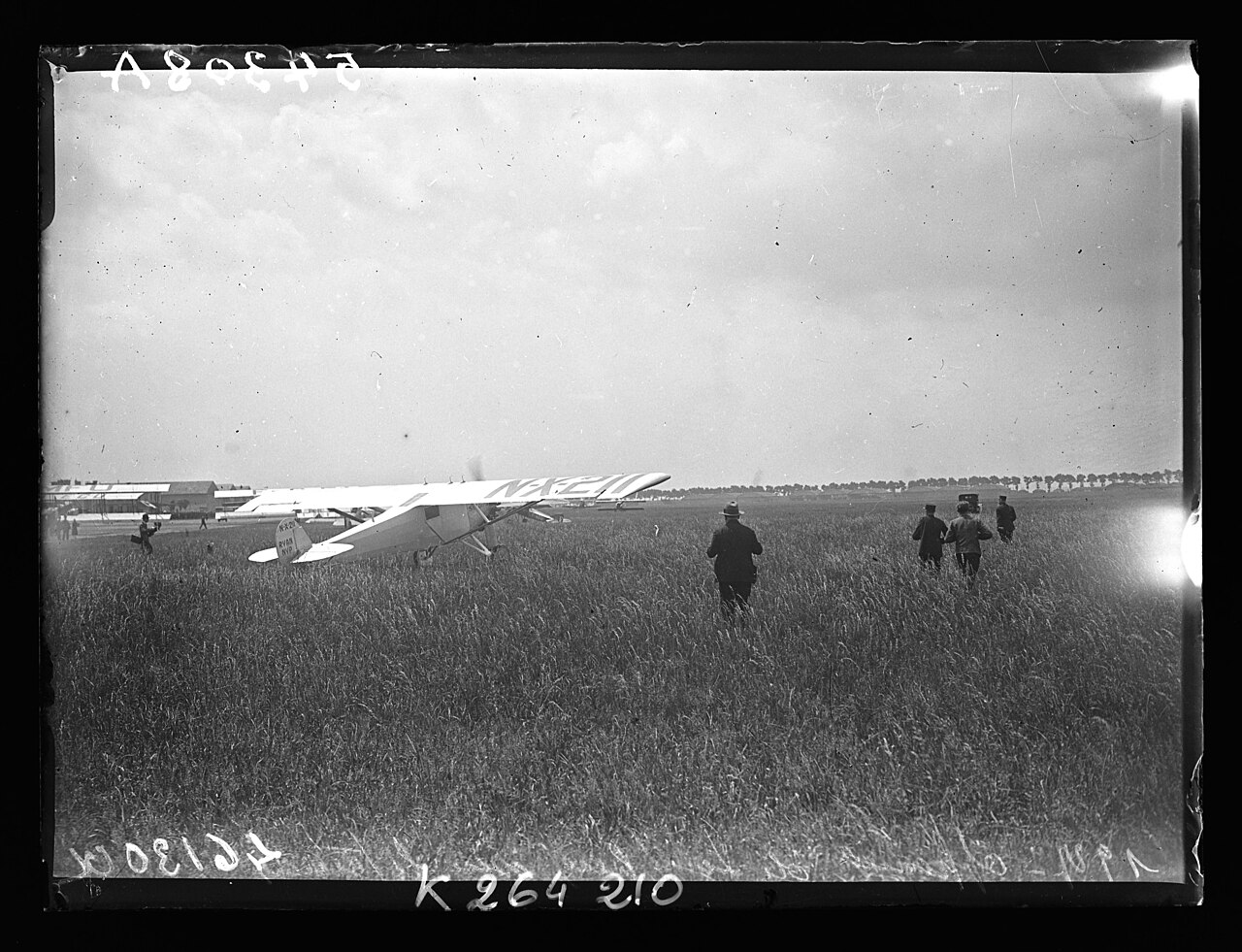
The aircraft first flew on 28 April 1927. After testing and a ferry flight to the eastern United States, Lindbergh waited for weather suitable for departure. He took off from Roosevelt Field on Long Island on 20 May, carrying a fuel load that made the initial take-off run especially consequential. He crossed the Atlantic using his instruments and dead reckoning, without another crew member to share duties or maintain a watch. On 21 May he landed at Le Bourget after thirty-three and a half hours in the air. The achievement was the first solo nonstop transatlantic flight, also made specifically between New York and Paris.
The reception at Le Bourget brought the crossing to an audience far beyond aviation circles. The aircraft subsequently became a means of presenting aviation to the public during Lindbergh's journeys and tours. It travelled across the United States and later visited Latin America and the Caribbean. Its career remained that of a unique machine associated with its pilot, rather than a type operated by an airline. These journeys extended the impact of the record by showing the actual aircraft to local populations. They belonged to a period of growing interest in air transport, without making it reasonable to attribute every commercial transformation of the interwar years to this single flight.
The NYP did not produce a family of production variants all bearing the name Spirit of St. Louis. Its relationship to other Ryan aircraft should not obscure the alterations imposed by its mission. Fuel capacity, cockpit arrangement and a reduced crew answered the requirements of one particular flight rather than the comfort needs of a regular service. Copies subsequently built for films, commemorations or flying displays are not the original aircraft. That distinction matters in museum collections: a familiar outline alone cannot identify the machine of 1927, any more than a reproduced colour scheme can establish the identity of another aircraft with a separate history.
In 1928 Spirit of St. Louis joined the Smithsonian, which preserves the original at the National Air and Space Museum in Washington. Its flying career thus ended shortly after the crossing and the tours that followed it. The object allows the compromises of a record aircraft to be examined: endurance, visibility, pilot fatigue and simplicity of equipment. Its importance also concerns the public reception of a technical achievement at a time when air transport was still establishing its place. Museum preservation ultimately reminds visitors that the success of May 1927 depended on a combination of preparation, specialised construction and flying skill, rather than solely on the celebrity acquired after landing.
Why it mattered
- The NYP completed the first solo nonstop transatlantic crossing.
- Its design prioritised endurance over direct visibility and comfort.
- Lindbergh's tours gave the flight lasting public prominence.
Where to see it
- National Air and Space Museum — WashingtonOriginal aircraft of 1927.
Sources
- Smithsonian National Air and Space Museum — Collections
- Britannica — Encyclopædia Britannica
- Smithsonian National Air and Space Museum — Ryan NYP Spirit of St. Louis