1902–1974
Charles Lindbergh
After his solo non-stop New York–Paris flight in 1927, Charles Lindbergh became an influential figure in aviation and politics, legacies that require separate assessment.
3 min read
Life
Born in Detroit and brought up partly in Minnesota, Charles Lindbergh left engineering studies to learn to fly. He worked in exhibition flying before receiving military pilot training. As an airmail pilot he gained experience of long flights, navigation and bad weather. This work connected him with a wider generation of aviators for whom carrying mail drove the development of aviation. The feature on the Aéropostale offers a comparison without conflating the French and American networks. His practical apprenticeship prepared him for a more ambitious undertaking: a non-stop flight linking New York and Paris across the North Atlantic.
The Orteig Prize offered a reward for the first non-stop flight between the two cities. Backed by businessmen from St Louis, Lindbergh commissioned Ryan to build a specially adapted monoplane, the Spirit of St. Louis. He chose to fly alone and gave priority to carrying fuel. The arrangement of the tanks restricted his direct forward view; a periscope and side windows supplemented his observations. This was not a universal prescription for ocean flying. It reflected the compromises of one particular attempt during the interwar years, before regular commercial transatlantic air services became established on a wider scale.
Achievements
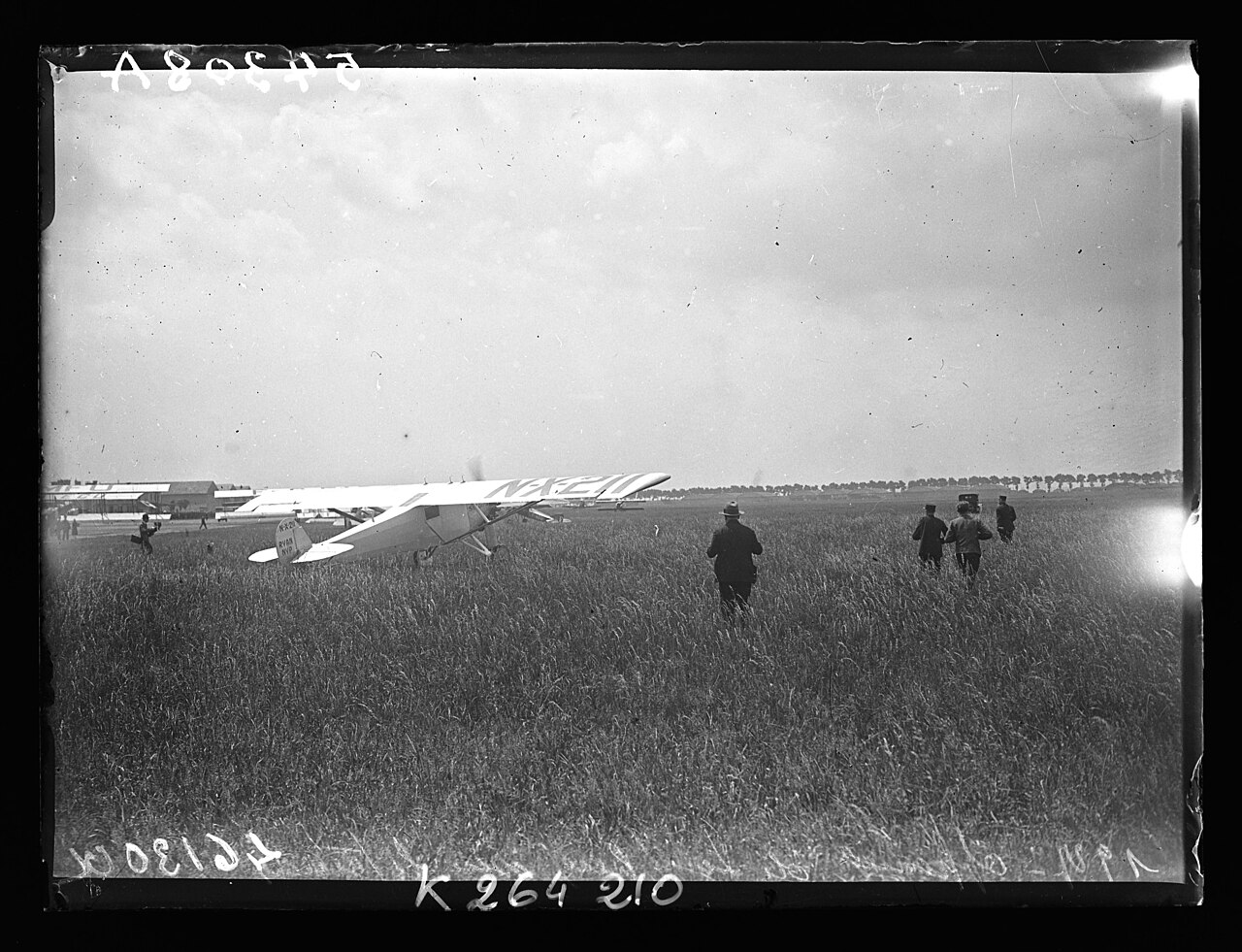
Leaving Roosevelt Field near New York on 20 May 1927, Lindbergh landed at Le Bourget on 21 May after roughly thirty-three and a half hours. He had made the first solo non-stop crossing of the North Atlantic. The wording matters: Alcock and Brown had already flown across without stopping in 1919, while other crews had crossed in stages. What was new was the solo flight and the New York–Paris connection, not the first aerial crossing of the ocean. Fatigue, weather and navigation made the undertaking demanding, but an account of those difficulties should not obscure these essential historical distinctions.
The reception in France and then the United States made Lindbergh an international public figure. His tours and public appearances encouraged interest in civil aviation. He advised companies and undertook route-survey journeys with his wife, Anne Morrow Lindbergh. Anne contributed navigation and radio work, a reminder that the image of the solitary pilot does not describe his entire career. Amelia Earhart’s crossing in 1932 extended the history of individual flights in another direction. The murder of the Lindberghs’ young son, kidnapped in 1932, also subjected the family’s private life to painful and lasting exposure in the mass media.
Legacy
His public role also had a political dimension that cannot be excluded from his legacy. Before the United States entered the war, he opposed intervention and became a spokesman for America First. His antisemitic remarks, notably in his Des Moines speech in 1941, drew strong criticism. His contacts with Nazi Germany and acceptance of a German decoration in 1938 added to the controversy. After Pearl Harbor he contributed to the American war effort as a civilian consultant and flew in the Pacific. This later activity neither erased his earlier statements nor removed the need to assess them in their own right.
Lindbergh published accounts of his experiences and became interested in nature conservation in later life. He died on Maui in 1974. His 1927 aircraft, preserved at the Smithsonian, remains an important object for understanding the flight’s technical preparation. A balanced biography distinguishes the pilot’s skill, the achievement’s impact through the media and the responsibilities of a public figure. The feature on women and aviation also offers a counterpoint to histories organised around isolated male heroes. Studying Lindbergh therefore means neither celebrating the 1927 flight without qualification nor denying its importance because of the political positions he adopted in subsequent years.
Sources
- Encyclopædia Britannica — Charles Lindbergh
- Smithsonian National Air and Space Museum — Collections