Douglas DC-3
Developed for American airlines, the DC-3 became a family of civil and military transports used worldwide.
History
The DC-3 took shape as a development of the DC-1 and DC-2 while American airlines sought to improve transcontinental transport. American Airlines wanted to replace its overnight aircraft with a machine offering proper sleeping berths. Douglas developed the Douglas Sleeper Transport, or DST, for this requirement, with a wider fuselage also allowing a higher-capacity daytime seating arrangement. The project therefore combined comfort with operating economics. It was not simply a matter of flying more passengers, but of distributing the expense of each journey across a sufficient commercial load. Advances in engines, equipment and infrastructure made this stage possible. The DC-3 belonged to that collective development rather than representing a break independent of the aircraft that had preceded it.
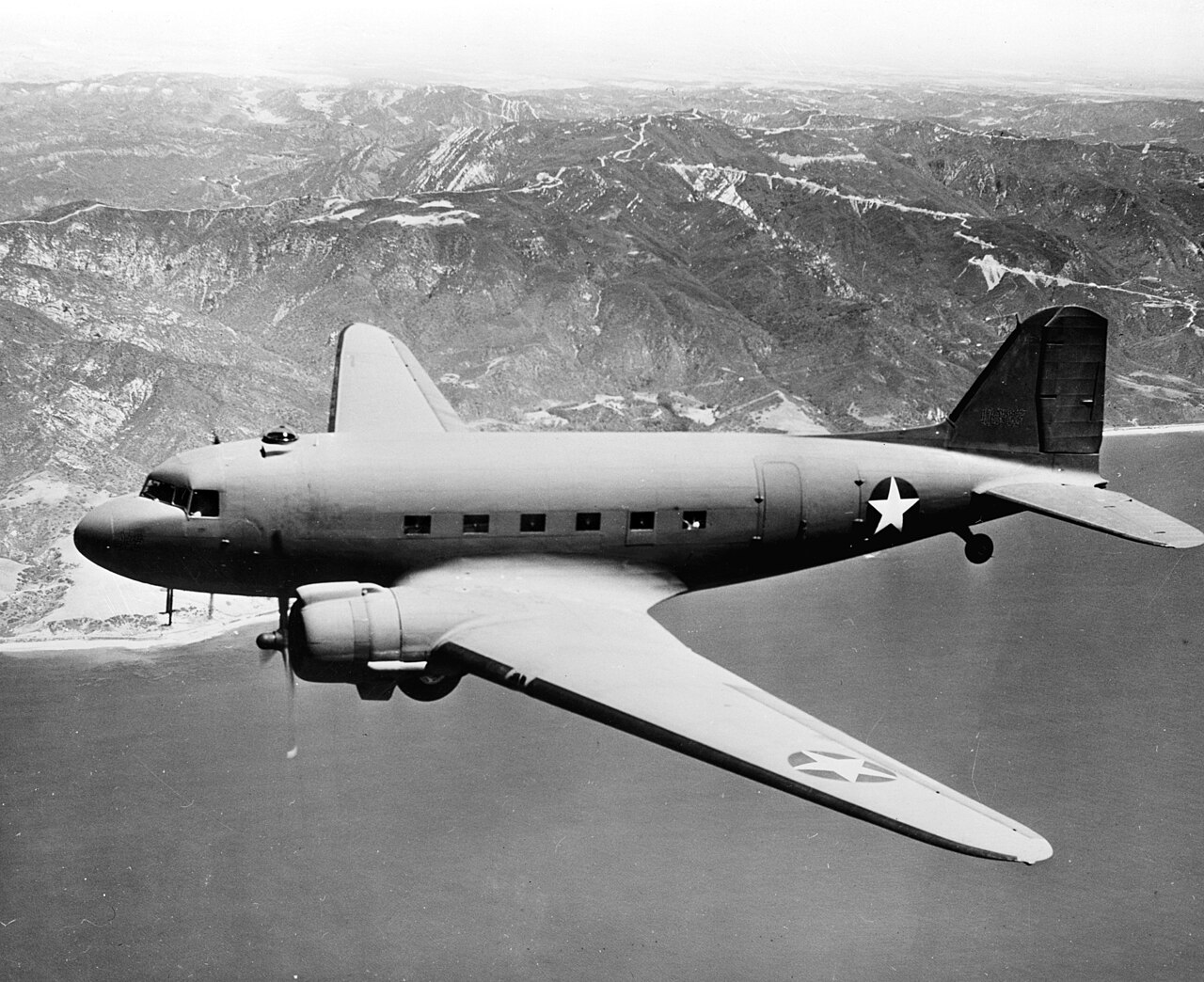
The aircraft was a metal low-wing monoplane powered by two radial engines and equipped with retractable main landing gear. Its tailwheel produced an inclined attitude on the ground, a feature still visible on preserved examples. The fuselage was unpressurised: weather conditions and terrain continued to influence routes and operating altitudes. Interior arrangements ranged from the DST's sleeping berths to rows of seats in daytime transports. Capacity depended on the choices made by individual operators. The aircraft thus combined established solutions with an enlarged airframe adapted to airline requirements. Its success did not depend on a single invention but on the balance between payload, range, maintenance and availability. These qualities had to work together if the machine was to remain useful in scheduled operations.
The first flight took place on 17 December 1935. American Airlines introduced the type in 1936, initially with sleeping accommodation and subsequently with aircraft intended for daytime travellers. Other American airlines adopted it and foreign orders followed. Passenger revenue could now cover a larger proportion of costs, without the same degree of dependence on mail income. Describing this change as guaranteed profitability on every route would nevertheless be excessive: load factors, fares and organisation remained decisive. The DC-3 primarily provided an aircraft better suited to regular commercial operation. Its introduction accompanied improvements in airports, navigation aids and procedures that shaped air transport before the war. The machine's economics and the development of the wider operating system were closely connected rather than separate achievements.
The Second World War transformed the scale and missions of this family. The military C-47 received freight provisions and a door suitable for loading, while other designations met different requirements. Aircraft carried troops, paratroopers, casualties and supplies, and some towed gliders. They participated in Allied operations across several theatres, including the landings in Europe. The name Dakota was used by British and Commonwealth forces. These aircraft should not all be confused with civilian DC-3s merely given a different paint scheme: their equipment and interior arrangements reflected their missions. Wartime production subsequently made a substantial pool of airframes, parts and technical skills available. This industrial and operational inheritance helped shape the type's post-war career as much as its original commercial design had done.
The family includes Douglas civil aircraft, American military transports and licensed manufacture abroad. In the Soviet Union the Li-2 resulted from local adaptation, while in Japan the L2D formed another branch. Production series differed in engines, equipment and some structural details. A manufacturing total therefore makes sense only if the included versions and countries are specified; no single figure is given here. After the war many military transports were fitted out for civilian airlines. Later modifications involved freight, specialised missions or replacing piston engines with turboprops. Such conversions extended an existing architecture but should not be described as aircraft remaining unchanged since 1935. Distinguishing these branches is necessary when comparing production totals, technical specifications and the careers of individual surviving machines.
After the war the DC-3 and its derivatives helped establish or rebuild networks on several continents. They subsequently surrendered major routes to faster aircraft with greater capacity, while remaining useful on secondary services and for freight. Their longevity depended on sustained maintenance, repairs and access to parts, not on an absence of wear. Examples preserved in museums allow visitors to examine cabins, flight decks and systems characteristic of unpressurised transport. The DC-3's legacy lies as much in this spread of operating practices as in its outline. It connects the economics of pre-war airlines, military logistics and the development of regional services without making those three histories entirely interchangeable. Its varied uses demonstrate how one basic design could be adapted to different operational settings.
Why it mattered
- The DC-3 improved the economics of scheduled passenger transport.
- Its military derivatives played an important role in Allied logistics.
- Surplus aircraft and foreign manufacture widened its distribution after the war.
Where to see it
- The Museum of Flight — Seattle, USA
Sources
- Smithsonian National Air and Space Museum — Collections
- Boeing — History
- National Museum of the U.S. Air Force — Aircraft fact sheets