Manufacturer
Douglas and McDonnell Douglas
An American manufacturer that became a major producer of civil and military aircraft before its integration into Boeing.
4 min read
Origins
Engineer Donald Wills Douglas, educated at the Massachusetts Institute of Technology, founded the Davis-Douglas Company with David Davis in 1920. The business was reorganised as the Douglas Company in 1921 in Santa Monica, California, and became the Douglas Aircraft Company in 1928. Its first notable programme was the DT-1 torpedo-carrying biplane, designed for the US Navy. It established a lasting relationship with the armed services, which supplied a substantial share of the company’s orders and technical experience for decades.
In 1933, the DC-1 began a line of ‘Douglas Commercial’ aircraft designed around all-metal construction and passenger transport. The DC-1 remained a prototype, but its development, the DC-2, was sold to airlines and helped change expectations of comfort and regularity. The company then developed several military and civil families. Like other American manufacturers, Douglas moved from an activity dominated by military contracts to large-scale commercial production, drawing on skills and tooling acquired during wartime.
Growth
The DC-3, which entered airline service in 1936, became the company’s most emblematic model. Its capacity, range and operating economy suited expanding air networks. During the Second World War, thousands were built as the C-47 for Allied forces. After the conflict, military aircraft were converted to civil transport, while the DC-4 and DC-6 served longer routes. The DC-3 is associated with the transformation of scheduled air transport, although its success cannot be separated from the infrastructure and markets of its period.
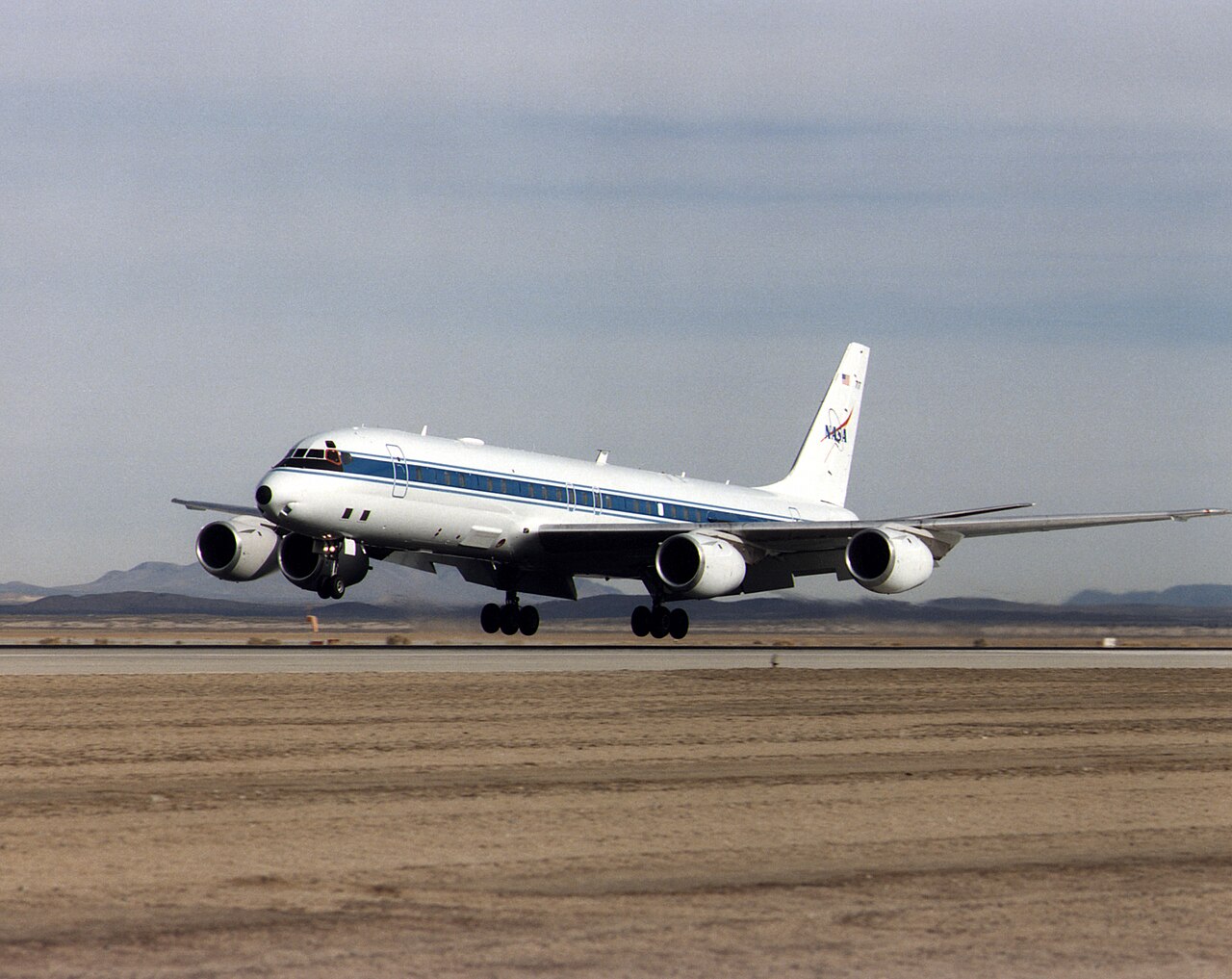
Douglas entered the jet age with the DC-8, introduced in 1959, and the smaller DC-9, intended for regional and medium-haul routes. These programmes illustrate two coexisting approaches: four-engine long-haul jets and single-aisle aircraft for shorter markets. The tri-jet DC-10 entered service in 1971. Its early years included accidents and safety difficulties, followed by investigations and modifications. Industrial history requires distinguishing design characteristics from the specific causes of individual accidents.
Major programmes
Beginning with the DC-9, Douglas offered an airliner family whose career continued under McDonnell Douglas. The DC-9 appeared in versions of increasing length and capacity. The MD-80, a development of the line marketed from the late 1970s, achieved international distribution. The MD-11, an updated successor to the DC-10, first flew in 1990 and entered service that year. The market was nevertheless shifting towards long-range twin-engine aircraft, and the model did not achieve the production volumes its maker had hoped for.
The ‘DC’ and ‘MD’ designations make the company’s transition visible, but do not by themselves describe all its activities. Douglas also built military aircraft, missiles and space launch vehicles. Commercial aircraft involved teams, suppliers and airline customers across several continents; their development depended on certification, finance and support as well as design. The models discussed here are therefore not merely a technical sequence: they reflect choices about capacity, engines and network organisation amid competition with Boeing and other manufacturers.
Mergers and acquisitions
The merger with McDonnell Aircraft was completed in 1967. Based in St. Louis, McDonnell was a major military manufacturer; the new McDonnell Douglas therefore combined civil and defence activities. The two legacies did not disappear at once: sites, programmes and engineering cultures continued to develop within the group. The merger took place as commercial-aircraft development costs were rising and company scale could help finance complex programmes.
In 1997, Boeing acquired McDonnell Douglas in a transaction that brought together two major American manufacturers. The McDonnell Douglas name ceased to identify an independent company, but aircraft in service and some production and support activities continued within the integrated organisation. The DC-3 remains the clearest link with Douglas history; other programmes were continued or closed according to their place in the portfolio. The combination changed the structure of the American industry without erasing the historical distinction between Douglas’s founding and the later merger.
Today
Douglas no longer exists as an independent manufacturer. Its history can be traced through preserved aircraft, types still operated, industrial archives and programmes inherited by Boeing. The broader setting includes post-war expansion of scheduled networks and the gradual replacement of piston-powered airliners by jets. Those changes affected fleets over many years rather than at a single turning point, and airlines weighed acquisition price, maintenance, route length and passenger demand. This context helps explain why a successful design could remain in service well beyond the period in which it was first introduced. The DC-3 remains visible in museums and with specialist operators; that continuity does not mean the original company still exists. A historical manufacturer profile must therefore distinguish the survival of an aircraft type, the retention of expertise and the legal status of the business.
Douglas’s development illuminates several changes in air transport: the move to metal construction, the growth of mass travel, the adoption of turbojets and the later consolidation of manufacturers. It also recalls the importance of military orders in the development of American industry. The widebody and single-aisle aircraft represent two categories. Comparing the DC-3, DC-8, DC-9 and DC-10 shows different responses to demand, not an inevitable progression. Boeing’s 1997 absorption ended McDonnell Douglas’s independent existence and placed its legacy within a larger group.
Notable aircraft
Other models
- Douglas DC-1 (1933)
- Douglas DC-2 (1934)
- Douglas DC-4 (1942)
- Douglas DC-6 (1946)
- Douglas DC-8 (1958)
- Douglas DC-9 (1965)
- Douglas DC-10 (1970)
- MD-80 (1980)
- MD-11 (1990)
Sources
- Boeing — History
- Encyclopædia Britannica — Douglas DC-3
- Encyclopædia Britannica — McDonnell Douglas Corporation