Manufacturer
Pratt & Whitney
Founded in 1925, American engine maker Pratt & Whitney has developed piston and jet engines for civil and military aviation.
3 min read
Origins
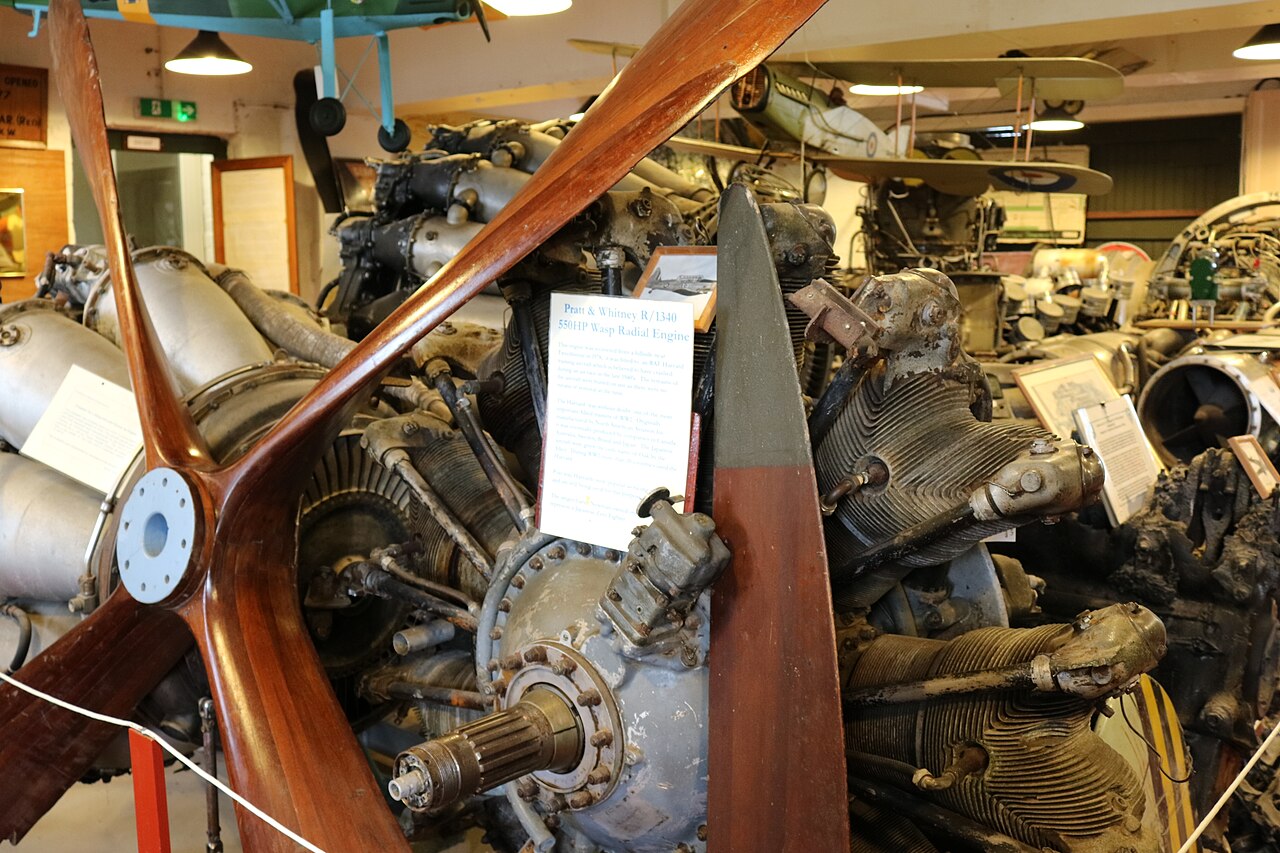
Pratt & Whitney Aircraft was founded in Hartford, Connecticut, in 1925 by Frederick Rentschler; in 1929 it joined United Aircraft and Transport Corporation. Its first major product, the Wasp, was an air-cooled radial engine. The design addressed a practical need: a compact, relatively light powerplant for a growing commercial and military aviation sector. The company’s name is rooted in New England industry, but its operations soon became national in scope.
The Wasp and its derivatives powered various aircraft between the wars. The company then developed more powerful radial engines, especially during the Second World War. This period strengthened its capabilities in design, serial production and technical support. These piston engines belonged to a generation before the turbojet, yet the production and engineering experience gained would matter in the transition to jet propulsion.
Growth
After the war, jet propulsion transformed the business. Pratt & Whitney developed the J57, whose civil JT3C version helped power the first generation of American jetliners. The JT3D, a turbofan derived from the J57, was later used on aircraft including relevant versions of the Boeing 707; the first Boeing 747s used the JT9D instead. It combined the bypass-flow principle with an architecture suited to large transport aircraft.
The JT8D became closely associated with short- and medium-range airliners of the next generation, including some versions of the Boeing 737. The JT9D was designed for widebodies and powered, among others, versions of the 747 and the Airbus A300. These programmes reflected several requirements: thrust, fuel use, noise, reliability and maintenance had to be considered together. Pratt & Whitney also maintained a substantial military-engine business.
Major programmes
The J58 was designed for the Lockheed A-12 and SR-71. It operated with afterburning and an inlet whose behaviour changed with speed. Popular accounts sometimes oversimplify it as a combined-cycle engine; it was a turbojet designed for the very high-speed flight conditions of these aircraft. This military programme remained distinct from the company’s civil transport-engine range.
In commercial aviation, the PW4000 and then the GTF families extended the company’s role. The PW4000 powers several widebody types, depending on variant and certification. The Geared Turbofan family, marketed as PW1000G, places a reduction gearbox between the fan and low-pressure turbine so those components can run at different speeds. Variants were selected for aircraft in the A320neo family; the ATR 42/72 is not among them, as it uses turboprop engines. Configuration and performance depend on the particular model.
The military portfolio includes the F100, an afterburning turbofan developed for American fighters. It was followed in separate programmes by the F119 for the F-22 and the F135 for the F-35. These engines are not variants of one design: each addresses a particular airframe, mission and technological generation. Development requires extensive testing, while in-service support uses networks distinct from those serving civil airlines.
Mergers and acquisitions
Pratt & Whitney Canada is a distinct company within the American group, with its own engine ranges, notably for business aviation, helicopters and regional turboprops. Its activities should not be conflated with those of US-based Pratt & Whitney. Through reorganisations of its parent company, the engine maker became part of United Technologies and later Raytheon Technologies, renamed RTX in 2023.
This succession of corporate structures reflects broader consolidation in aerospace and defence, rather than a technical change in the identity of the engines. The Pratt & Whitney name continued to identify an engine design and support business within these groups. Programmes are also developed with airframers, suppliers and certification authorities under agreements that differ from one engine to another.
Pratt & Whitney Canada develops a range separate from that of the US company. The PW100, designed and produced by the Canadian business, is a turboprop used on regional transport aircraft. The family should not therefore be assigned to the American parent’s jet-engine portfolio, even though both businesses share a corporate history. This distinction matters when considering design responsibility, locations of activity and the support networks associated with each range.
Today
Pratt & Whitney is now a business within RTX. It designs, manufactures and supports civil and military engines, as well as related systems. In-service support is central to the business: inspections, repairs, parts, documentation and operator assistance affect fleet availability. Engine maintenance is governed by airworthiness requirements and procedures specific to each type.
Propulsion remains an area of continuing development, shaped by targets for fuel consumption, noise, durability and operating cost. High-bypass architectures and gearboxes are among the technical approaches, without eliminating trade-offs in integration, weight and maintenance. The company’s history therefore links the radial engines of the 1920s with current turbofans, while keeping its US and Canadian businesses distinct. The propulsion feature places these developments in context.
Notable aircraft
- Douglas DC-3
- Boeing 707
- Boeing 737
- Boeing 747
- Lockheed SR-71 Blackbird
- Airbus A300
- Airbus A320
- ATR 42 / ATR 72
Other models
- Wasp (1925)
- JT3D
- JT8D
- JT9D
- J58
- PW4000
- PW1000G
Sources
- Encyclopædia Britannica — History of flight
- Encyclopædia Britannica — Pratt & Whitney
Related reading
Feature
From piston engine to turbofanAircraft
Boeing 707Aircraft
Boeing 737