Airbus A320
A European single-aisle aircraft combining digital fly-by-wire controls with a family approach.
History
After the A300 and A310 widebodies, Airbus sought to extend its offering to short and medium-haul routes served by single-aisle aircraft. The A320 programme was launched in 1984, in a market where airlines needed to renew their fleets while controlling operating costs. The project built on the European industrial cooperation already established around Airbus. It was not simply a scaled-down widebody: cabin size, the frequency of turnarounds and cockpit organisation addressed different requirements. Air France was among the early customers and became the launch airline for entry into service, giving the programme a place within an established network carrier's fleet renewal plans.
The A320 combines a low-wing airframe and two turbofan engines with digital fly-by-wire flight controls. Pilot inputs through sidesticks are interpreted by computers that command the control surfaces. In normal operation, protections restrict certain excursions beyond the flight envelope; their availability depends on the control laws and system condition. The cockpit is arranged around electronic displays and designed for two pilots. The single-aisle cabin can accommodate six seats abreast. Initial engine options included the CFM56 and V2500, depending on the version, within an architecture allowing airlines to choose between suppliers. These choices joined conventional airliner geometry to a different approach to controlling the aircraft.
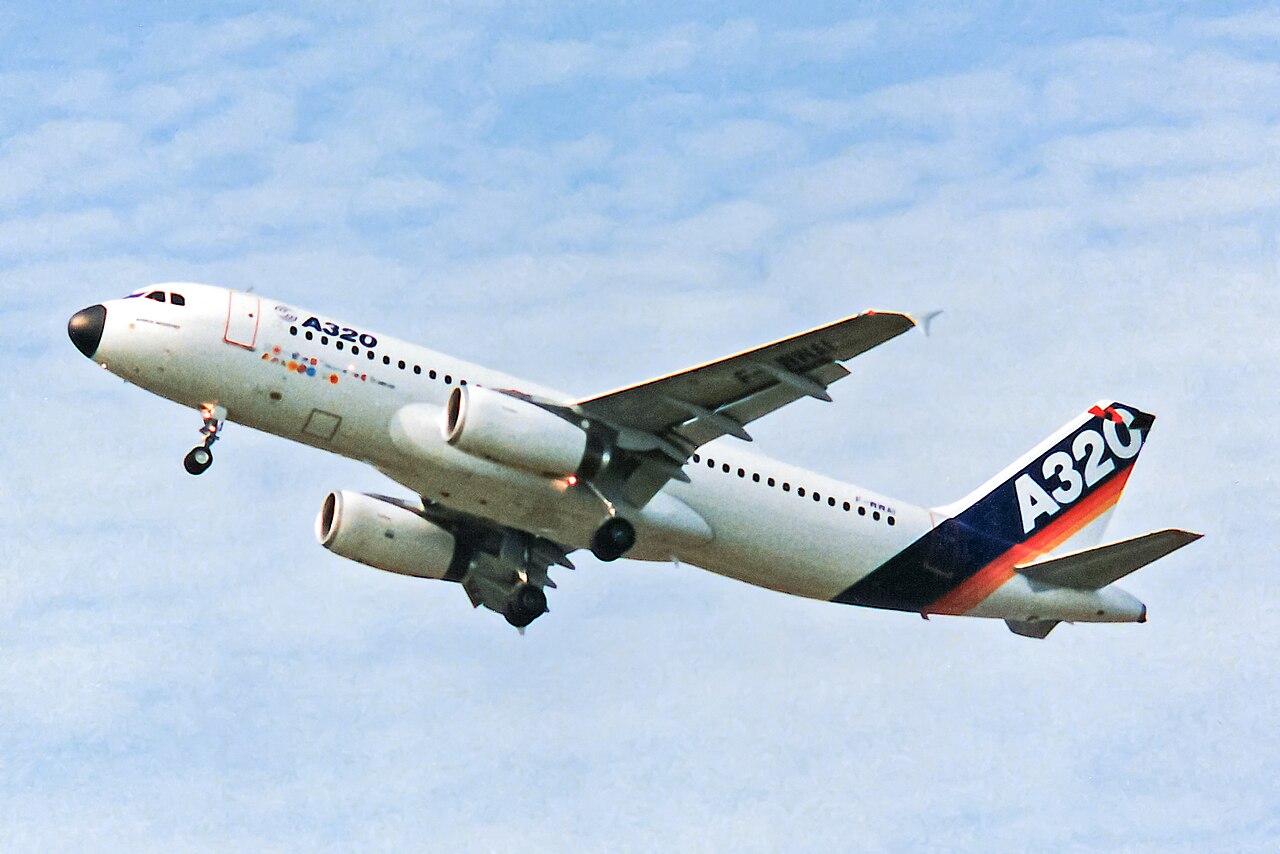
The first A320 made its maiden flight from Toulouse on 22 February 1987. Certification and deliveries subsequently opened the way to entry into service with Air France in April 1988. The transition from testing to commercial operation required crew training, maintenance preparation and the introduction of new procedures. The aircraft brought a different flight-control interface into large-scale single-aisle airline service. Electrical controls removed neither the pilots' responsibilities nor the need to understand automation. Their use was accompanied by working methods and training adapted to the interactions between the crew, computers and aircraft systems. Operating the new type therefore involved organisational changes as well as the introduction of a new airframe.
The A320 was adopted by network airlines, leisure carriers and low-cost airlines. It serves domestic and international routes, with cabin arrangements varying between markets. Available capacity depends on seat layout, travel classes and certified limits, so a single number cannot describe every cabin. For operators, the family's appeal extends beyond fuel consumption alone. Similarities between cockpits and systems help airlines organise fleets, subject to the qualifications and training that remain necessary. Production rests on a European industrial network supplemented by final assembly lines outside Europe. The aircraft's commercial career thus connects the evolution of airline business models with the geographical development of aircraft manufacturing and assembly.
Around the A320, Airbus developed the stretched A321, followed by the shorter A319 and the still shorter A318. These models belong to one family but have distinct capacities and performance characteristics. The neo generation introduced new engines, offered with LEAP-1A or PW1100G-JM powerplants depending on configuration. The A320neo first flew in 2014 and entered service with Lufthansa in 2016. Aircraft from the preceding generation are commonly described as ceo to distinguish them from neo models. This development does not erase differences between versions: weight, range, equipment and cabin possibilities must always be related to the specific model and its technical standard rather than to the family name alone.
The history of the A320 does not end with a general withdrawal from service. Older aircraft leave airline fleets while subsequent generations extend the use of its architecture. Its legacy is especially apparent in the spread of digital fly-by-wire controls and the pursuit of commonality between commercial models. Airbus adopted this cockpit philosophy on other families, with the adaptations appropriate to each. The A320 therefore illustrates the relationship between technical choices and the daily organisation of airlines. Studying it requires distinguishing the original model, the expanded family and successive engine generations, rather than indiscriminately assigning them the same dates, dimensions or performance figures across every version.
Why it mattered
- The A320 spreads digital fly-by-wire controls through single-aisle airline transport.
- The sidestick cockpit changes the interface between crew and systems.
- Commonality between models contributes to airline fleet organisation.
Where to see it
- Aeroscopia — Blagnac, FranceFirst A320 prototype.
Sources
- Airbus — Our history
- EASA — Type certificates