Manufacturer
Safran
A French aerospace and defence group, Safran is an engine maker and equipment supplier.
3 min read
Origins
The industrial history leading to Safran passes through several French companies, notably Gnome et Rhône. Formed by combining engine businesses, it produced piston engines for aviation before the Second World War. Its radial engines powered civil and military aircraft. This period illustrates the importance of national production at a time when European engine makers sought mastery of technologies essential to aviation.
In 1945, Gnome et Rhône was nationalised and incorporated into the Société nationale d’étude et de construction de moteurs d’aviation, later known as Snecma. The new company continued engine production and design, then moved towards gas turbines. This transformation was part of the post-war reconstruction of French industry. Piston engines gradually gave way to turbojets, reshaping skills, test facilities and relationships with airframers.
Growth
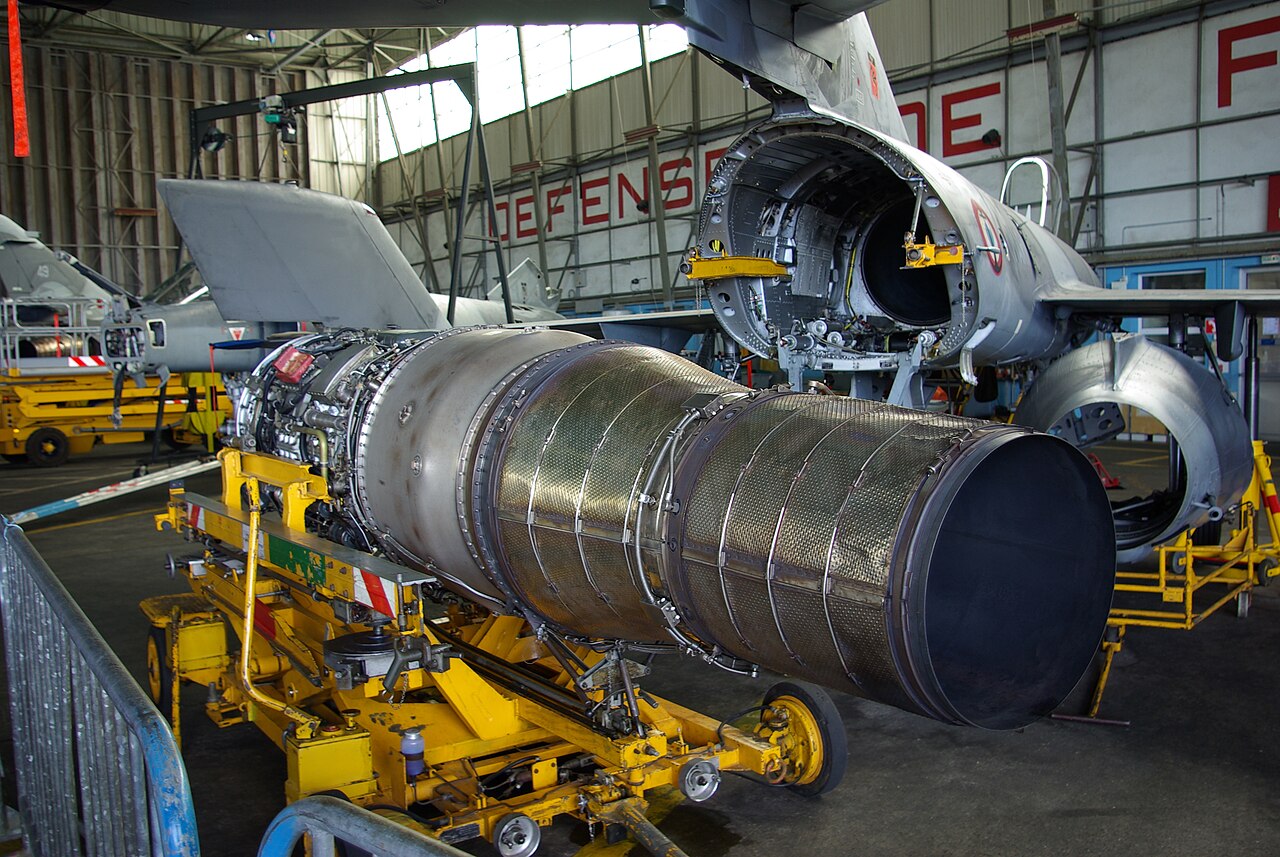
Snecma developed the Atar family of jet engines for French military aircraft. Variants powered the Mirage III and other aircraft, accompanying the growth of jet combat aviation. The programme required continual adaptation of engines to changing airframes, performance needs and operating conditions. It helped establish a lasting French capability in military engines, alongside civil programmes carried out in cooperation.
Another major programme was the Olympus 593, developed jointly by Snecma and Rolls-Royce for Concorde. The two companies contributed to a propulsion system for supersonic transport: the Olympus engine, afterburning and a variable-geometry nozzle. Concorde’s commercial operation began in 1976. Franco-British cooperation combined a division of industrial work with technical coordination in a project distinctive in its operating profile and scale.
Major programmes
In 1974, Snecma and General Electric created CFM International, a joint venture to develop and market a civil engine family. Its name combines GE’s CF6 and Snecma’s M56. The CFM56 became one of the most widely used narrowbody engines, powering versions of the Boeing 737 and Airbus A320. The programme’s industrial reach rests on this long-running cooperation, while retaining shared governance and a joint brand distinct from either parent company.
The M88, developed by Snecma and later Safran, powers the Rafale. In civil aviation, the LEAP, developed by CFM International, powers variants of the Boeing 737 MAX, the A320neo family and the COMAC C919. It is a joint-venture programme, not an engine developed by Safran alone. Design brings together several industrial partners, with responsibilities divided and certification specific to each application.
Mergers and acquisitions
In 2005, Snecma and Sagem merged to form Safran. The transaction brought together propulsion with electronics, systems and equipment businesses. It created a group whose roots span several branches of French industry. The new organisation retained specialist companies and brands, including Snecma for engines, while developing a shared group identity.
The merger did not dissolve CFM International’s structure or remove the role of its industrial partners. Safran owns half of the joint venture with GE; programme decisions are governed by agreements between the two groups. Safran has since integrated other businesses and companies, but the most relevant events in its engine history remain the 1945 nationalisation, CFM cooperation and creation of the group in 2005.
Today
Safran operates in aircraft engines, aerospace equipment and defence. Its portfolio combines programmes developed directly by the group with partnerships, notably CFM International with GE Aerospace. For engines in service, technical support includes maintenance, repair, parts supply and airline assistance. These activities take place within certification and airworthiness frameworks that evolve over each type’s lifetime.
The group contributes to research aimed at reducing fuel use and emissions while accounting for safety, cost and operational needs. An announced improvement alone does not prove results under every condition: comparisons must distinguish engines, aircraft and mission profiles. From Gnome et Rhône to LEAP, this history traces the move from piston engines to turbojets and turbofans, and the growing importance of partnerships. The propulsion feature sets out the general principles.
French propulsion history also includes specialist companies whose capabilities later entered larger industrial groups. Founded in 1938, Turbomeca concentrated on lightweight turbines, particularly for helicopters. Hispano-Suiza had earlier developed aircraft engines and equipment; its activities were integrated into French groups during post-war reorganisations. These histories differ from Snecma’s, but help explain the range of activities brought together within Safran.
In 2018, Safran completed its acquisition of Zodiac Aerospace, a supplier specialising in areas including aircraft interiors and cabin equipment. The transaction broadened the group beyond engines by strengthening its aerospace-equipment activities. It illustrates a portfolio strategy distinct from propulsion partnerships alone: a group can combine engines, systems and equipment while retaining specialist technical businesses. Zodiac Aerospace thus became part of Safran’s recent history without changing CFM International’s identity.
Notable aircraft
Other models
- Gnome 9N (Gnome et Rhône)
- Atar 9C
- M88
- Olympus 593
- CFM56
- LEAP
Sources
- Safran — Musée Safran
- Encyclopædia Britannica — Safran
Related reading
Feature
From piston engine to turbofanAircraft
ConcordeAircraft
Boeing 737