Feature
From piston engine to turbofan
Propellers, turbines and bypass engines: a history of architectures, their uses and the compromises between power, thrust, fuel consumption and maintenance.
5 min read
Turning heat into motion
An aircraft engine must provide propulsive force without imposing excessive weight. In a piston engine, combustion moves pistons that drive a crankshaft and then a propeller. The propeller accelerates a mass of air backwards; the reaction pushes the aircraft forwards. The engine produces mechanical power, while the propeller turns that power into thrust. Distinguishing these stages explains why increasing power does not automatically produce a proportional increase in speed. Aerodynamic resistance, propeller efficiency and installation weight all interact, and improvements to one component must be assessed within the complete aircraft rather than in isolation.
The 1903 Flyer carried a four-cylinder engine built by Charlie Taylor with the Wright brothers. A chain transmission drove two propellers. Success depended on the combination of engine, transmission, propellers and airframe, rather than the powerplant alone. The Wright brothers notably developed blade shapes as rotating wings. In the pioneer era, reducing engine weight while providing cooling and a reliable fuel supply remained a central difficulty. Progress also meant being able to repeat flights, not simply leaving the ground once. An engine therefore had to be judged both by its output and by dependable operation.
Rotaries, radials and inline engines
The rotary engine, exemplified by Gnome designs, has cylinders that rotate with the propeller around a fixed crankshaft. This arrangement aids cooling and offers an attractive power-to-weight ratio for early aircraft. It also brings lubrication demands and gyroscopic effects that influence handling. It must not be confused with the fixed-cylinder radial engine. In the latter, the crankshaft rotates while the cylinders remain attached to the crankcase: an essential mechanical distinction despite their shared circular appearance. Similar outlines can therefore conceal very different arrangements, with consequences for maintenance as well as for the pilot.
During the interwar years, air-cooled radial engines powered many transports, including the Douglas DC-3. Inline or V engines, often liquid-cooled, offered different compromises in shape and installation; the Merlin in the Spitfire is a familiar example. No single arrangement embodies progress by itself. Supercharging, fuels, metallurgy and variable-pitch propellers increased the capabilities of piston engines. At altitude, a supercharger helps compensate for thinning air, but adds components and thermal demands. The development of piston propulsion was thus a combination of advances rather than a simple succession of increasingly powerful engine layouts.
The turbine and the beginnings of the jet
The turbojet changes the conversion chain. A compressor compresses air, fuel burns in a combustion chamber, and the gases then pass through a turbine and nozzle. The turbine extracts the energy needed to drive the compressor; the accelerated flow contributes to thrust. Unlike the intermittent cycle within cylinders, combustion is continuous during normal operation. Compressor, chamber and turbine form a closely coupled system. Producing a useful engine therefore requires more than creating a jet: the components must operate together across a range of settings and withstand high temperatures without losing their mechanical integrity.
Frank Whittle in Britain and Hans von Ohain in Germany developed turbojets independently during the 1930s. The Heinkel He 178 flew on 27 August 1939 with an engine designed by von Ohain. The Gloster E.28/39 flew with a Whittle engine in 1941. War accelerated development, leading to operational use of the Messerschmitt Me 262 in 1944. Early jets notably suffered from limited service life and high fuel consumption. Their high-speed performance should not obscure manufacturing difficulties, available materials and the new demands placed on maintenance crews learning to support a different kind of propulsion system.
Two paths: direct jet thrust and propellers
After the war, commercial transport progressively adopted turbine power. The Comet entered service in 1952 with turbojets. Jets could fly faster and higher than conventional piston transports, but their usefulness depended on stage length, fuel and operating conditions. Early jet aircraft therefore did not immediately replace every propeller-driven type. Propulsion history here meets the history of route networks: a technical solution must suit the distances served, the available runways and the capabilities of maintenance workshops. The engine that performs well on a long route is not necessarily the most suitable choice for a shorter one.
The turboprop uses a gas turbine primarily to drive a propeller, generally through a reduction gearbox. The Vickers Viscount entered commercial service in 1953 and illustrates this alternative path. The ATR 42 and 72 demonstrate its persistence on regional routes. At moderate speeds, the propeller accelerates a large mass of air through a relatively small velocity increase, favouring propulsive efficiency. At higher speeds, compressibility effects at the blades become restrictive. The turboprop is therefore neither a modernised piston engine nor a stage simply superseded by the jet: it is a distinct use of the gas turbine.
Bypass engines and widebody aircraft
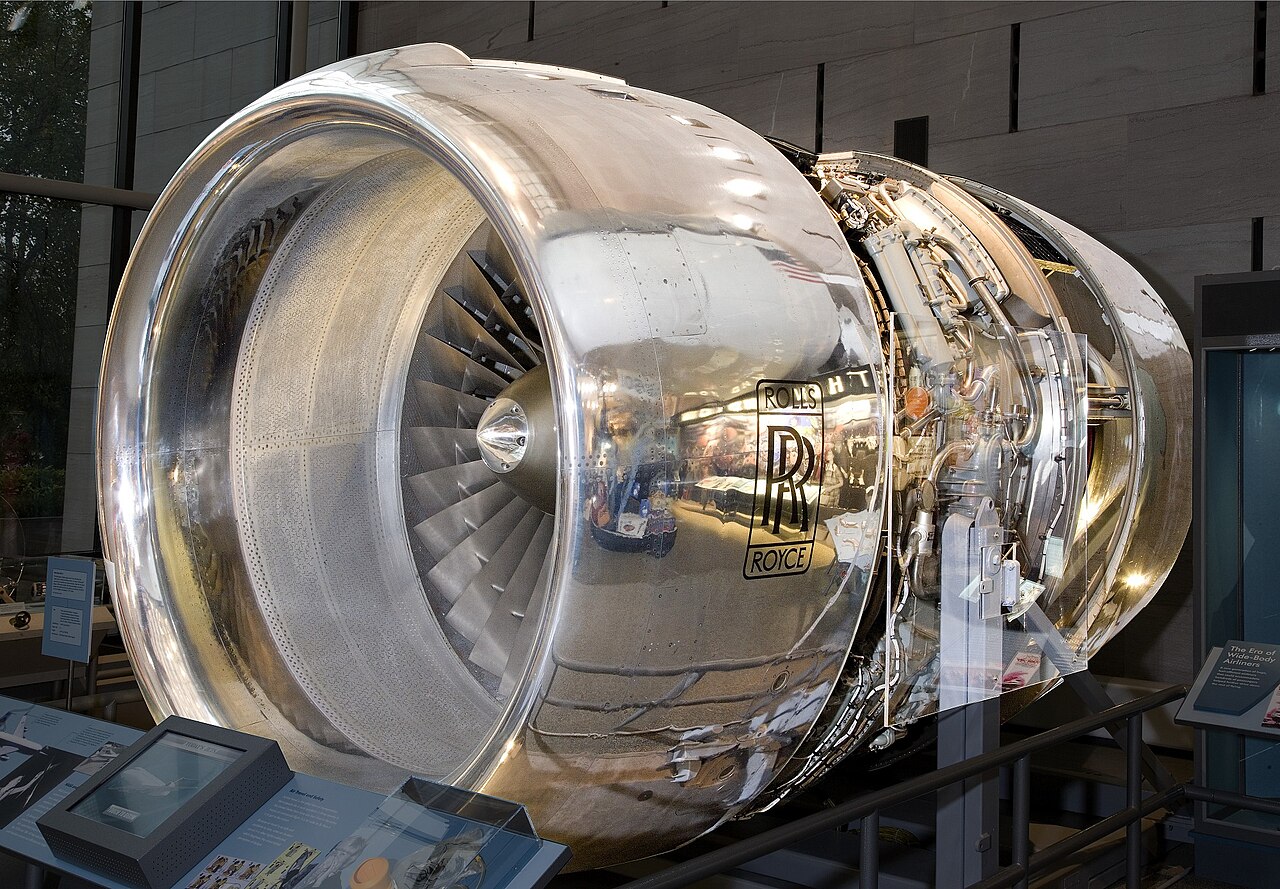
The turbofan adds a fan driven by the turbine. Some air passes through the core while another stream bypasses it. The bypass ratio is the ratio of the mass flow bypassing the core to the mass flow passing through it. It describes neither a fuel proportion nor directly a share of thrust. The bypass stream, often called cold in contrast to combustion gases, has nevertheless received energy from the fan. Low-bypass engines preceded the widespread adoption of large civil fans; bypass propulsion therefore did not suddenly appear with the arrival of widebody aircraft.
The Boeing 747, which entered service in 1970 with the Pratt & Whitney JT9D, marked the commercial expansion of high-bypass engines. The General Electric CF6 and Rolls-Royce RB211 also belong to this generation. In subsonic flight, accelerating more air less strongly improves propulsive efficiency and reduces some noise sources compared with the fast jets of early turbojets. But a larger fan also increases nacelle dimensions, weight and drag. Selecting an engine remains an integration compromise, not a search for the highest possible bypass ratio regardless of other conditions. Engine and airframe must be considered together.
Materials, control and maintenance
Improving the core depends notably on compression and allowable temperatures ahead of the turbine. Superalloys, blade cooling and thermal coatings enable parts to operate in a severe environment. These gains have limits: heat, centrifugal forces and repeated cycles stress the components. Some architectures separate several rotating spools operating at different speeds; others add a gearbox between turbine and fan. There is therefore no single turbofan architecture. Design choices seek to match each component to its task while controlling weight, fuel consumption and mechanical complexity. A change beneficial to one component must still work within the complete engine.
Digital FADEC control commands the engine and monitors its limits using information from sensors. It removes neither inspection requirements nor wear. The maintenance feature therefore complements performance history with in-service monitoring: examining parts, looking for damage and respecting prescribed life limits. Finally, improved efficiency and an absence of emissions are not synonymous. Engines burning fuel remain associated with emissions and climate effects. The decarbonisation feature addresses that separate question, without presenting the turbofan as the inevitable endpoint of all aircraft propulsion. Piston engines, turboprops and turbofans continue to answer different operational needs rather than forming a single ladder of replacement.
Sources
- NASA — Aeronautics
- Science Museum — Collections
- Smithsonian National Air and Space Museum — Collections
- Safran — Musée Safran
- Boeing — History
Related reading
Manufacturer
Rolls-RoyceManufacturer
Pratt & WhitneyManufacturer
GE AerospaceManufacturer
SafranAircraft
Wright FlyerAircraft
Boeing 747Glossary
TurbofanGlossary
TurbopropFeature
Aircraft maintenance, from mechanic to Part-66 technicianFeature
Towards low-carbon aviation