Messerschmitt Me 262
The Me 262 entered combat in 1944, combining jet performance with the constraints of wartime development and production.
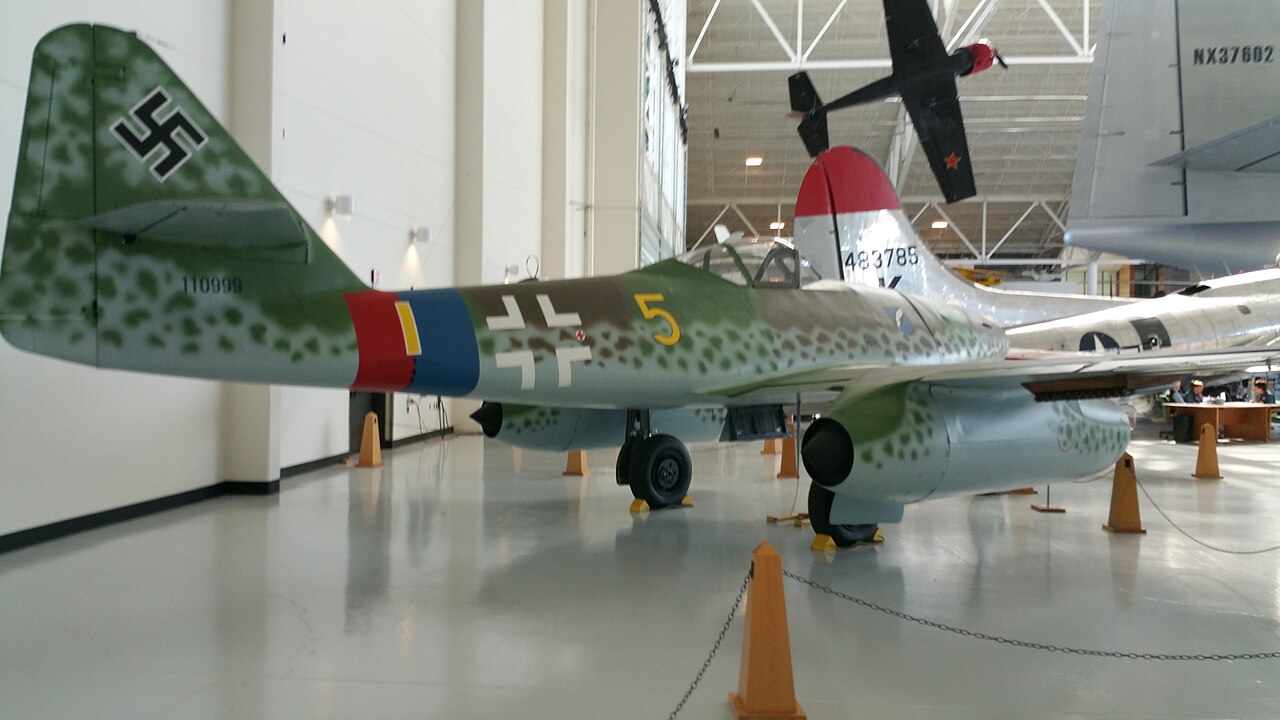
History
The Messerschmitt Me 262 was studied before jet propulsion had become standard military equipment. In the late 1930s, German work on turbojets opened the possibility of a fighter whose performance no longer depended on a propeller. Airframe and engines nevertheless progressed on different schedules. The project cannot therefore be understood as the simple installation of immediately available equipment on a finished aircraft. Trials, industrial decisions and Luftwaffe requirements accompanied a lengthy development process. Wartime conditions increased expectations but also imposed constraints on materials, personnel and manufacturing arrangements. Those circumstances are essential to understanding the gap between an experimental aircraft taking flight and a service machine becoming operationally available.
The Me 262 received two engine nacelles beneath its wings and a fuselage accommodating the pilot and armament. Production aircraft used Junkers Jumo 004 turbojets with axial-flow compressors. The wing had moderate sweep, which should not be equated without qualification with the wings of later jet fighters. The prototypes also underwent changes to their landing gear before a tricycle arrangement was adopted for production machines. Removing the propeller eliminated some constraints but introduced others: engine acceleration, response to throttle movements and the life of hot components became central concerns for pilots and maintenance teams alike. Jet power changed the practical demands of operating the aircraft, not merely its maximum speed.
The prototype first flew on 18 April 1941 with a piston engine installed in its nose, as the turbojets were not yet ready for satisfactory use. That date must be distinguished from 18 July 1942, when Fritz Wendel flew the Me 262 solely under jet power. The second milestone determines the year used in this entry. Further trials remained necessary before military employment. The type entered combat in 1944 after evaluation by specialised units. Its chronology demonstrates that a first jet-powered flight meant neither immediate availability in quantity nor complete operational readiness on the day of the test, even when the basic airframe had already been flown.
The Luftwaffe used the Me 262 to intercept Allied formations and conduct attack missions. Its speed complicated combat for propeller-driven fighters, but also required changes to firing approaches and interception arrangements. Take-off and landing remained vulnerable phases. Actual effectiveness depended on serviceable engines, fuel, trained pilots and usable airfields. During 1944 and 1945 these conditions deteriorated in Germany. Production also relied on forced labour within the Nazi industrial system. The aircraft's performance should not obscure that human dimension, nor be confused with an ability to change the war's outcome by itself. Technical capability and the wider conditions necessary to employ it were separate, though closely connected, questions.
The Me 262 A-1a fighter version carried four 30 mm cannon in its nose. The Me 262 A-2a addressed fighter-bomber employment, with equipment adapted for carrying bombs. Other installations concerned reconnaissance, two-seat training and night fighting. Some projects or prototypes did not lead to use comparable with that of the principal versions; each proposed variant should therefore not be presented as a substantial operational production series. Debates over priority for bombing belong to the programme's history but do not explain its delays alone. Engine maturity and production difficulties remained essential factors, alongside changing requirements and the practical obstacles to introducing a new propulsion system during wartime.
Germany's surrender ended Luftwaffe operation of the Me 262 in 1945. Captured aircraft were studied by the Allies, while Czechoslovakia continued limited postwar production of a derivative designated Avia S-92. Preserved examples now allow this early generation of operational jet fighters to be examined. The aircraft in the US Air Force museum was transferred to the United States for evaluation after the conflict. The Me 262's legacy is neither a story of a decisive weapon nor a single line of descent to every subsequent jet: it demonstrates concretely both the speed advantages and the technical, industrial and operational limitations of a propulsion system still in its early development.
Why it mattered
- The Me 262 was among the first jet fighters committed to combat.
- Its career demonstrates the gap between maximum speed and sustained operational effectiveness.
- Its industrial history includes the use of forced labour within the Nazi system.
Where to see it
- National Museum of the United States Air Force — Dayton, Ohio, USA
- Deutsches Museum — Munich, Germany
Sources
- National Museum of the U.S. Air Force — Aircraft fact sheets
- Deutsches Museum — Sammlungen
- National Museum of the U.S. Air Force — Messerschmitt Me 262A Schwalbe