de Havilland Comet
The first jet airliner in commercial service, the Comet combined an operational advance with a consequential history of structural fatigue.
History
The Comet originated in British planning for post-war civil transport while the world conflict still occupied the aircraft industry. The Brabazon Committee's work distinguished several requirements and included a place for jet transport. De Havilland possessed experience with both aircraft and engines that allowed it to approach this field. The project nevertheless required more than a change of propulsion: speed, altitude, pressurisation and commercial operation had to be considered together. BOAC became the central participant in introducing it to service. The programme aimed at international routes with a relatively compact aircraft at a time when piston transports remained the reference for timetables, infrastructure and crew training. Bringing the new propulsion system into that environment required an integrated aircraft and operating programme.
The four-jet aircraft had a pressurised cabin and engines buried in the wing roots. This integration produced an outline different from aircraft with engines suspended beneath their wings. Early Comets used de Havilland Ghosts; subsequent developments adopted Rolls-Royce Avons. High-altitude flight reduced exposure to some turbulence but subjected the structure to pressure differences repeated on every journey. Openings, joints and manufacturing methods therefore acquired particular importance. The airframe had to withstand aerodynamic loads as well as pressurisation cycles. These demands were not entirely unknown, but their combination with the intended operating tempo went beyond the experience accumulated on earlier generations. Understanding the aircraft's development consequently requires attention to its structural design as well as to the greater speed provided by its engines.
The prototype flew on 27 July 1949. On 2 May 1952 BOAC opened a commercial Comet service between London and Johannesburg with intermediate stops. The aircraft became the first jet airliner to operate a scheduled service. Its speed shortened journeys and its propulsion provided a different experience from piston engines. Entry into service did not yet mean nonstop flights between every major destination: range, payload and available airfields still required stages. The opening months therefore combined the appeal of new equipment with the constraints of an existing network. Other operators became interested in the type, while crews and technical departments acquired experience that still existed on only a limited scale. Routine operation had to establish practices beyond those demonstrated by the prototypes.
Accidents abruptly called this initial operation into question. After a disaster near Calcutta in 1953, two in-flight breakups occurred over the Mediterranean in January and April 1954. The fleet was grounded, with a temporary return to service between the two 1954 accidents. Investigation combined wreckage recovery, metallurgical examination and repeated pressurisation tests on an airframe placed in a water tank. These revealed inadequate structural fatigue life and stress concentrations around openings. Reducing the explanation to square passenger windows alone would be misleading: equipment openings, manufacturing details and the conditions of the original tests also mattered. The findings changed methods for evaluating pressurised structures and establishing their endurance. The investigation addressed a combination of design and testing issues rather than identifying one isolated visual feature as a complete explanation.
Later Comets were not simply the original model returned to circulation. Structural and engine changes accompanied the family's development. The Comet 2 notably entered British military use, while the Comet 3 served in developing an enlarged configuration. The revised, longer-range Comet 4 entered service in 1958. BOAC used it on the North Atlantic before the Boeing 707 began its own commercial transatlantic services. Versions 4B and 4C addressed other combinations of capacity and range. Their careers involved several airlines, including BEA, Olympic and Mexicana. Dimensions and capacities varied sufficiently for a single value applied to all Comets to convey little useful information. The later aircraft must therefore be distinguished from the early machines both technically and in accounts of their operating history.
The Comet continued a commercial career after its return but did not recover its industrial lead of the early 1950s. Larger American aircraft occupied a growing share of the market, while British examples gradually moved to secondary services and eventually left airline routes. Some airframes also undertook test duties. The Nimrod maritime patrol aircraft derived from the family, although with substantial changes associated with its military role. The Comet's legacy thus extends beyond both the first jet service and the accidents. It includes a return with a revised airframe and a lasting contribution to fatigue substantiation practices. This history demonstrates that regular operation is itself a technical test, distinct from successful first flights and demonstrations of performance, and that the development of an airliner continues beyond its initial introduction.
Why it mattered
- The Comet inaugurated scheduled jet passenger transport in 1952.
- Investigation of the in-flight breakups advanced understanding of fatigue in pressurised structures.
- The Comet 4 achieved a commercial return with a substantially revised airframe.
Where to see it
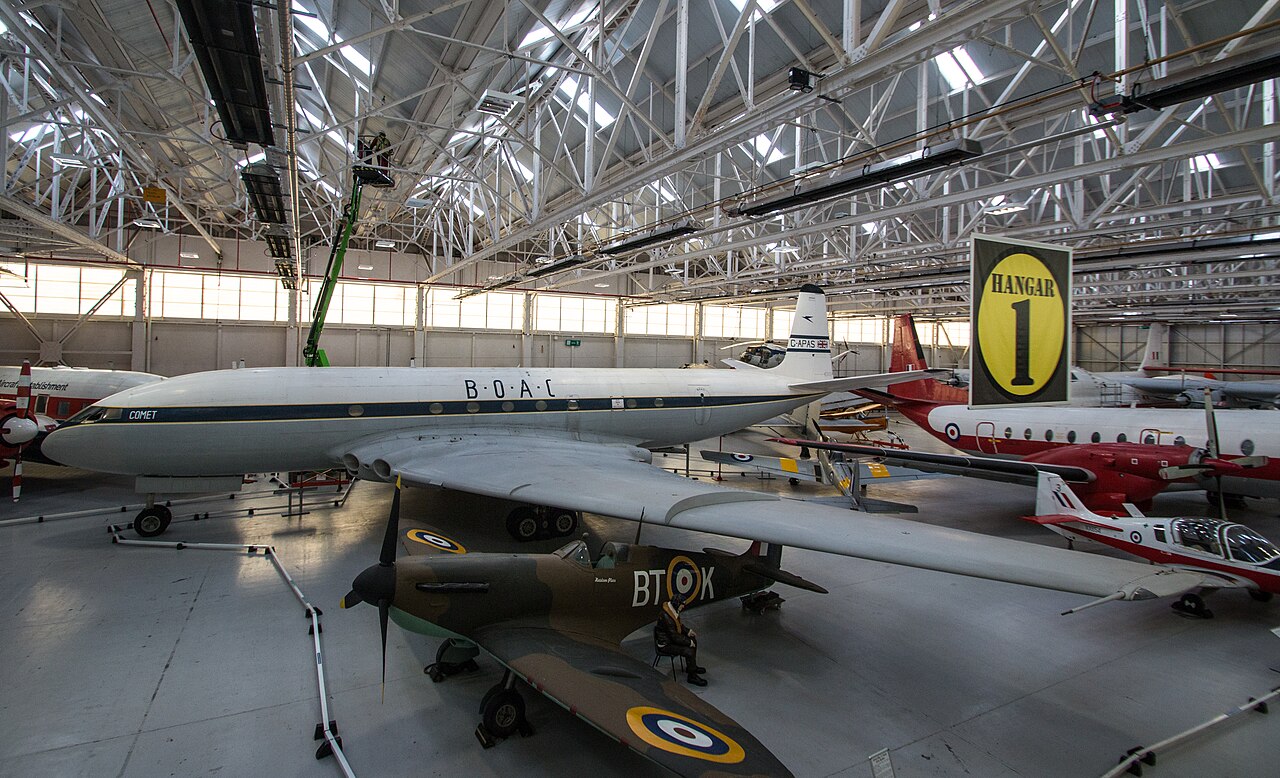
- RAF Museum Midlands — Cosford, United KingdomComet on display at Cosford.
Sources
- Science Museum — Collections
- RAF Museum — Collections
- Federal Aviation Administration — De Havilland DH-106 Comet 1