Wright Flyer
The 1903 Flyer brought the Wrights’ research into sustained, controlled powered flight into practice.
History
In Dayton, Ohio, Wilbur and Orville Wright ran a bicycle workshop that provided both income and practical experience of lightweight mechanisms. From 1899 they studied the work of earlier experimenters, particularly Otto Lilienthal, and investigated the available knowledge about flight. They believed that controlling a machine in the air had to be solved before installing an engine. A kite followed by several gliders allowed them to move gradually from observation to experiment. The dunes of North Carolina offered steady winds, open ground and sand for landings. This programme directly preceded the construction of the Flyer and explains its configuration. It was a sequence of connected investigations rather than an isolated attempt to add power to an untested airframe.
Disappointing results with the 1901 glider led the brothers to measure the characteristics of wing sections themselves in a small wind tunnel. Their 1902 glider then combined wing warping with a movable rudder, while an elevator stood at the front. The Flyer retained this arrangement in a wood and fabric biplane. The pilot lay on the lower wing and controlled wing warping through a cradle moved with his hips. Charles Taylor helped build the engine in the Dayton workshop. Chains drove two pusher propellers rotating in opposite directions. Their shape also resulted from aerodynamic investigation rather than simply copying marine propellers. Airframe, control system and propulsion were therefore developed as interdependent parts of the same experimental flying machine.
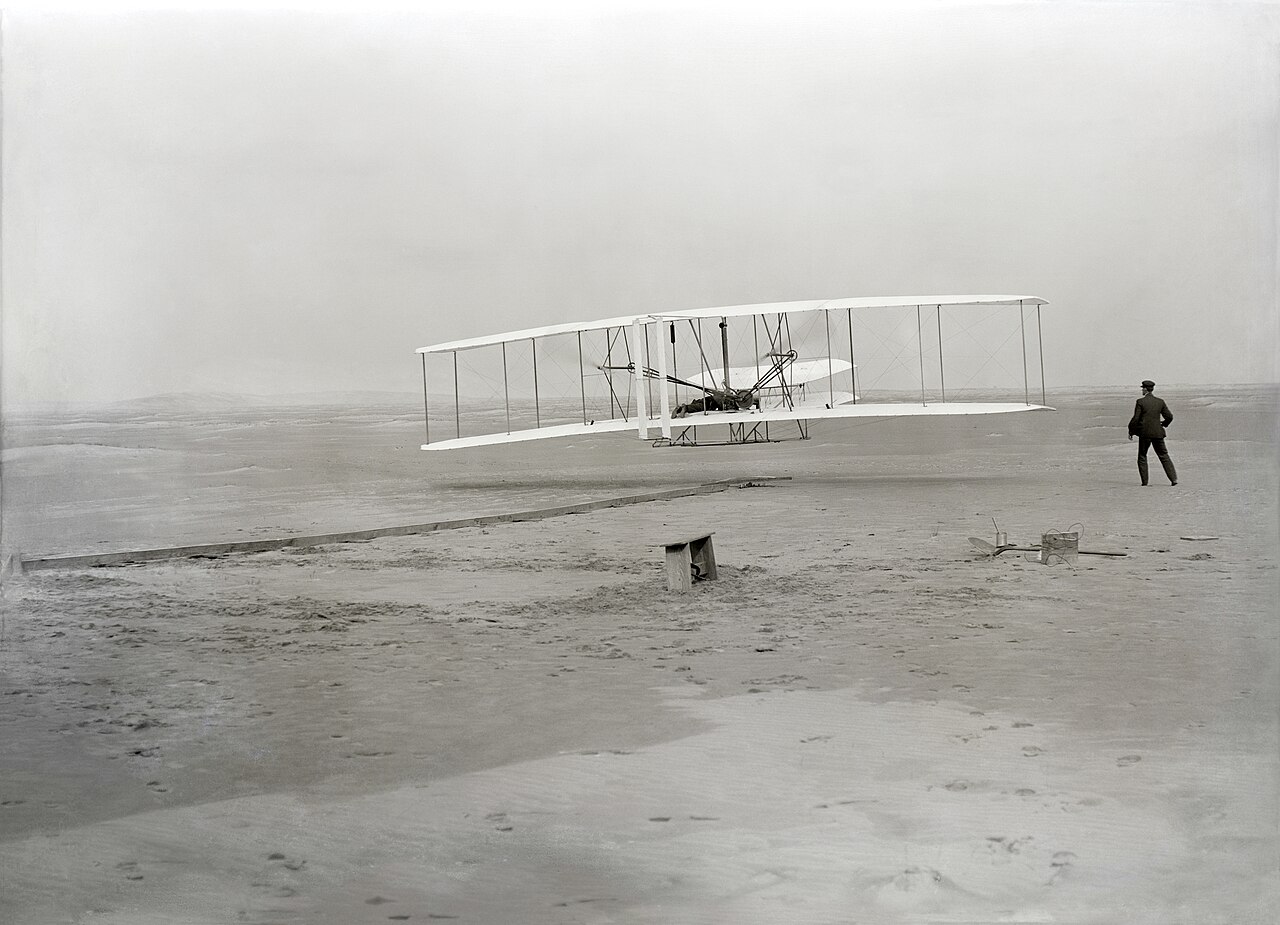
An initial powered attempt on 14 December 1903 ended prematurely and required repairs. On 17 December Orville made the first of the day's four successful flights: twelve seconds and approximately thirty-six metres. The fourth, flown by Wilbur, lasted fifty-nine seconds and covered roughly two hundred and sixty metres. The aircraft left a launching rail laid on the ground. A headwind contributed to the take-off conditions, but propulsion came from the engine carried aboard. These flights were short and handling remained difficult. Nevertheless, they demonstrated that a heavier-than-air machine carrying its pilot could sustain and control its flight, rather than merely descend from an elevated starting point. Both the distance and duration were recorded as part of the experiments.
The 1903 Flyer had no commercial or military career and carried no passengers. Its flying activity was confined to that single day of trials. After the fourth flight a gust overturned the machine on the ground, damaging it sufficiently to end the experiments. The brothers took its components back to Dayton and continued their programme with other aircraft. The object built in 1903 must therefore be distinguished from the Wright machines demonstrated publicly several years later. Displays in Europe and the United States, early customers and pilot training belong to a subsequent stage. The first Flyer's lack of a regular service career is part of its history and does not reduce the importance of the results that it achieved.
The Flyers of 1904 and 1905 were experimental successors, not production variants of the same aircraft. The Wrights now worked near Dayton at Huffman Prairie, where wind conditions differed from those on the coast. They progressively improved launching, turning, stability and flight duration. The 1905 Flyer allowed them to fly extended circuits and marked the transition towards a machine that could be used repeatedly. Later models altered seating, controls and control surfaces further. Grouping all these stages under a single name would conceal the differences between the initial demonstration of 1903 and the development of a practical aeroplane in the following years. Each successor addressed limitations revealed by the previous machine rather than merely reproducing its predecessor's layout unchanged.
Preserved and subsequently reassembled, the original aircraft also acquired a museum history. It was displayed at London's Science Museum before joining the Smithsonian in 1948. It is preserved at the National Air and Space Museum in Washington, with restoration combining original components and replacement materials, including the covering. Its interest thus extends beyond the familiar photograph of a single take-off on the dunes. It documents a method based on measurement, testing and successive correction. Three-axis control remains fundamental to aircraft handling, although later aeroplanes generally replaced wing warping with ailerons. The Flyer also illustrates how achieving controlled flight required structure, aerodynamics, propulsion and the pilot's learning process to be brought together within a coherent programme of research and development.
Why it mattered
- The 1903 Flyer achieved sustained, controlled powered flights with a pilot aboard.
- Its design relied on aerodynamic measurements and progressive trials.
- It combined controls acting around all three axes of flight.
Where to see it
- National Air and Space Museum — Washington, United StatesRestored original 1903 Flyer.
Sources
- Smithsonian National Air and Space Museum — Collections
- NASA — NASA History