ATR 42 / ATR 72
A Franco-Italian turboprop family designed for regional services.
History
The ATR programme emerged from the meeting of two regional transport projects studied by Aérospatiale in France and Aeritalia in Italy. The two manufacturers signed their cooperation agreement in 1981. Their objective was an aircraft suited to routes where demand did not justify a larger jet airliner. Choosing turboprop propulsion reflected the search for controlled fuel consumption on short sectors. The partnership divided industrial responsibilities between the two countries, with final assembly in Toulouse. Its first model, the ATR 42, initially addressed the market for an aircraft carrying around forty passengers, rather than attempting to duplicate the capacity of larger mainline aircraft.
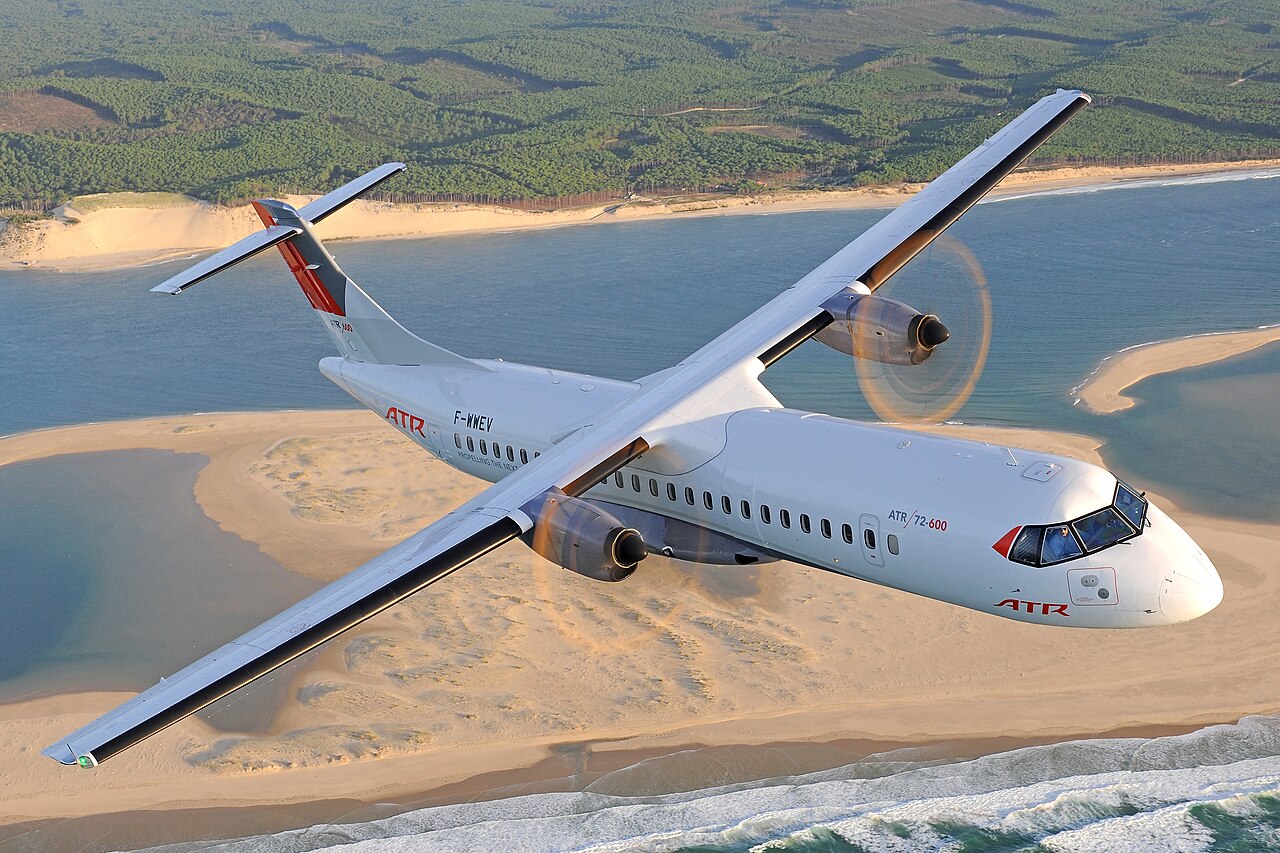
The airframe combines a high wing, a T-tail and two Pratt & Whitney Canada turboprop engines. The wing position leaves the sides of the fuselage clear and provides substantial ground clearance for the propellers. The cabin normally has four seats abreast, separated by a central aisle. The engines drive propellers whose blade count changes between generations. The design addresses the operating conditions of regional networks: frequent stops, access to smaller airports and daily maintenance. Nevertheless, the ATR remains a transport aircraft subject to certification procedures and to operating limitations established for each version and airfield, rather than an aircraft free of the constraints applying to commercial aviation.
The ATR 42 made its first flight at Toulouse on 16 August 1984. French and Italian certification followed in September 1985, before initial deliveries and entry into service with Air Littoral in December. Development of a stretched version subsequently produced the ATR 72, which first flew on 27 October 1988. Finnair received its first example in October 1989. These milestones must be distinguished: the year 1984 marks the beginning of flight testing for the original model, not for the 72. The manufacturer thereby established a family offering two capacities while retaining substantial technical commonality between the smaller and the larger aircraft.
ATRs found customers among independent regional airlines and carriers feeding the connecting hubs of larger airlines. Their operation extended across European networks, island groups and numerous Asian routes. The choice between the two models depends on passenger demand, required performance and the constraints of each service. The aircraft also connect communities distant from major centres, where travelling by land or sea takes considerable time. This variety of applications does not imply suitability for every airfield: runway condition, obstacles, weather and payload remain decisive elements of flight preparation. Regional operations therefore combine the advantages of the aircraft with route-specific planning and operating procedures.
The early series were progressively supplemented by the 500 versions and then by the 600 generation. Changes concerned propulsion, propellers, cabin fittings and onboard equipment. ATR 600 aircraft introduced a cockpit with large displays and updated avionics. Stretching the 72 also involved structural and performance differences; it was not simply a matter of adding seats to an otherwise unchanged airframe. Alongside passenger layouts, aircraft have been converted for freight transport. The ATR 72-600F is a newly built cargo version, distinct from conversions of aircraft previously employed on passenger services. The family therefore includes different technical configurations as well as different arrangements for carrying revenue loads.
There is no single retirement date for this family: withdrawal of an individual aircraft depends on its age, maintenance and its operator's decisions. Different generations coexist within the programme's history without sharing every item of equipment or every limitation. The ATR legacy lies in the continuity of Franco-Italian cooperation and in the place retained by turboprops in commercial transport. Their history demonstrates that airline networks do not depend exclusively on jet aircraft. It also provides an example of the gradual adaptation of a common architecture to airline requirements, rather than the systematic replacement of an established model by an entirely new design whenever commercial needs change.
Why it mattered
- The programme establishes industrial cooperation between France and Italy.
- The two models offer different capacities with substantial technical commonality.
- The family illustrates the continuing role of turboprops in regional networks.
Where to see it
- Aeroscopia — Blagnac, FranceATR 42 and ATR 72.
Sources
- ATR — About ATR
- EASA — Type certificates
- ATR — ATR’s key milestones over the years