Manufacturer
ATR
ATR is a Franco-Italian manufacturer of regional turboprop aircraft, established by Aérospatiale and Aeritalia.
4 min read
Origins
ATR, short for Avions de Transport Régional, was established in 1981 as an economic interest grouping between Aérospatiale in France and Aeritalia in Italy. The two companies contributed aerospace experience and an industrial organisation spanning several countries. The joint company was headquartered in Toulouse. Its aim was to develop regional turboprop aircraft for short- and medium-distance routes, especially where demand did not warrant a larger jet.
The project formed part of the growth of European regional transport. Airlines needed aircraft able to serve secondary cities and airports with more modest infrastructure. Turboprops offered operating economics suited to these sectors and lower cruise speeds than jets. Franco-Italian cooperation divided design and manufacturing responsibilities while opening access to international markets. The company began with a complementary pair of aircraft.
Growth
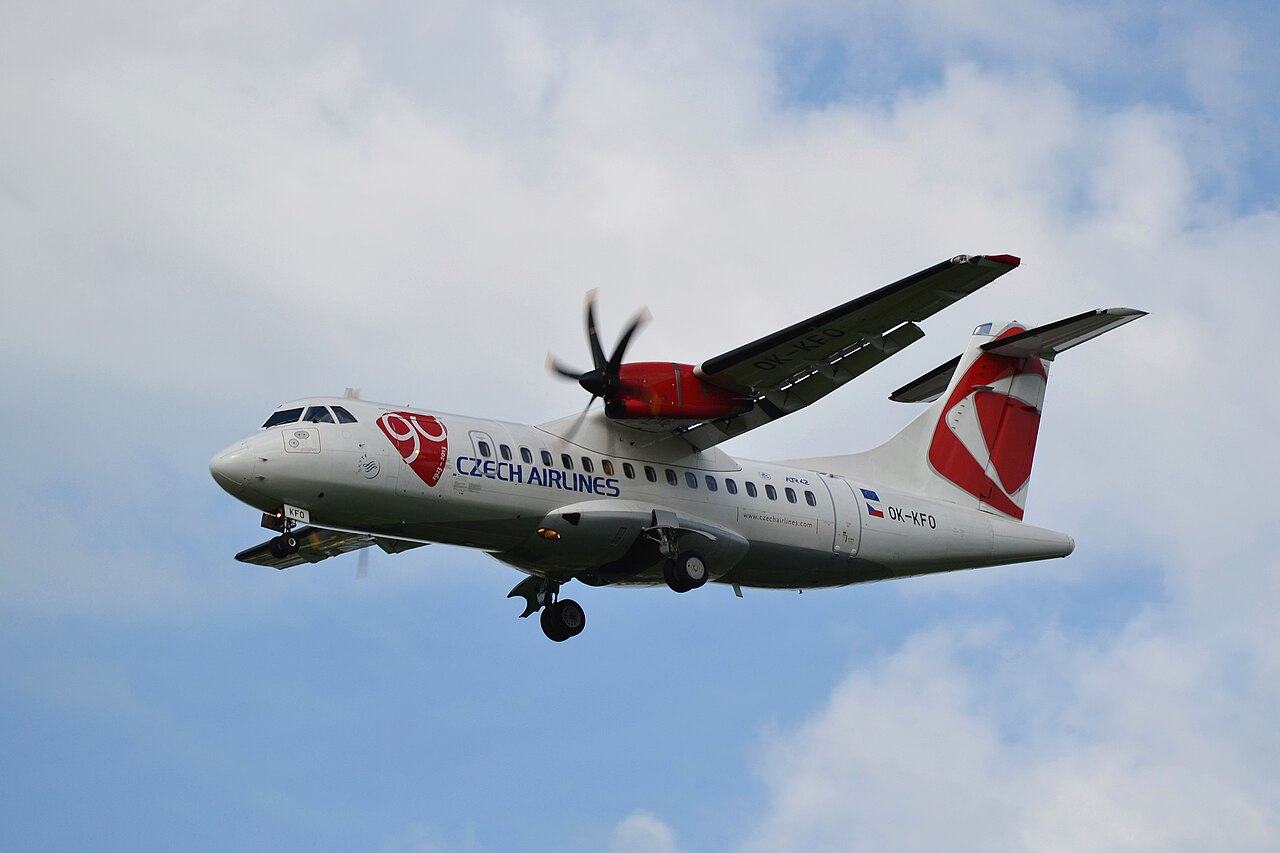
The first programme, the ATR 42, made its first flight in 1984. It is a high-wing aircraft with two turboprop engines, designed to carry around forty passengers depending on configuration. Its design targets regular regional services, with a pressurised cabin and systems meeting airline requirements. Initial deliveries to operators took place in the late 1980s. The aircraft established the new manufacturer’s commercial presence.
ATR subsequently developed the ATR 72, a stretched version with greater capacity. Launched in January 1986, it first flew in 1988; the first delivery, to Finnair, took place in October 1989. The two models share an architecture and systems, helping operators train crews and maintain mixed fleets. The manufacturer has introduced successive improvements to engines, avionics and cabin arrangements. The ATR 42 and ATR 72 family serves networks where frequency, capacity and operating costs must be balanced.
Major programmes
The ATR 42 and ATR 72 were designed for worldwide markets and have been operated on several continents. Passenger versions account for most of the family, but specialised variants also exist, including freighters and aircraft for government and surveillance missions. Turboprops are not simply an obsolete technology: on short sectors they offer operational characteristics well suited to the task, although airline choices also depend on fuel prices, infrastructure and demand.
Design and production draw on the partners’ facilities. Airframes, components and systems are manufactured in different countries and integrated through a coordinated industrial chain. Toulouse is the headquarters and hosts support activities, while the shareholders’ facilities contribute to production. The company must also provide training, spares and technical assistance to a fleet distributed worldwide. The programme’s continuity depends as much on these services as on the original aircraft design.
Mergers and acquisitions
The founding companies changed over time. Aeritalia became part of Alenia, and subsequent Italian industrial combinations led to Alenia Aeronautica and Leonardo. In France, Aérospatiale became part of EADS, later renamed Airbus. ATR’s ownership structure evolved with these changes without the joint venture being absorbed. Airbus and Leonardo became equal shareholders, maintaining cooperation between French and Italian industry.
This shared governance requires coordination between two groups whose activities extend far beyond regional aircraft. ATR remains a distinct company, with its own commercial portfolio and support responsibilities. The evolution of its owners illustrates the consolidation of European aerospace from the 1990s and 2000s onwards. It combines the capabilities of a major European group with those of Italian industry while retaining a clear specialisation in regional transport.
Today
ATR continues to operate from Toulouse and remains equally owned by Airbus and Leonardo. Its range is based on the ATR 42 and ATR 72, whose versions and equipment have evolved since the initial series. The aircraft serve scheduled airlines, regional operators and specialised users. The company also provides fleet support, training solutions and technical services, all essential to day-to-day operation in varied environments.
The manufacturer occupies a particular place in European civil aviation: unlike major jet programmes, its specialisation is the regional turboprop. Its history illustrates cross-border industrial cooperation, the adaptation of aircraft to less dense networks and the continuity of an aircraft family across several decades. ATR aircraft are also encountered at regional airports and in collections, where they demonstrate the importance of short-haul air transport.
Designing a regional aircraft also involves trade-offs specific to the network it serves. Airports, sector length, rotation frequency and payload affect both configuration and operation. An aircraft of moderate capacity can allow an airline to link cities that would not support a larger type. In return, the economics depend on load factors, fuel costs and technical reliability. These considerations explain why ATR combines aircraft development with long-term operational support.
The ATR 72-600 is an evolution of the family, with modernised avionics and updated equipment compared with earlier series. The -600 designation continues the ATR 72 airframe rather than creating an entirely new type. Cabin and system changes address operator requirements and certification rules. Successive versions show how a manufacturer can keep an aircraft family current through gradual changes while retaining a shared architecture.
Notable aircraft
Other models
- ATR 42
- ATR 72
Sources
- Airbus — Our history
- ATR — About us
- ATR — ATR milestones
Related reading
Aircraft
ATR 42 / ATR 72Manufacturer
AérospatialeManufacturer
AirbusFeature
Toulouse, aerospace capital