1867–1912 · 1871–1948
Wilbur and Orville Wright
Working in Dayton, the Wright brothers combined aerodynamic measurements with practical flying experience to achieve powered, sustained and controlled flights in 1903.
3 min read
Life
Wilbur and Orville Wright grew up in a family that encouraged reading and technical curiosity. In Dayton, Ohio, they worked in printing before opening a bicycle business. Repairing and manufacturing bicycles gave them experience of lightweight mechanisms, transmissions and precision work. Income from the shop supported their aeronautical research. Their collaboration did not erase their individual personalities: they debated solutions, compared observations and divided the work between them. They approached flight as a set of problems to investigate, rather than expecting to produce a finished machine in a single attempt. Their workshop provided both practical skills and a means of paying for experiments.
From 1899 they studied the available literature, including Otto Lilienthal's research, and requested publications from the Smithsonian. They chose the area around Kitty Hawk, North Carolina, for its steady winds and sandy ground. Gliders were tested between 1900 and 1902. When the results fell short of expectations, they did not simply plan to add more power: they built a wind tunnel in Dayton and compared model wings. The resulting measurements led them to revise their calculations and their choice of aerofoil, linking small-scale tests with observations in the field. Experimental evidence could therefore correct the assumptions on which a design had been based.
Achievements
Control lay at the centre of their approach. Wing warping controlled roll, while a forward elevator controlled pitch. In 1902 a movable rudder, coordinated with wing warping, improved their handling of turns. The brothers learnt to fly through repeated glides rather than waiting until they had an engine. For the powered machine, their mechanic Charlie Taylor built a petrol engine, while they investigated propellers as rotating wings. Their solution thus brought together aerodynamics, propulsion and piloting. It did not treat invention as merely a question of finding an engine powerful enough to raise a load, without considering what happened once the machine was airborne.
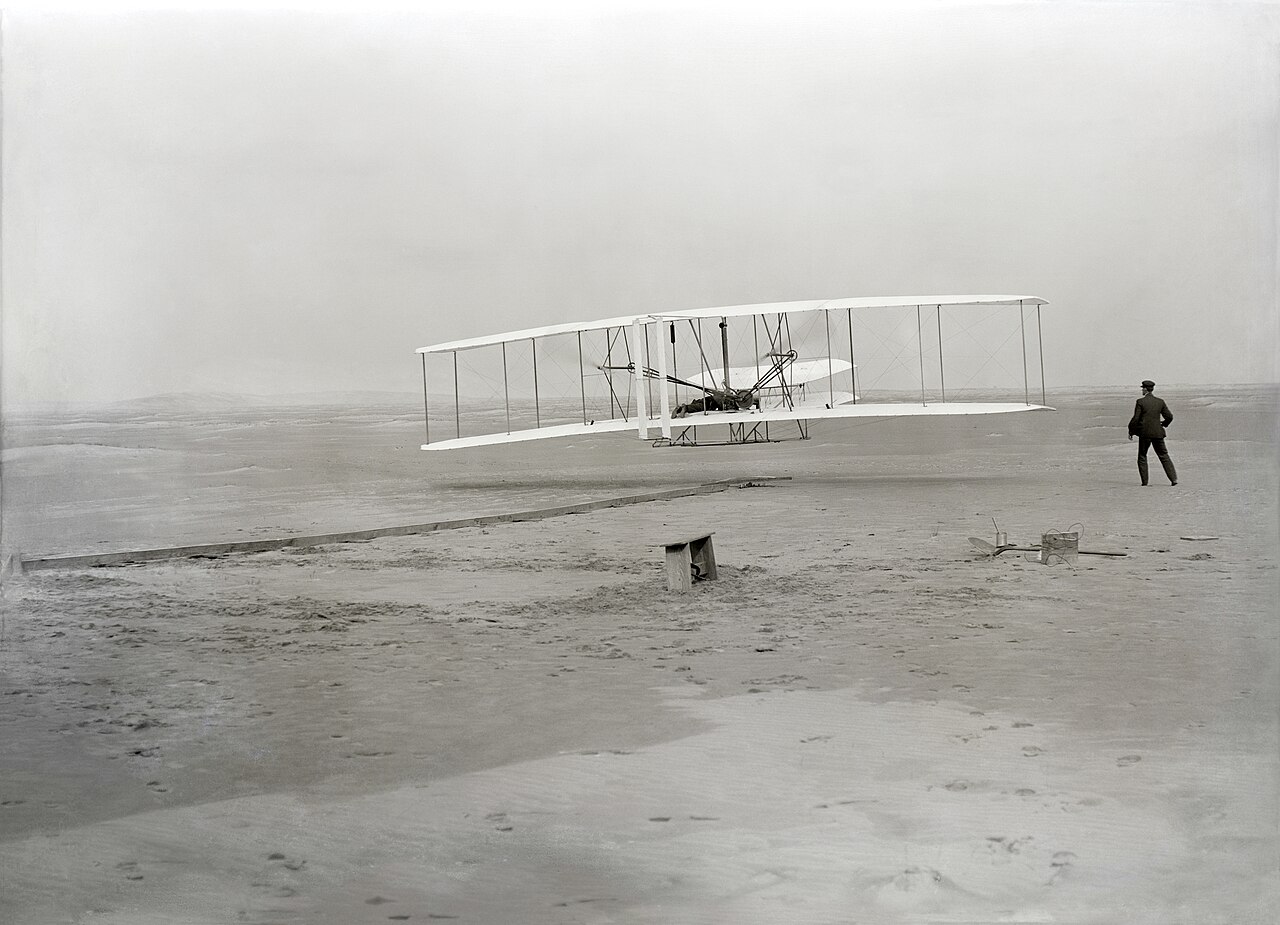
On 17 December 1903 they made four flights with the Flyer at Kill Devil Hills. Orville piloted the first, lasting twelve seconds; Wilbur made the last, which lasted fifty-nine seconds. The machine used a launching rail but no catapult on these flights: its engine supplied the thrust needed for take-off. It remained difficult to fly and was not yet a practical vehicle. At Huffman Prairie, near Dayton, the machines of 1904 and 1905 allowed them to develop circuits, endurance and control of the flight path. This progression matters as much as the December day that became the familiar symbol of their achievement.
Legacy
The brothers next sought patent protection and contracts. Their secrecy and the lack of major public demonstrations encouraged scepticism. In 1908 Wilbur flew near Le Mans while Orville conducted trials for the United States Army at Fort Myer. The French demonstrations made the precision of their turns and the duration of their flights plainly visible. They entered an already active field, in which Santos-Dumont had made public flights and Louis Blériot was pursuing his own experiments. Recognition of the Wrights therefore does not mean that every other programme derived directly from their machines, or that aviation developed through a single uninterrupted line.
Wilbur died in 1912; Orville continued his activities and defended their historical contribution. The 1903 Flyer entered the Smithsonian in 1948 after being exhibited in London. Their legacy rests on coordinated control around all three axes and a method linking calculations, measurements and repeated trials. The early history of aviation cannot be reduced to one date, but their flights established a specific milestone: a powered machine could carry its pilot while remaining under directional control. Later designers would discard some of their arrangements while retaining the fundamental requirement for effective control in flight. Their significance lies in that working combination, not simply in leaving the ground.
Sources
- Encyclopædia Britannica — Wright brothers
- Smithsonian National Air and Space Museum — Collections
- Smithsonian National Air and Space Museum — Researching the Wright Way
Related reading
Aircraft
Wright FlyerEra
The pioneers (1783–1914)Pioneer
Alberto Santos-DumontPioneer
Louis Blériot