1872–1936
Louis Blériot
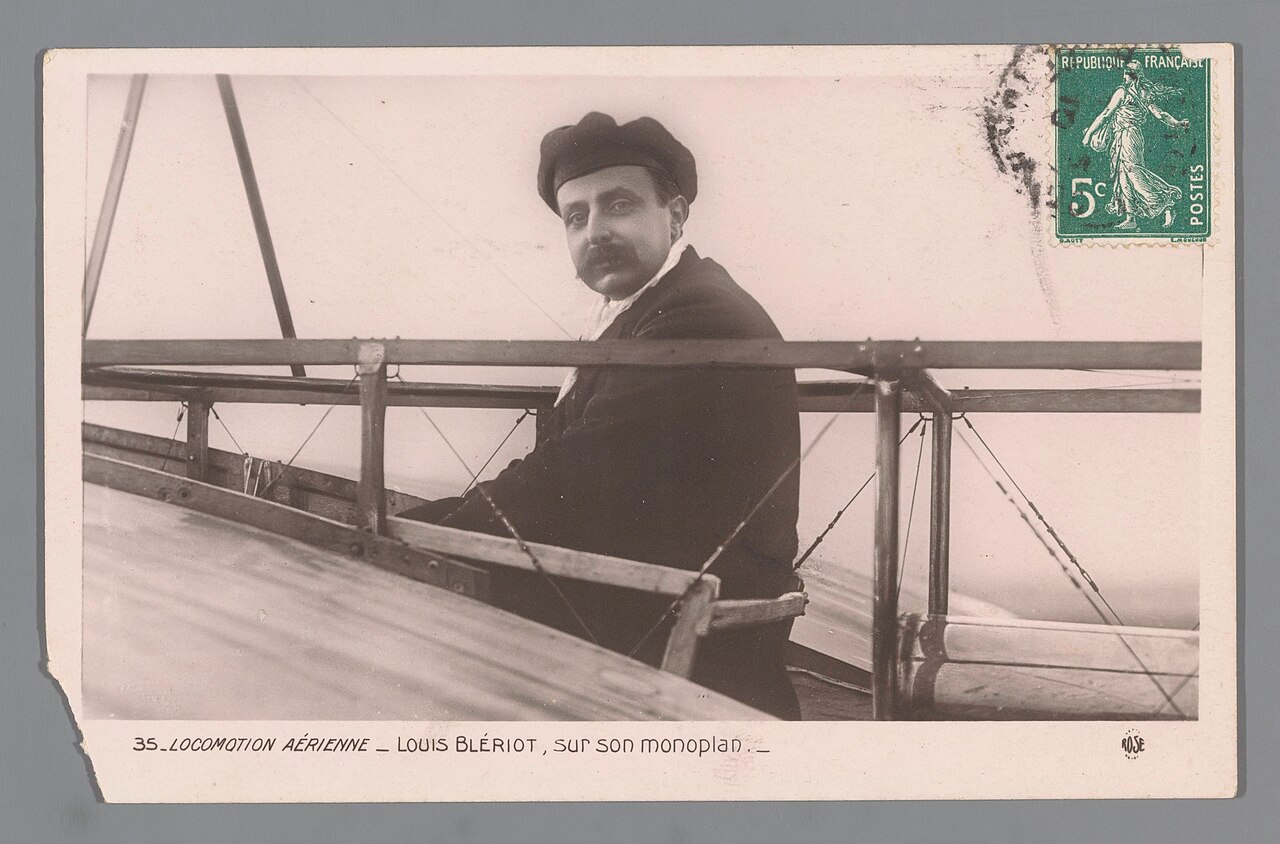
An industrialist who became a pilot and aircraft manufacturer, Louis Blériot crossed the Channel in 1909 and secured an international market for his monoplane.
3 min read
Life
Born in Cambrai, Louis Blériot trained at the École Centrale in Paris. He developed a car-headlamp business whose profits financed his aeronautical research. This industrial background distinguished him from many experimenters: he understood workshops, manufacturing and sales. Aircraft nevertheless remained a risky investment. At the beginning of the century no single configuration had become established, and each new machine required further spending before it could even make a flight useful enough to guide the next stage of development.
Blériot tried several configurations and worked for a time with Gabriel Voisin before continuing independently. Testing brought fragile machines, accidents and repeated alterations. Alongside the biplanes of Santos-Dumont and the Wright brothers, he explored the monoplane. His career belongs to this pioneering period of aviation, when designers often had to serve as their own test pilots, identify a machine's shortcomings and find the money to put them right before attempting another flight.
The Blériot XI, designed with the involvement of Raymond Saulnier, gave him an aircraft capable of more convincing flights in 1909. The monoplane had a braced fuselage, a tractor propeller and a wheeled undercarriage. Lateral control relied on wing warping, rather than ailerons. This arrangement is a reminder that adopting a monoplane layout did not mean using all the controls that would later become standard on aeroplanes, or that aircraft design had already reached a settled form.
Achievements
On 25 July 1909 Blériot took off near Calais and reached Dover in the Blériot XI. The flight lasted a little over half an hour and won the Daily Mail prize for the first aeroplane crossing of the Channel. Navigation was rudimentary, engine reliability limited and the landing rough. The event did not establish a regular transport service. It demonstrated instead that a small aeroplane could cross a stretch of sea long regarded as a protective barrier.
The crossing transformed his commercial prospects. Orders followed, and the Blériot XI entered service with civilian pilots, flying schools and armies. Several versions were built, so the type was not confined to the particular machine flown across the Channel. Blériot now linked aircraft sales with flying instruction. This combination helped move aviation beyond individual prototypes towards organised production and training, even though its methods remained far removed from those of an industry with fully established standards and procedures.
The XI's success also highlights the importance of collaborators and users. Once sold, an aircraft had to be assembled, repaired and understood by people other than its inventor. Flying schools provided an essential connection between the workshop and new pilots. They passed on practical skills and experience, while flights elsewhere exposed the machine to different airfields and conditions. This circulation of aircraft and knowledge gave the Blériot name a reach no longer dependent on the manufacturer's own experiments. It helps explain why the history of the type belongs as much to the development of flying instruction as to the story of records and sea crossings.
Legacy
In 1914 Blériot took control of SPAD, whose fighters, designed under Louis Béchereau, played an important role during the war. His business continued into the interwar years, notably through Blériot-SPAD. He died in Paris in 1936. His legacy reaches beyond the celebrated flight to the relationship between invention, public demonstration, training and manufacture. The Channel crossing became a turning point because it translated a technical performance into commercial confidence, without removing the considerable risks that still accompanied early aviation.
Sources
- Encyclopædia Britannica — Louis Blériot
- Encyclopædia Britannica — Blériot XI
- Musée de l'Air et de l'Espace — Collections
- Science Museum — Collections
Related reading
Aircraft
Blériot XIEra
The pioneers (1783–1914)Pioneer
Alberto Santos-Dumont