Lockheed SR-71 Blackbird
The SR-71 is a reconnaissance aircraft designed for sustained missions above Mach 3 at high altitude.
History
The SR-71 developed in the Cold War, when the United States sought intelligence from regions protected by extensive defences. The vulnerability of reconnaissance aircraft imposed new requirements for speed and altitude. At Lockheed, the Skunk Works team led by Clarence 'Kelly' Johnson worked on the family that produced the A-12, developed for the CIA. The SR-71 was a related aircraft but adapted to US Air Force requirements with two crew members and reconnaissance equipment. Missions, operators and dates for the different aircraft in this lineage should therefore not be confused despite their similar outlines. Their shared development background does not make them interchangeable types.
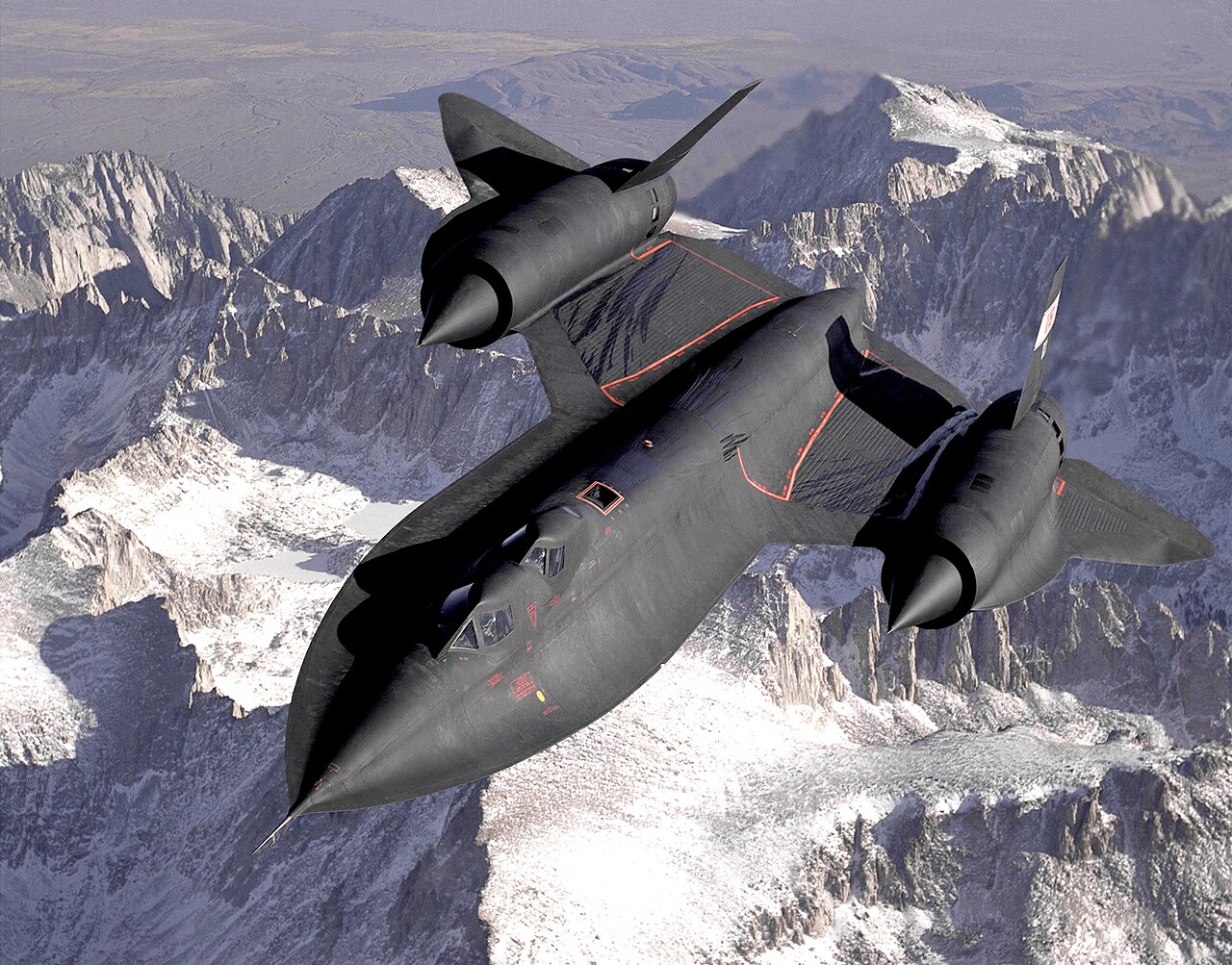
Sustained flight above Mach 3 imposed substantial thermal constraints. The structure made extensive use of titanium, while fuselage and wing shapes were developed for high-speed flight. The two Pratt & Whitney J58 engines operated with complex air intakes, whose moving spikes and control arrangements helped manage the airflow. The propulsion installation needs to be understood as a system combining inlet, engine and exhaust nozzle. Fuel also contributed to the aircraft's thermal management. These decisions required particular preparation and maintenance procedures; performance cannot be separated from the technical resources that made it achievable during a mission. Speed was therefore an outcome of system integration rather than engine power considered alone.
The first SR-71 flew on 22 December 1964, with Robert Gilliland at the controls. Entry into US Air Force service followed in 1966, before operational missions from Asia began in 1968. Building capability required crew training and the organisation of specialised support. The pilot flew the aircraft, while the reconnaissance systems officer managed equipment associated with intelligence collection. Both wore pressure suits suited to high-altitude flight conditions. The aircraft was designed to observe and return information; it did not carry weapons intended to attack the targets it monitored during its missions. This distinction is central to understanding its role within the wider organisation of American military aviation.
US Air Force units operated the SR-71 along reconnaissance routes associated with American strategic requirements. Overseas detachments supplemented the organisation established in the United States. Sorties required detailed preparation, particularly for routing, weather, sensors and tanker rendezvous. Aerial refuelling was a normal element of long-distance operation. Collected information could come from photographic, radar or electronic systems, depending on equipment and mission. Speed and altitude reduced certain threats but did not eliminate operational constraints. A successful sortie also depended on maintenance teams, intelligence specialists and ground support resources. The visible flight represented only one part of a larger process of preparation, collection and subsequent handling of information.
SR-71 production comprised thirty-two aircraft: twenty-nine SR-71A reconnaissance aircraft, two SR-71B trainers and one SR-71C trainer. Instruction versions had specific arrangements to support training, distinct from the usual operational layout. The A-12 and experimental YF-12 interceptor belonged to the same technical ancestry but were not production variants of the SR-71. This distinction avoids mixing totals and performance figures. In July 1976, an SR-71 established speed and altitude records in its category. These documented flights publicly demonstrated some of the aircraft's capabilities without, by themselves, summarising the conditions and objectives of everyday strategic reconnaissance operations. Record performance and routine mission planning answer different historical questions.
The US Air Force first retired the SR-71 in 1990, then returned a small number to service during the 1990s. NASA also used the type for flight research, with its final flights taking place in 1999. Airframes were subsequently preserved in several museums. They allow the presentation of thermal expansion problems, air intakes and equipment needed for very fast cruise. The SR-71's legacy consequently concerns the integration of propulsion, materials and mission systems within one aircraft. Its history illuminates a particular form of aerial intelligence gathering, with measured results and considerable resources required for operation. Preserved aircraft help explain those demands as well as the performance for which the type became known.
Why it mattered
- The SR-71 combines materials and propulsion for sustained cruise above Mach 3.
- Its operation depends on specialised support and aerial refuelling.
- Aircraft continue in a research role with NASA.
Where to see it
- Smithsonian National Air and Space Museum — Steven F. Udvar-Hazy Center — Chantilly, Virginia, USA
Sources
- NASA — NASA History
- National Museum of the U.S. Air Force — Aircraft fact sheets
- Lockheed Martin — Creating the Blackbird