Manufacturer
Lockheed
An American civil and military aircraft manufacturer integrated into Lockheed Martin in 1995.
4 min read
Origins
Brothers Allan and Malcolm Loughead had founded earlier aircraft companies together in 1912 and 1916; the Lockheed Aircraft Company was founded in 1926 in the Los Angeles area by Allan Loughead, with Jack Northrop among others. The family name was given a simplified spelling to make its pronunciation easier. Its first notable success was the Vega, a wooden-structure monoplane whose prototype flew in 1927. Its design combined a light airframe with careful streamlining. The type served in commercial transport and long-distance flights, bringing considerable attention to the young firm.
The Vega was associated with pilots of the interwar period and women aviators of the interwar period, but those achievements should not obscure the type’s commercial uses. Lockheed followed with metal-structure transports, including the twin-engine Model 10 Electra, introduced in the 1930s. Aircraft in the family served airlines and public organisations. On 2 July 1937, Amelia Earhart’s Electra 10E disappeared during her round-the-world flight; its fate remains undetermined. This historical event is distinct from the industrial development of the model, which continued in other versions.
The company also developed military aircraft. The growth of government orders, particularly from the Second World War onward, transformed its scale and production capacity. Lockheed became one of the major American suppliers, with teams specialising in airframes, systems and high-performance aircraft. Its divisions changed over the decades; the name Skunk Works referred to the advanced-development organisation associated with confidential projects.
Growth and airliners
The Constellation was designed during the Second World War to meet long-distance transport requirements. Its pressurised fuselage, four piston engines and distinctive tail made it recognisable. Wartime restrictions delayed large-scale civil operations; after the conflict, it became an important aircraft for transatlantic airlines and government services. Several versions were built to reflect changing capacity and range requirements. It illustrates Lockheed’s place in post-war commercial aviation alongside competing manufacturers.
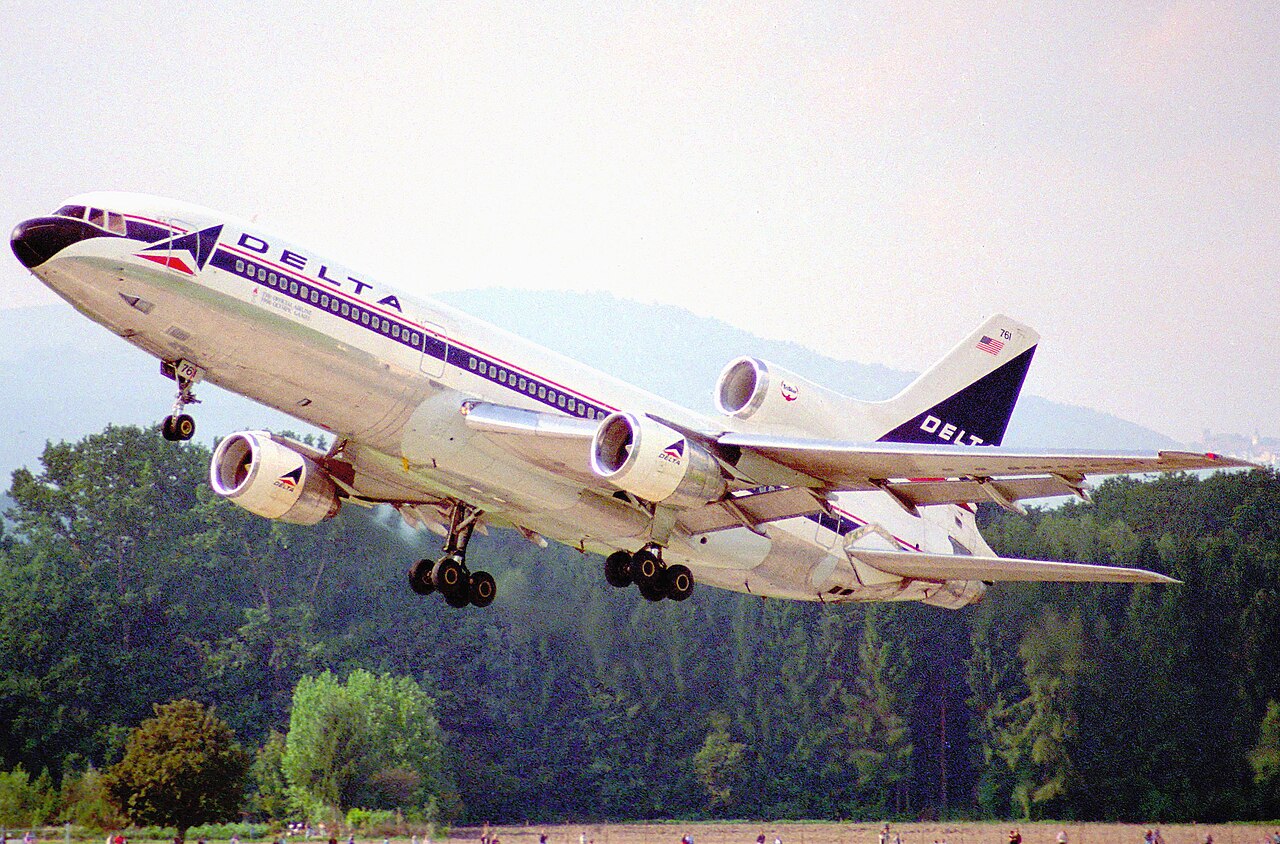
At the beginning of the jet age, Lockheed continued to develop civil transports, but the L-1011 TriStar was its last major airliner programme. The widebody tri-jet entered service in 1972, after delays associated in part with engine-maker Rolls-Royce. The TriStar combined equipment advanced for its time with a complex and costly architecture. It faced strong competition, notably from the DC-10 and 747, and sales were insufficient to deliver the expected profitability. Lockheed ended its participation in commercial-aircraft manufacturing in 1981.
This withdrawal did not mean an end to aerospace activity: the company concentrated resources on military contracts, systems and advanced technologies. The distinction between commercial aviation and defence matters because the organisation continued aerospace work after the TriStar ended. Defence programmes involved schedules, customers and confidentiality rules different from those of airliners.
Research and defence
Lockheed built several military aircraft that marked twentieth-century technical history. The twin-boom P-38 Lightning served during the Second World War. The F-104 Starfighter was designed as an interceptor, prioritising speed and high-altitude performance. The SR-71 Blackbird, developed through classified projects, first flew in 1964 and entered operational service in 1966. Its high speed and operating altitude reduced exposure to threats, but required particular materials, procedures and maintenance.
The SR-71 was developed by the advanced projects division commonly known as Skunk Works, under Clarence ‘Kelly’ Johnson and later leaders. This small, specialised organisation became a central part of Lockheed’s public history. Its role should be understood in the context of government-funded programmes and Cold War strategic reconnaissance requirements. The aircraft’s performance resulted from a combination of design and operating choices, not a single isolated innovation.
Lockheed also took part in research programmes and space systems, and developed stealth aircraft such as the F-117. These activities extended the company’s role in American defence, with expertise beyond aircraft manufacture alone. Military development is subject to particular security, testing and support requirements. It coexisted with commercial activity that had ended, illustrating a gradually strengthened specialisation rather than the disappearance of the company after the L-1011.
Integration and legacy
In 1995, Lockheed merged with Martin Marietta to form Lockheed Martin. The new company brought together aerospace, space, electronics and defence activities. Lockheed therefore ceased to exist as an autonomous business, while several programmes and capabilities continued within the group. The change formed part of a wave of consolidation in the American defence industry after the Cold War, as companies reorganised portfolios and structures.
Lockheed Martin, distinct from Boeing, remains active in defence and aerospace. This institutional continuity does not mean every division and practice of historical Lockheed survived unchanged. The civil Vega, Electra, Constellation and TriStar belong to different periods and served distinct markets. The SR-71, preserved in museums, represents a past military programme; it is not evidence of a current capability. Historical accounts must distinguish technical heritage, the present-day company and its current products.
Lockheed’s history connects interwar commercial aviation with Cold War strategic reconnaissance and, later, the consolidation of defence industries. It shows how one manufacturer could design very different aircraft for customers with contrasting requirements and constraints. Its withdrawal from commercial aviation in 1981 was a major industrial decision; the 1995 merger closed another chapter, that of the independent company. Its legacy continues within a much larger organisation, now principally oriented towards aerospace and defence.
Notable aircraft
Other models
- Lockheed Vega (1927)
- Lockheed Model 10 Electra (1934)
- Lockheed P-38 Lightning (1939)
- Lockheed P-80 Shooting Star (1944)
- Lockheed L-1011 TriStar (1970)
- Lockheed F-117 Nighthawk (1981)
Sources
- NASA — Aeronautics
- Smithsonian National Air and Space Museum — Collections
- Encyclopædia Britannica — Lockheed Martin Corporation