Lockheed Constellation
A pressurised four-engine aircraft that supported the growth of long-distance routes after the Second World War.
History
The Constellation originated in the late 1930s, when American airlines were seeking greater speed and range from their transports. Howard Hughes, who had become an influential shareholder in TWA, discussed an aircraft suitable for transcontinental services with Lockheed. The manufacturer was then working towards its first large four-engine transport. Robert Gross, Hall Hibbard and Clarence 'Kelly' Johnson contributed to the undertaking. The project had to combine performance, commercial capacity and comfort over lengthy stages. Its launch preceded the United States' entry into the Second World War, but the conflict profoundly changed the conditions of development and the initial market for the aircraft.
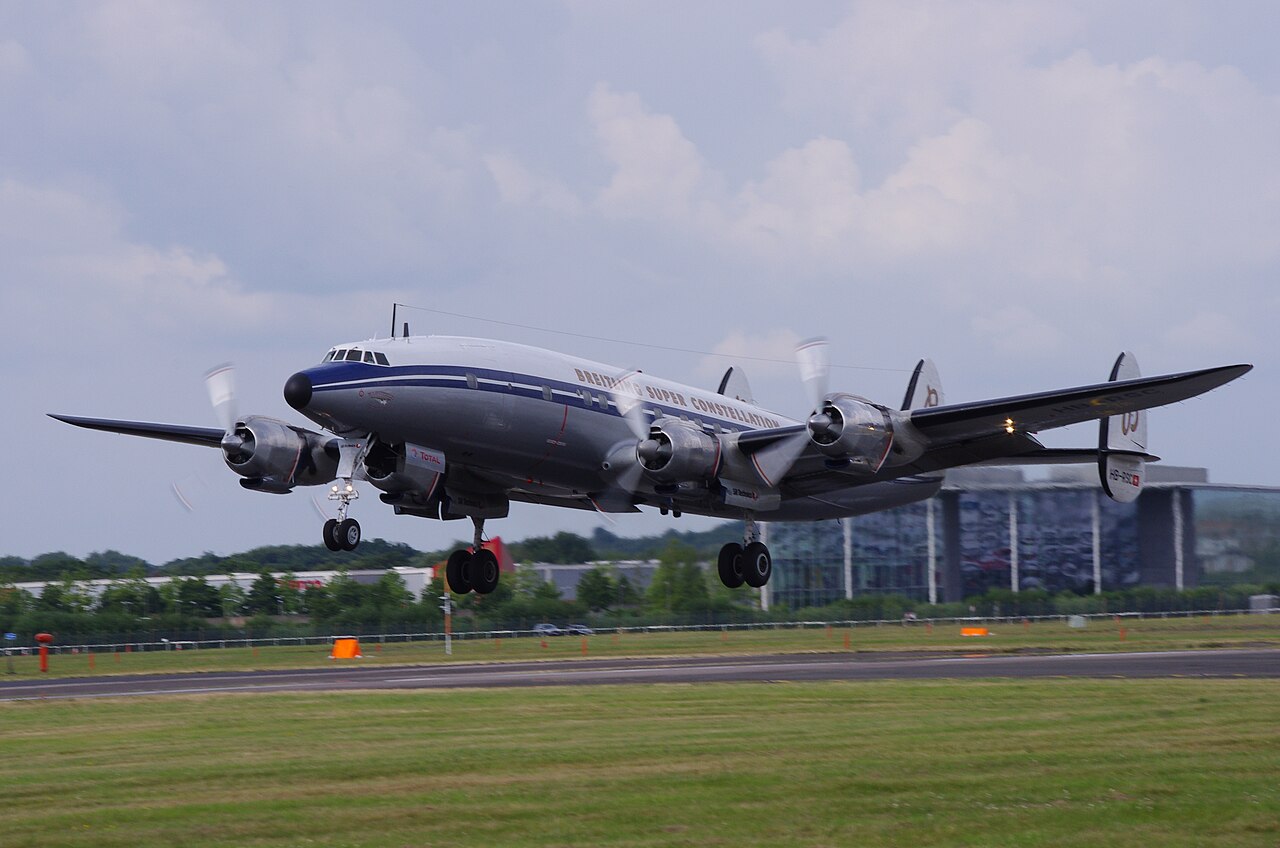
The Lockheed L-049 had a pressurised cabin, retractable tricycle undercarriage and four Wright radial engines. Pressurisation allowed travel at a higher altitude than many earlier transports without requiring passengers to wear oxygen masks. Its curved fuselage and three vertical tail surfaces gave it a distinctive outline. This arrangement limited the overall height of the tail, making existing hangars easier to use. The engines, their accessories and the aircraft's systems nevertheless required considerable technical attention. The pursuit of speed therefore eliminated neither the limitations of piston-powered transport nor the need for organised maintenance. These requirements remained part of the aircraft's everyday operating environment throughout its airline career.
The first Constellation flew on 9 January 1943. Military requirements then took precedence over the planned civilian deliveries. Aircraft were used by American forces under the C-69 designation, performing transport duties. This initial period combined development and operation in wartime conditions. After hostilities ended, Lockheed redirected production towards airlines and adapted available aircraft for commercial transport. TWA began commercial operations with the type in 1946. The availability of a fast, pressurised aircraft matched the recovery of international travel and plans for expanding networks, particularly on routes between America and Europe. Its civilian introduction thus belonged to the wider reconstruction of scheduled air transport after the war.
TWA and Pan American were among the American operators, while Air France, KLM and Qantas used different versions of the family. Layouts and itineraries varied with the airline, the distance involved and the intermediate stops available. The Constellation served transatlantic links, transcontinental routes and wider intercontinental networks. Journeys remained sensitive to winds, payload limitations and engine condition. Inside the cabin, however, pressurisation and passenger accommodation made lengthy stages more practicable. Flight crews included pilots and a flight engineer; on some routes, navigation and radio specialists also formed part of the operating crew. These duties reflected the technical and navigational demands of long-distance airline flying during this period.
The family developed in stages rather than remaining a single model. The L-049 was followed by versions including the L-649 and L-749, then the stretched Super Constellations, including the L-1049. The L-1649 Starliner received a new wing and was intended for very long distances. These designations covered differences in capacity, fuel provision and engines that need to be distinguished. Military versions included transports and radar early-warning aircraft. In the latter, detection equipment and operator stations transformed the four-engine aircraft's mission. Constellation therefore describes a lineage of civilian transports and specialised platforms, rather than one technical configuration that remained unchanged throughout production and service.
From the late 1950s, jet airliners gradually displaced Constellations from major commercial routes. Their higher speed changed schedules and passenger expectations. Some piston-powered aircraft continued in freight work, military activities or specialised employment long after their replacement on the busiest services. Examples were subsequently preserved by heritage institutions. Their presentation helps explain pressurisation systems, the flight engineer's work and the practical limitations of piston propulsion. The family's history consequently illuminates a transition: the expansion of intercontinental travel after the war, immediately before commercial jet transport became widespread. It also places individual aircraft within the changing operational practices of airlines rather than treating their appearance alone as their historical importance.
Why it mattered
- The pressurised cabin facilitates long commercial stages.
- The family serves airlines on several continents.
- Military versions extend its use to radar early warning.
Where to see it
- The Museum of Flight — Seattle, USA1049G Super Constellation.
Sources
- Smithsonian National Air and Space Museum — Collections
- Lockheed Martin — Constellation